• TalkBass has been independent since 1998. Add your voice.
    Create a free account to reply to discussions, view embedded media, and browse with fewer display ads.
    Join freeLog in
    Want zero display ads or expanded classifieds tools? Compare plans.

1x 18 folded cab build?

Hello,

I've been drooling over the Acoustic 360/361 re-issue setup that's out now, but since I live in Europe, with the purchase price plus taxes plus shipping, that's never going to happen. So I've been having the crazy thought of building a folded horn cabinet with an 18-inch speaker. Would that make any sense? Does anyone use that kind of stuff anymore?

Regardless of what others say, if I were you and I wanted an Acoustic 360/361 style cab, I would build one. Keep in mind that, based on a quick CAD model of the 361 drawings that Jim Carr posted, the plywood for building the 361 will have a mass of ~34 kg/75 lbs. This considers using 18 mm birch plywood, and excludes any joinery, glue blocks, or fasteners. Add the weight of the driver and hardware and you have one massive speaker cabinet, which is not necessarily a bad thing, IMO :bassist:
 
Or here's another more graphically pleasing version of what's going on:

http://dennysguitars.homestead.com/Acoustic370cabPlansP1.html

Acoustic_370.CabinetPlans1.gif


Acoustic370HornsDiagram1.gif
 
Keep in mind that, based on a quick CAD model of the 361 drawings that Jim Carr posted, the plywood for building the 361 will have a mass of ~34 kg/75 lbs.
Take a lesson from the BFM builders: half-inch Baltic Birch.

Using the proper bracing, the lighter/thinner BB is strong as a tank.
Bill's bass horn designs are very well thought out for bracing.
Swiss cheese the brace panels for weight reduction.

These bracing techniques take longer to fabricate, but you only do this once.
You load/unload that darn thing forever.
The increased fabrication time is paid back, with interest, many times over.

I have a number of sheets of 18mm BB, and the only use they are going to see is rebuilding my bathroom floor.
Thick plywood is for slam-bam mass production techniques with no bracing.
 
If you ever want to build this design you need to build it with very good connections. Do not connect it with cold joints. Swaluw connections or similar should be used. I own some large cabs and they are done like that. With current Neodynium driver designs and very well made cabinets the result might please you...

The Acoustic 408 might be a better choice... But key is a very well made cabinet with smart connections to make it as sturdy and light as can be. You will be making a cabinet that will go much much lower than many current designs. And when using modern neodynium drivers they will make excursions giving you sounds well below 18 hz. It will be very clear, very full and you will need not much amplifier wattage. But a very heavey amp is still advised as only an high wattage design will be able to controll 4 15 inch woofers...
 
Thank you all very much for sharing all of this information and experience, I really did not expect such interest in this concept! I have read all the posts carefully and as far as I'm concerned I see two possible issues: throw and low frequency response. As much as I like woofy mid-bass, I play in a two-guitar band and I always have to tell the guitarists to turn the bass down, so me bringing more mud would just make everything a big mess. Also, I play mostly indoor small or medium venues, so that throw thing could be a problem.

I think I might give it a shot with a smaller speaker and cabinet, say a 15 or a 12. I would also pick a single long horn design with the speaker on top, since I read here that longer horns are needed for low bass response, and having a speaker high up would make it easier to hear.
 
Really? I always thought it had more to do with space and power efficiency in reproducing a specific frequency range.

A number of reasons.

The major disadvantage large drivers have over smaller ones when it comes to highs and, the larger the driver is, mids, is that large drivers start to beam the high end and midrange at lower frequencies than smaller drivers, and the larger the driver is, the lower the frequencies that they start beaming.

Used as a subwoofer, that disadvantage doesn't matter, because the driver isn't producing any midrange or high frequencies.

The other reason, partially already mentioned, is because it is simpler to use one larger driver than a bunch of little ones if you just want to push the same amount of air. This means it's cheaper, because even if the magnet is larger and there's more cone area and so more material used, it still saves money. It also will usually weigh less, and be easier to put together.

This doesn't mean that large drivers are incapable of having high end (there's actually a dude on here who has two 1x30" cabs, and the video demo of them that he did showed that they have quite a bit of upper midrange, and actually didn't have as much low end as one might expect), or that small drivers can't have a lot of low end.

The beaming characteristics of drivers means that it just makes sense to use smaller ones when possible for high frequencies, and it's just way more efficient to have a 15", 18", or 21" speaker when going to design a subwoofer cab than to use dozens of headphone sized speakers.
 
I allso saw here at Talkbass a version with 12 inches. Build like the 408. That would make it a lot easier to transport I think. And since the cabinet wouldn't be as deep it would be easier to fit at home and move around...... Just a thought...

And if you tilt the top speaker somewhat it would provide exellent monitor sounds wherever you are on the stage...
 
Also, I play mostly indoor small or medium venues, so that throw thing could be a problem.
...
I would also pick a single long horn design with the speaker on top, since I read here that longer horns are needed for low bass response, and having a speaker high up would make it easier to hear.
There is a time and place for bass horns, and the above is not it.

I've been doing the bass horn thing since the 60's, have designed and built a good number of them and know how they work.
A bass horn is not the right cab for the venues you play.
My bass horns are used for:
  • Outdoor Gigs
  • Slamming DJ Gigs
Bass horns are herd animals.
Unless you are constructing a built-in, the horn must be sized small enough to transport.
A transportable horn does not have sufficient mouth area to full produce low frequencies.
This means multiple bass horns summing to a larger mouth area.
I haul mine in a 5x10 trailer.

The horn discussed above will not produce any deep bass because the path is too short.
The horn path must be a quarter-wave length, or longer, at the lowest desired frequency.
Below this frequency, it is just a direct radiator shouting into a tunnel.
The modern equivalent (and much better design) of a short path horn is the BFM Jack Series

'Throw' is a misnomer when applied to bass.
Camp fires do not get hotter 20 feet away, and neither do bass horns get louder at 20 feet away.
Speaker cabs are pressure devices, and the highest pressure is always at the source.

All moving transducers generate motion distortion which introduces higher frequency components into the produced signal.
A folded bass horn attenuates higher frequencies within the folds of the horn where the wave length exceeds 1/12 the radius of the bend.

Long wave bass travels much farther than short wave highs.
Blue whales sing between 10 ~ 40 Hz because their sound travels so far.
What you hear far away is the bass left over after the highs are attenuated inside the horn, and after the highs have faded over distance.
Commercial direct radiator cabs produce little true LF energy, and do sound quite thin when heard at a distance.
My bass horns bring the Noise Police who get complaints from over a mile away.

OP, this is a long explanation of facts and expectations. It has nothing to do with G.A.S. or just wanting to tinker with the old W-horn designs.
In your situation, I would build a tall 'n skinny 2-way direct radiator.
Put the woofer on the bottom for floor coupling, and lower center of gravity.
Put the highs on top closer to your ear.
A 39" or taller box is easier to wheel about than a clunky 4x10 or other squat configuration.
 
I allso saw here at Talkbass a version with 12 inches. Build like the 408. That would make it a lot easier to transport I think. And since the cabinet wouldn't be as deep it would be easier to fit at home and move around...... Just a thought...

And if you tilt the top speaker somewhat it would provide exellent monitor sounds wherever you are on the stage...
I agree! with modern lightweight 12" drivers and a change of cabinet size and porting to suit the new drivers.
+ all the new 1/2 inch birch and clever bracing.
I don't have to move mine:D so it's OK but it's the one with the, old alnico magnet drivers in.:bassist:
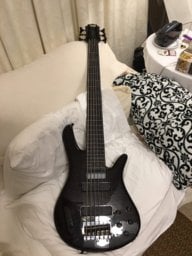
The original Sounds monstrous and glorious but the size and weight is disastrous by today's standards.
PS do you have a link to the 12" 408 downsize article.
 
NOOT....

Thanks for being patient with us..as you see we are all passionate about this.

I also appreciate the build-plan/ sketches some have provided, as well as insight leaning toward the Acoustic 408., which is also an excellent cabinet from what IO have read.

I hope this inspires you to build.

I cannot imagine your frustration.. of wanting a cabinet no longer in production..nor the costs of shipping one if you purchased a used one. 301's are readily available here in the U S A at various prices and condition, but all cost a fortune to ship, due to their weight @ 150 pounds.

My main argument all along was that if YOU want to build a '301 styled' W-Horn cabinet..THEN DO SO.. and don't let others talk you out of YOUR original request and desire.

Is a folded horn designed cabinet overkill for your needs? Perhaps.. perhaps not. And what if you perform in a larger club later..or change band mates and you are up against a 2 large guitar stacks.. That happened to me over..and over.. again. No worries now. I am glad that I bought a horn cab. Heavy weight yes...HEAVIER SOUND YESSSSSSS.

I have used my folded horn in tiny venues..kept my volume low as possible and retained MY tone.

Once I took my horn cab home after a gig.. used my 2x15 next night, as I thought the horn cab was overkill. Band leader was disappointed in my overall sound on the night I used the 2x15. He said that as long as my volume was blending with the band, that my tone was equally as important, which was was lost when I used my 2x15...Lesson learned.

Regardless, a folded horn cab sounds 'delicious' to my ears VS standard designs. I have never heard a 408, but I would consider purhasing or build one of those if I so choose.

Good luck and let us know what YOU decide. [ I still hope that you build a 301, by the way..]
 
Absolutely not..just a catch phrase I developed like my other one many enjoy.."Let your ears have the vote..your wallet gets the veto"..That's mine too.

I agree that a build compromise ..actually employing thinner plywood and using bracing ..ala BFM ....would save weight.

I wish horn cabs were all lighter. I like the sound.. not the weight.
 
  • Like
Reactions: lizardking837
I have never seen nor heard a 408..and that design interests me as well. They are perhaps even heavier.

If wired @ 2 ohms, you could get full power from certain heads, like the ACC 370, which only develops full power @ 2 ohms..Only in one cab, rather than (2) 4 ohm cabs.

I don't see why you couldn't get similar results in a smaller cab of same deign..employing 4x12's..4x10's as opposed to 4x15's.. by using ratios in build dimensions.
 
I don't have any way to compare a 301 cabint to a 408 cabinet, but I can say from first hand loading and unloading knowledge that a 408 is a whole lot lighter than a 361. It is big, bigger than a 361, but it is somewhat easier to horse around simply because there's no power amp in the bottom of the cabinet. It is a little bigger than an Ampeg 'fridge, but it may be lighter, probably because there are four magnets instead of eight. But, the weight difference is minimal if there is one. With a 320 head, it sounds amazing, and it pushes plenty of air. I like the sound of a 320 through it far better than I liked the sound of a 370 through it. That's a personal preference, because I like cleaner rather than grittier sound, and a 370 will give you a somewhat grittier sound. And, having played through all of them except a 301, I still prefer the sound of a 360 through a 361, even though a 320 head is a little more flexible because it is a two channel head as opposed to a single channel, especially if you want to do any Ric-o-sound experiments.
 
To the OP:

What really is your end goal here? If you're doing a recreation or an interpretation of these designs for the sake of a project and curiosity, then that's cool.

But in consideration of what has been said here about how they work and why they do what they do, it probably would be good to explore your end goal. In many ways, these cabs were designed to work with the speaker technology of the time and were made to solve a specific set of limitations based upon the speakers of the era and the amps of the era. In doing so, they also create their own 'negatives' as well as the positives. Speakers have changed greatly since these designs were created, as have amps. Many of the issues these designs addressed may not be problems any more.

Something to consider.
 
The 408 is kind of a neat design. It's not a horn really. What happens is the 2 inner facing drivers get some highs knocked off of them by the cab design, so you've basically got 215's worth of highs/uppermids and 415's worth of mids/lowmids/upperbass. And lots of power handling with 4 drivers. The downside?....buying 4 drivers.

It'd be heavy, but probably no worse to move than an 810.
 
To get an idea of the high end of the 371, look at the specs of the 370 head bright switch.

The bright switch produces a boost of "4dB per octave from 200Hz to 5kHz."

This was an attempt to force some high mids and high end from that speaker and cabinet. Used with a "modern" bass speaker cabinet (say a ported 4X10 with tweeter horn) the effects of that bright switch are rather brutal.

The 361 cabinet had a "high" output jack that used a 300Hz @ 4 ohms padded highpass filter to be able to use a 4 ohm extension cabinet to produce the mids, high mids and highs that the folded horn cabinet didn't produce.

I've never seen one in use.

The rather uncontrolled low end of a 370 head into a modern speaker cabinet compared to the relatively "polite" low end of a GK is a whole 'nother subject.

I looked up the specs of the Gauss speaker commonly used in these cabinets. The Xmass of the 4 ohm 18" Gauss driver was 1mm. The small chamber was necessary to limit driver excursion. Specs can be found on this page.

http://dennysguitars.homestead.com/Gauss18P1.html