• TalkBass has been independent since 1998. Add your voice.
    Create a free account to reply to discussions, view embedded media, and browse with fewer display ads.
    Join freeLog in
    Want zero display ads or expanded classifieds tools? Compare plans.

2 Precision Basses for a 2 bass quiver?

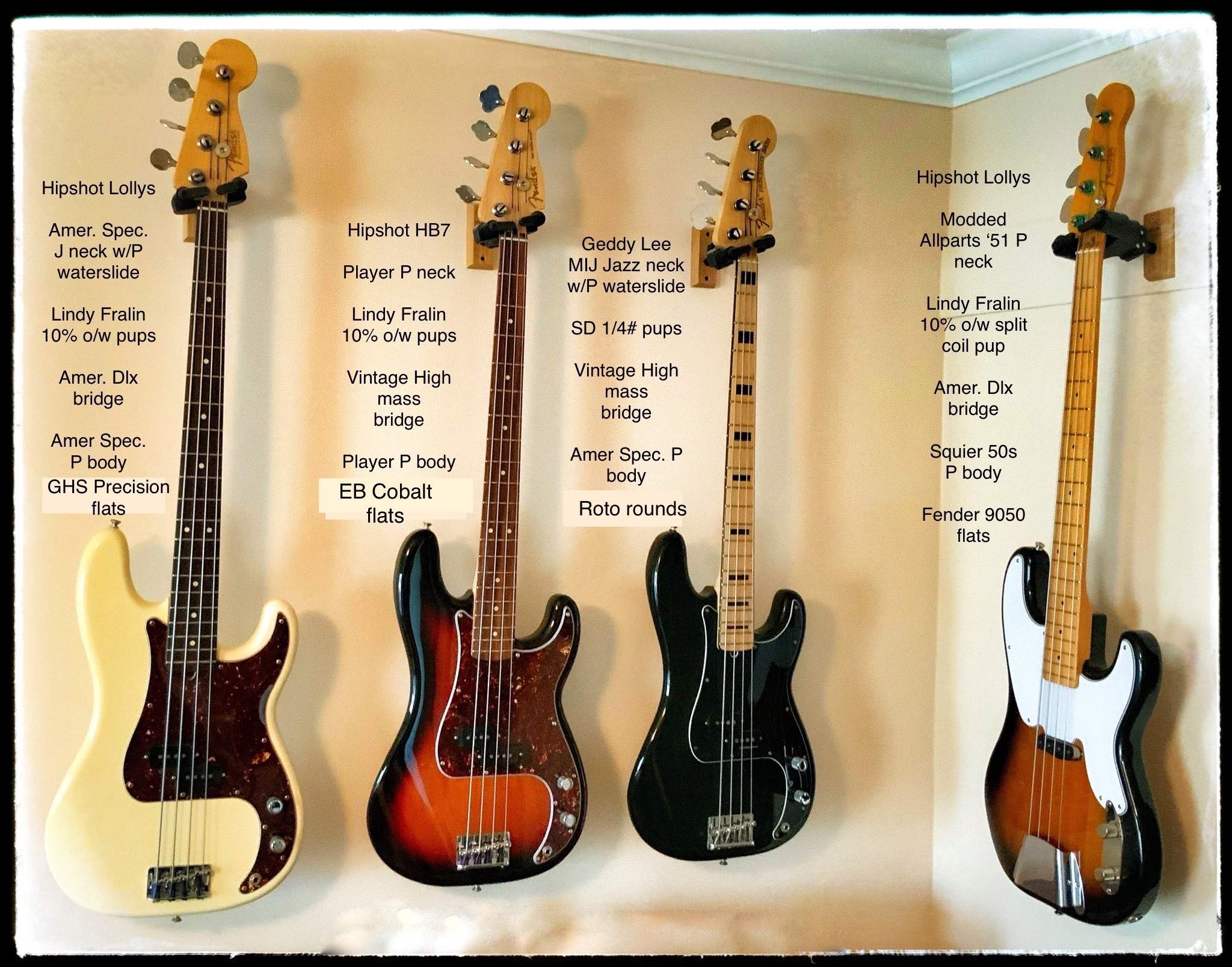
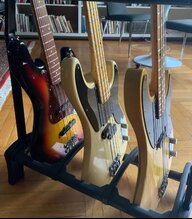
Not silly… I like the feel & simplicity of a P… so I have 4 (owned a RIC for 35yrs & have had a few other, assorted, basses)
The black one will, probably, always have Roto Rounds… the Sunburst one, sometimes, wears GHS Pressurewounds :thumbsup:

… not that my opinion amounts to anything :laugh: 4-bass quiver… 4-P’s

FA749C34-A645-4460-AFF8-7F7D4E1C2A41.jpeg
 
Last edited:
I've been playing bass guitar for a few years (long-time guitarist) and I've got an itch to expand beyond my one bass setup. I've got a bass that I love and plan to hang on to - an American proII precision with a maple fretboard. It's currently wearing flats, and one of the reasons I'm considering adding a bass to my arsenal is that I would like to have round wound tones available. I play a little bit of everything, and as much as I love the flat wound sound, sometimes it doesn't quite cut it. I'm actually considering picking up an AO 60s P-bass, putting the flats on that, and repurposing my proII as my round wound rock machine.

Is this silly? Should I take the chance to branch out and add a Rickenbacker, a Music Man, or even a Jazz to the mix? Maybe add a short scale for the flats with round wounds on my current P-bass? On the one hand, two P-basses, one with flats and the other with rounds, covers a ton of the ground that I'm interested in. On the other hand, diversity is the spice of life. What say you?

Not silly to have 2 PBs. I like your idea to have rounds on your second bass.

As opposed to 2 PBs, keep your eye out for a Pj configuration bass. I’ve been playing a MIA Fender PBj with rounds for the best part of 17 years. It’s a great voice, and that would be my choice.

As for different manufacturers, hey, you’re footloose and fancy free. Check them out before buying. And have fun doing it. If your current bass is a 4 string, consider a 5 string or even a 6 string.

Keep in mind, the more you look, the more choices you have. Be patient and choosey. Best wishes.
 
  • Like
Reactions: staurosjohn
When I made the decision to start taking 2 basses to shows, it was because I was pretty regularly breaking strings at shows. And having to stop midway through a set to re-string was a drag, just like our guitarist.
So my motivation wasn't to have " more tones available ".... It was to quickly replace what was lost. So it became clear to me that if my main war hammer was a Pbass, I needed another Pbass.
So I picked up an 84 MIJ P to compliment my 78.
Even when I didn't use it, it looked cool setting on a stand behind me.
They both wore Rotosound rounds, cause, thats just how I rolled.
They did sound a little different, so I guess I still wound up with some tone variation.
red and blonde.jpg
 
Two P’s is probably where I will end up. Or three. I mean, I need one with La Bellas, and one with rounds, and maybe one with another kind of flats. (Recent TI convert here.)

But I was working on a recording a couple years ago and after trying and trying to dial in the tone, I ended up laying it down with my daughter’s Jazz bass (with rounds). So if you do end up shopping outside the P family, I’d get a J. Familiarly Fender, but altogether different.

Final answer: get another P…and then get a J, too.
I agree, the likely next logical thing to grab is probably a Jazz (after your P bases are covered) unless.....you go with some kinda shortscale, maybe hollowbody, like a Mustang, Hofner or whatever. I find for recording, after the P's w flats or rounds it's those kinda basses that see far more studio time than J's these days.
 
I have a variety of basses right now but my plan is to downsize to two at some point. I have a bass that started life as a Squier affinity P with a Duncan quarter pound that is basically a parts bass and I'll never let it go. I recently got an LTD AP-5 which is a PJ but I only ever use the P pickup. It's a bit less aggressive sounding than the P which means it fits my bill for a super versatile in all areas bass, and then I can keep the Squier for when a really aggressive sound is perfect.
 
I never think it's a bad thing to explorer and find/have options for tone and basses to play, however once you find that one, you're looking for then (technically) you're good. Or that is how I believe.
 
I've been playing bass guitar for a few years (long-time guitarist) and I've got an itch to expand beyond my one bass setup. I've got a bass that I love and plan to hang on to - an American proII precision with a maple fretboard. It's currently wearing flats, and one of the reasons I'm considering adding a bass to my arsenal is that I would like to have round wound tones available. I play a little bit of everything, and as much as I love the flat wound sound, sometimes it doesn't quite cut it. I'm actually considering picking up an AO 60s P-bass, putting the flats on that, and repurposing my proII as my round wound rock machine.

Is this silly? Should I take the chance to branch out and add a Rickenbacker, a Music Man, or even a Jazz to the mix? Maybe add a short scale for the flats with round wounds on my current P-bass? On the one hand, two P-basses, one with flats and the other with rounds, covers a ton of the ground that I'm interested in. On the other hand, diversity is the spice of life. What say you?
There's nothing wrong with having two of the same model, especially when each have different strings. Beware of the 60's AO if neck shape is important. I found them to be wide (which I like), but quite shallow (front to back). It was an odd shape to my hand, and I'm one who likes large necks. Just an FYI

Personally, after years of having two of each (one primary, one backup), I've embraced the idea of having one example of each-- so, one Ric, one P, one Ray, etc.

Also keep in mind there are different ways to flavor flat's to rock: some modern flats can do the traditional thing along with a rock attitude (Chromes, or Cobalts), while rounds can get close to the flat tone. Here's a video that does a good job of showing what flats can do in a rock setting:

Thanks to that video, I spent all of last year exploring different strings on different basses and found some new favorite combinations ;)

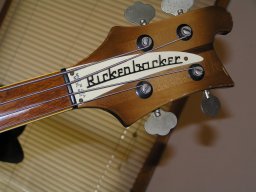
You mentioned perhaps adding a Rickenbacker; I strongly support this train of thought ;)
RIc&Fender.jpeg


Best of luck!
 
There's nothing wrong with having two of the same model, especially when each have different strings. Beware of the 60's AO if neck shape is important. I found them to be wide (which I like), but quite shallow (front to back). It was an odd shape to my hand, and I'm one who likes large necks. Just an FYI

Personally, after years of having two of each (one primary, one backup), I've embraced the idea of having one example of each-- so, one Ric, one P, one Ray, etc.

Also keep in mind there are different ways to flavor flat's to rock: some modern flats can do the traditional thing along with a rock attitude (Chromes, or Cobalts), while rounds can get close to the flat tone. Here's a video that does a good job of showing what flats can do in a rock setting:

Thanks to that video, I spent all of last year exploring different strings on different basses and found some new favorite combinations ;)

You mentioned perhaps adding a Rickenbacker; I strongly support this train of thought ;)
View attachment 4610007

Best of luck!

Lots of great info here, thanks! The Ric appeals in part because one of my favorite rock bassists is Mike Mills of R.E.M. fame who tended to play a Ric and a P. A 4003 or 4003s is definitely on the "to try" list. The bassist in my first band many years ago played a 70s Ric and got a great sound out of it, too.
 
  • Like
Reactions: Wolfhound32
I use an Ultra P with with rounds [Fender 7250/Markbass Ultimate] and can get great vintage P tone w/rounds in full on passive but also some very usable Modern [Stingrayish] in both Active and Passive using blend control.

I was considering both American Pro or Stingray Special before buying Ultra.
Played P's[rounds] most of my Gigging days from '75 to 2012 but had Gig with Cover Band doing 80's to early 2000's New Wave to Alt Rock and bought a EBMM Reflex and the versatility worked great.

The Ultra satisfied both; could get my comfortable Vintage P tone and very similar EBMM Tones.
 
P basses offer an exceptionally wide tonal variety for simple, single pickup instruments. Everything from "Takin' It To The Streets", "The Boys Are Back In Town", "Happy Anniversary" and "Forget Me Nots" to "The Joker", "Bernadette", "Hold On, I'm Coming" and "Hold Your Head Up". That's not counting the fretless variety. One with flats and one with rounds can cover a lot of territory. Having other models can reduce the chance of future redundancy. If you require a backup for gigs, using a similar instrument is beneficial, even if they're not identical. You always have the option of buying two less expensive basses. Or three...or four... Hey, this IS TB, after all. What'd you expect? :roflmao:
 
I've been playing bass guitar for a few years (long-time guitarist) and I've got an itch to expand beyond my one bass setup. I've got a bass that I love and plan to hang on to - an American proII precision with a maple fretboard. It's currently wearing flats, and one of the reasons I'm considering adding a bass to my arsenal is that I would like to have round wound tones available. I play a little bit of everything, and as much as I love the flat wound sound, sometimes it doesn't quite cut it. I'm actually considering picking up an AO 60s P-bass, putting the flats on that, and repurposing my proII as my round wound rock machine.

Is this silly? Should I take the chance to branch out and add a Rickenbacker, a Music Man, or even a Jazz to the mix? Maybe add a short scale for the flats with round wounds on my current P-bass? On the one hand, two P-basses, one with flats and the other with rounds, covers a ton of the ground that I'm interested in. On the other hand, diversity is the spice of life. What say you?

If you want the bass with rounds to be a "rock machine" I would strongly consider the Musicman Stingray. I love the tone of my Stingray for rock bass. A P or P-J with rounds also sounds good in rock and is a bit more diverse, but if I just want a Rock bass I like the MM. I use the single pickup version.
 
At one time I had 3 PJ's all with the same pickups and strings, and a P with flats with the same P pickup. Still have two PJ's left, too. I specifically set them up to sound as close to identical as possible. And honestly, I could do just as well with a straight-up P, but I like having a little J-ish mid scoop available to me quickly at times. Versatility comes from you, not the gear, although sometimes a radical tonal change can inspire you. It can also send you up S creek :D
 
I went over 40 years with one bass. Now that I can afford to have a collection I have to put in a plug for the G&Ls. I've got an L2000 and an ASAT, and I'm convinced they're the most versatile of my basses.

Active/Passive, series/parellel, switches enable just about any tone I could want.
 

Latest posts