
• TalkBass has been independent since 1998. Add your voice.
    Create a free account to reply to discussions, view embedded media, and browse with fewer display ads.
    Join freeLog in
    Want zero display ads or expanded classifieds tools? Compare plans.

20Hz Speaker Fluctuations ??

Just moving a string in a magnetic field, or stressing a piezo can generate a low frequency signal.

My SWR amp does this in a HUGE way as compared to other brands. This is based on very similar tone settings when played normaly. Could be that they have a built in low frequency bump in their design that others don't, or, perhaps the other brands don't have as flat a response curve.

Have very limited experience with separate pre / power amp rigs design to towards audiophile specs so perhaps the issue occurs with separates as well.
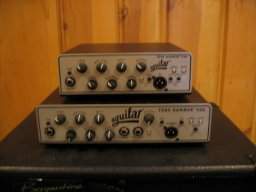
 
My SWR amp does this in a HUGE way as compared to other brands. This is based on very similar tone settings when played normaly. Could be that they have a built in low frequency bump in their design that others don't, or, perhaps the other brands don't have as flat a response curve.

Have very limited experience with separate pre / power amp rigs design to towards audiophile specs so perhaps the issue occurs with separates as well.

Per the above, they don't have that subharmonic roll-off (or whatever that deep low base limiting is called on bass amps) built in like virtually all other amps (hence they make a big deal of their amps going down to 20 or 10 hz or something crazy). Bad design IMO. It's a classic case of something that sounded good 'on paper' (we'll make our amps go lower than anybody elses!!!!), and then didn't really translate into a positive in the real world IMO.
 
With an SWR, if I simply pushed the strings toward the pickups without making any sound the 15" EV speaker would have massive excursion with the amp turned up.

.02
Doing so you'd create sub sonic tones below the range of your hearing, which should be filtered out as they serve no purpose except to kill drivers and suck up power from the amp.

I know an audiophile who insists that vinyl has better low end because he can see his speakers moving. I tried to point out it's the warp of the records he's watching and he should filter it out to get even better bass, but sometimes being an audiophile is a visual thing.
In this case he's an Audiofool. Filtering out turntable noise was the purpose of rumble filters on older hi-fi pre's and amps, you don't see them now because CDs don't rumble.
 
This has turned into quite the topic.
I hooked up the GT/SWR Preamp to my Mackie 1400I that has a adjustable low filter and it made all the difference in the un wanted meaningless speaker travel.
I found that setting it at about 40 Hz was the nice happy medium if I turned it below that the overtravel condition came back when I turned the filter up to 100Hz there was very little speaker travel but a very noticable loss in low Bass.
When I would thump on the muted strings over the pickups the speakers were much more stable also,not something that I normally do.
I am using my 2x15 cab to test this because it seems that the 15s were affected a little more than the 10s by this problem.
So in conclusion from a simple non technical standpoint installing a 40 Hz filter will solve my problem.
Can I simply start by putting a 100uf Non Polarized cap on the positive line out of the preamp and judge which way I need to go?This is how I would customize my Car Audio Installations that I did.And if it works then I can make it a 1st or 2nd order to speed up the db cut slope (ie 6,12 or 18 slope).
Steve
 
Hi.

Sounds like the tuning frequency of Your cab is 40 Hz or thereabouts then. Assuming it's a vented design. Sealed cabs behave a bit differently.

As You probably have the needed components at hand, just try them. The pre out does'nt necessarily like a short, but shouldn't mind even if you did that, otherwise there's nothing to lose and everything to gain ;).

Regards
Sam
 
Can I simply start by putting a 100uf Non Polarized cap on the positive line out of the preamp and judge which way I need to go?
100 uF is a couple of decimal points too high. Also a cap will only give 6dB filtering, which is better than none, but not by much. 12dB is the minimum required to be effective, while 18 or 24dB is preferred.
 
100 uF is a couple of decimal points too high. Also a cap will only give 6dB filtering, which is better than none, but not by much. 12dB is the minimum required to be effective, while 18 or 24dB is preferred.
That was my thought with the 1st or 2nd order to get a quicker cut.
What do you recommend that I start with??
I checked and the Max input voltage and it is 9.75 volts for the Amp just to give us a Idea of the size Capacitors I will need.
Thanks Steve
 
I checked and the Max input voltage and it is 9.75 volts for the Amp just to give us a Idea of the size Capacitors I will need.
Thanks Steve
The voltage is immaterial, what counts is the input impedance of the amp. There are sources on-line for this stuff, mainly in the hi-fi realm. You can build higher order filters with caps and resistors, but they have high insertion losses. Active filters are much better.
 
This speaker cone travel issue is one I have had since I started using my Modulus with Bart HBs. This does not occur with other basses I have. But if I grab a string on the Modulus and pull/push it perpendicular to the pickup, the speaker really travels scary far - especially my 18".

I've got a tube pre -> Stewart power amp that has the afore mentioned rediculous 5Hz - 100K Hz type of freq response. And no low-cut filter anywhwere.

I really like the idea of those RCA filters linked above, but I also have 1/4" cables at this time. I suppose I could buy the RCA filters, and RCA->1/4" adaptors, and put the filters in the line.
 
You have the same power amps that I do. My Mackie amps I run with the high pass filter set to around 25Hz. My Carvin amps I run with the limiter on. I have never experience subsonic problems although I have seen the cones move in a similar manner to that which you describe. Pre-amps are BMax-T, ART Tube Channel and a tube pre-amp of my own design with a transformer output.

Adding a high pass filter after your pre-amp is a simple thing. It can consist of a series capacitor with a resistor to ground. I seem to remember high pass filters with a phono (RCA) socket at each end. These were for car audio but I can't remember who was selling them.

Paul

P.S.

Thanks Seamonkey, I did do a search on the Part Express site and came up empty. OP you can get RCA to phone plug adapters at Radio Shack or even Parts Express.

P
 
There is a hump in the bass of that preamp but not near as much as the hump in the mid/high mids. Moreover there is 6db dip at 250hz and that's what makes the bass sound accentuated. I use a vented cab that is tuned to 50hz. You can roll the leftmost eq knob fully counterclockwise to 31hz then adjust the slider down between -6 and -9db to help control rumble. It also tightens up the sound. I actually roll the Bass control up and then do this. Sounds quite nice.

Take a look at this:

Invalid Link Removed

fdeck is TBer that sells these. You may want to look him up and see if it will work on electric and if he's still selling them.
 
There is a hump in the bass of that preamp but not near as much as the hump in the mid/high mids. Moreover there is 6db dip at 250hz and that's what makes the bass sound accentuated. I use a vented cab that is tuned to 50hz. You can roll the leftmost eq knob fully counterclockwise to 31hz then adjust the slider down between -6 and -9db to help control rumble. It also tightens up the sound. I actually roll the Bass control up and then do this. Sounds quite nice.

Take a look at this:

Invalid Link Removed

fdeck is TBer that sells these. You may want to look him up and see if it will work on electric and if he's still selling them.
That is a really clean High Pass Filter but unfortunatly it is only rated up to 1 volt where Im pretty sure that we need it to go up to 10 volts.
Steve
 
Hi.

You can roll the leftmost eq knob fully counterclockwise to 31hz then adjust the slider down between -6 and -9db to help control rumble. It also tightens up the sound. I actually roll the Bass control up and then do this. Sounds quite nice.


:o Tubes have really got me carried away once again and messed with my memory ;).
Haven't used my ST220 for a long time and as I just dialed the low end for no rumble and left it there, I just forgot about it.
So there's an inbuilt hi-pass filter there already.

Regards
Sam
 
Hi.


:o Tubes have really got me carried away once again and messed with my memory ;).
Haven't used my ST220 for a long time and as I just dialed the low end for no rumble and left it there, I just forgot about it.
So there's an inbuilt hi-pass filter there already.

Regards
Sam

Not necessarily. Please understand that I'm only a four-stringer. My low E will not put out much signal down in the 20-30hz range. So, if I take 6-9db off at 31hz, I've cut a notch out of any signal going down into the unused range and made a bit more power available up higher by deadening anything lower. With my cab being tuned to 50hz, I'm better off utilizing the power and lowering the odds of rumble and damage from subsonics. My bass range is also tighter. Considering the specs of the speaker cabinet, percieved loss of bass is negligible but with a clearer signal.
