• TalkBass has been independent since 1998. Add your voice.
    Create a free account to reply to discussions, view embedded media, and browse with fewer display ads.
    Join freeLog in
    Want zero display ads or expanded classifieds tools? Compare plans.

2x12 cab + 4x10 cab - Which one on top?

Which cab on top: 4x10 or 2x12


  • Total voters
    84
I don't listen to engineers and scientists. I listen to the guys who are actually out there gigging night after night, venue after venue and to guys who play in a similar fashion as I do in terms of how they like to sound. Having said that, I'm seen marcus Miller on stage with each 4x10 side by side. They may have even been tilted a little but from what I've read from all the experts and wanna bees here on TB, his config is a no no. All this tickles me to no end. There are poeple who DO, and folks who sit back and talk about doing. having put my own foot in my own mouth, welcome to Talk Bass :-)
 
I don't listen to engineers and scientists. I listen to the guys who are actually out there gigging night after night, venue after venue and to guys who play in a similar fashion as I do in terms of how they like to sound. Having said that, I'm seen marcus Miller on stage with each 4x10 side by side. They may have even been tilted a little but from what I've read from all the experts and wanna bees here on TB, his config is a no no. All this tickles me to no end. There are poeple who DO, and folks who sit back and talk about doing. having put my own foot in my own mouth, welcome to Talk Bass :-)

If you've read my response on this thread you'll see that I explained (in a scientific sort of way) why one would choose side-by-side or vertical. Marcus is right, he wants the THUMB, so placing them side by side and on the floor gives him a big low-mid boost and he tilts them to get just enough highs for that snap he's famous for.
I build and design speaker for more then 25 years and I'm bassplayer, what people experience sound-wise can be explained scientifically. I use science for my own advance, saves me a lot of experimenting and buying cabs and amps.....
 
I don't listen to engineers and scientists. I listen to the guys who are actually out there gigging night after night, venue after venue and to guys who play in a similar fashion as I do in terms of how they like to sound. Having said that, I'm seen marcus Miller on stage with each 4x10 side by side. They may have even been tilted a little but from what I've read from all the experts and wanna bees here on TB, his config is a no no. All this tickles me to no end. There are poeple who DO, and folks who sit back and talk about doing. having put my own foot in my own mouth, welcome to Talk Bass :-)

How cool, we actually have a gigging musician posting here :rolleyes:
 
Having said that, I'm seen marcus Miller on stage with each 4x10 side by side. They may have even been tilted a little but from what I've read from all the experts and wanna bees here on TB, his config is a no no.
I think the big debate is not about having multiple cabs or side by side vs. stacked. It's about mixing cabs with different driver sizes or worse (it seems) mixing driver sizes in one cabinet. Something about out of phase wave fronts cancelling each other therefore reducing the bass response. The Mesa cab is even more disappointing as there was no crossover dividing the signal between the single 15 and four 10 inch drivers.

Considering how long the wave length is at these low frequencies, I'm still not personally convinced that there is a big enough difference between a 12" and 10" driver to make that much of a difference. In reality, a slight phase difference may actually enhance, flaten and extend the bass response! There are so many design considerations such as port sizes and their location for example. Maybe the designers at Mark Bass took all this into consideration to design the ultimate pair of cabs??? The MusicMan cabs have crossovers. The 4x10 comes with a horn. The 2x12 has no horn but instead a unique 6" mid driver.

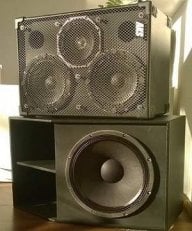
In my original post I asked a simple question. When using a 4x10 cab with a 2x12 cab which one is better on top? My own personal conclusion after thinking about this for a while now and considering all the comments is 2x12 on bottom, 4x10 on top. The main reason being that bass frequencies are less directional then high frequencies so it is better to have the 4x12 on the bottom. It is also better to have the cab with the horn in it on top. This combination looks a little weird as the 4x10 cab is larger. It seems that it is more common to have the larger cab on the bottom. In reality they do sound great either way.

Maybe I should just alternate them stacking all four cabs vertical with the head on top! Problem is that I would need a couple of longer cables (oops, all cables should be the same length will be the next debate) and also will need a step ladder to get to my volume control!
 
Depending on the cabs, you could get really cool results one way or the other...or neither. One obnoxious thing to keep in mind with a mixed stack like that is that, if your stack is your stage monitor (which is usually the case), you'll be hearing the top cabinet a lot more clearly than the bottom one. With mixed cabs, that means what you hear - and therefore what you tweak your EQ to - is different from what people in the audience will be hearing when they get a more even blend of the cabinets. The effect may subtle, but could affect your choice of stacking order if you really end up doing this.
 
Debate is really fun to me until it turns hostile, then it just gets kinda silly...and a little sad.

Has anyone ever taken different rigs to a club and compared how they sound? I have, but I build cabs and wanted the information. A backline company sent me the 'tried and true' 410 on top of a 115 rig (GK RBH series) and next to it we placed a little fEARful 15/6. The amp used was a GK 1001rb. The 15/6 is a small 8ohm cab, the 410/115 stack is a 4 ohm stack. There were a few musicians, 3 FOH people and a tour manager. The 15/6 was louder and lower and when you walked around the room, the sound was much more even throughout. It was unanimous that the little 55lb cab killed the 190+lb stack in every way. I've also taken a FEARLESS F215 and my favorite 810 and done the same test at a club. The difference was silly and obvious to everyone there. We also took a Genz Uber212 and Uber410 out for a time. Both very nice cabs for what they are, but never worked together. It worked better with the 212 on top, but was far from optimal.

The smug anti science coming from the 'working pros' can get so mean spirited..."You guys read your charts and graphs while I'm out there doing it, man!" Please :rollno: I did over 200 shows last year in 15 different countries, which confirmed the science to me more than ever. Full time pro players don't have the right to talk down to 'weekend warriors.' We're all here to learn and have some fun :)
 
You're assuming that because the 12 is bigger than the 10, it must also have lower frequency output. This is the flaw. You cannot determing how low a cab will go based on driver size alone- and in fact, it's the least important factor.

Please explain... I'm looking for explanations please not just assertions.

I would think an 18" would go lower than an 8" for example. What is the important factor(s)?

I was actually thinking more about the mid range driver and the horn location as I explained above but you are right, I've also always presumed the larger the speaker, the lower the frequency response.

Thanks dukeorock for your real world example above. I also have an RBH 4x10 cab and have always thought of getting the 1x18 RBH to go with it. That settles that!
 
Please explain... I'm looking for explanations please not just assertions.

I would think an 18" would go lower than an 8" for example. What is the important factor(s)?

I was actually thinking more about the mid range driver and the horn location as I explained above but you are right, I've also always presumed the larger the speaker, the lower the frequency response.

Take a look at Phill Jones' stuff. He uses multiple 8" driver, and goes really low. Response is not a function of diameter, but many other design parameters. You can make a small speaker go low, it just wont be as efficient as a large speaker designed to go just as low. The reason you see 15" or 18" subs and not a 20x8 sub is economics. It is less expensive and lighter to use one or two big speakers. That doesnt mean that all big speakers are better for lows, and all small speakers are better for highs. It means that each speaker has unique design parameters that need to be taken in to account when building an enclosure around them.
 
Please explain... I'm looking for explanations please not just assertions.

I would think an 18" would go lower than an 8" for example. What is the important factor(s)?

I was actually thinking more about the mid range driver and the horn location as I explained above but you are right, I've also always presumed the larger the speaker, the lower the frequency response.

That's pretty common, just not really true :) A good 8" driver with the right specs, can go just as low as an 18" driver, but not as loud, usually.

 
Really what you need to look at for a good reference of how low a speaker will go (or how well it will reproduce low frequencies) is displacement.

Lets look at some examples.

Here is a [Invalid or Expired Link Removed]. Lets compare that to this [Invalid or Expired Link Removed]. That 15 may get way louder in the upper register, but the 10 will spank it in true usable bass.
 
Thanks dukeorock for your real world example above. I also have an RBH 4x10 cab and have always thought of getting the 1x18 RBH to go with it. That settles that!

My pleasure, bro :)

The simplest, safest bet is this- If you love your current cab, but need more lows or SPL then get another cab exactly like the one you already have...usually, it's everything you like doubled :)

Personally, I don't care what Geddy, or Flea or whoever use and think it's silly when folks use them as 'examples.' Unless you got tickets on the stage, odds are very good you've never heard their cabs. You hear a DI going into the PA. I've had tons of endorsements over the years and have stood in front of cab stacks and smiled for the picture. You'd smile too if someone just gave you a bunch of gear for free :hmm:
 
...Full time pro players don't have the right to talk down to 'weekend warriors.' We're all here to learn and have some fun :)

I couldn't appreciate this comment more. A touring professional has way more on his plate than the best science approved design. Endorsement deals for one mean a lot to some players.

Those of us footing the bill ourselves have to think alittle harder.

Thanks Mark.
 
I couldn't appreciate this comment more. A touring professional has way more on his plate than the best science approved design. Endorsement deals for one mean a lot to some players.

Those of us footing the bill ourselves have to think alittle harder.

Thanks Mark.

Welcome :)

I totally get the endorsement thing for full time pros...it's often more than just free stuff, though that really helps offset touring expenses. For example, our trailer and everything in it was stolen one afternoon...Fender made arrangements to have a full rig ready for all of us that same day, so we wouldn't have to cancel any shows. Support goes a long way too.

Honestly, I often wish I'd never heard a greenboy cab. It costs me more to build my own cabs than I've paid in over a decade, but once you've heard something that's right, there's no going back :D
 
Really what you need to look at for a good reference of how low a speaker will go (or how well it will reproduce low frequencies) is displacement.

Lets look at some examples.

Here is a [Invalid or Expired Link Removed]. Lets compare that to this [Invalid or Expired Link Removed]. That 15 may get way louder in the upper register, but the 10 will spank it in true usable bass.


I can't argue with the manufacturer specs although the Vd is directly related to the surface area of the cone so a bigger cone usually means more air movement. Very cool information. I was blown away by the difference in the two. Thanks for the specs. We bass players need to move a lot of air! (Pun intended)

http://www.members.shaw.ca/loudspeakerbuilder.ca/thiele-small.html

Vd - No, it not that kind of VD. This Thiele-Small parameter is the Peak Diaphragm Displacement Volume which the total volume of air the cone will move. It is calculated by doubling Xmax then multiplying the result by Sd (Surface area of the cone). The higher the Vd figure is the better it is for use as a sub-bass driver.
 

Latest posts