
Enjoy the benefits of a premium membership!
Upgrade Account
-
TalkBass has been independent since 1998. Add your voice.
Create a free account to reply to discussions, view embedded media, and browse with fewer display ads.
Join free Log in
Want zero display ads or expanded classifieds tools? Compare plans.
You are using an out of date browser. It may not display this or other websites correctly.
You should upgrade or use an alternative browser.
You should upgrade or use an alternative browser.
3-way cabinets & overdrive / distortion
- Thread starter pablomigraine
- Start date
More options
Who Replied?
Wow thanks so much for all this feedback TB!
So after some thought, I'm going to commission a custom self-powered enclosure from the Ye Olde Master, Don Oatman. This will be something akin to a Greenboy 12126T. I figure I'll be running both cleans and OD, and more than once in this thread it's been said it may be better to have something more like an FR/FR enclosure and apply some cabsim or a LPF when needed than be stuck trying to get some sparkle out of a more vintage design. I'll update this thread with any progress.
Thanks all!
So after some thought, I'm going to commission a custom self-powered enclosure from the Ye Olde Master, Don Oatman. This will be something akin to a Greenboy 12126T. I figure I'll be running both cleans and OD, and more than once in this thread it's been said it may be better to have something more like an FR/FR enclosure and apply some cabsim or a LPF when needed than be stuck trying to get some sparkle out of a more vintage design. I'll update this thread with any progress.
Thanks all!

Check out the Broughton Messenger pre to control your FRFR cab. Also consider a programmable eq. like 99 Presets Free The Tone PA-1QB Programmable Analog 10-Band Bass EQ Pedal or Source Audio EQ2 Programmable Equalizer PedalWow thanks so much for all this feedback TB!
So after some thought, I'm going to commission a custom self-powered enclosure from the Ye Olde Master, Don Oatman. This will be something akin to a Greenboy 12126T. I figure I'll be running both cleans and OD, and more than once in this thread it's been said it may be better to have something more like an FR/FR enclosure and apply some cabsim or a LPF when needed than be stuck trying to get some sparkle out of a more vintage design. I'll update this thread with any progress.
Thanks all!
Last edited:
Check out the Broughton Messenger pre to control your FRFR cab. Also consider a programmable eq. like 99 Presets Free The Tone PA-1QB Programmable Analog 10-Band Bass EQ Pedal
I appreciate the suggestion! Marty at Motor City is one of the greatest dudes in the business!
I counter with - www.neuraldsp.com/quad-cortex
Jim Carr
Dr. Jim
- Jan 21, 2006
- 16,223
- 7,613
- 76
- Disclosures
- fEARful Kool-Aid dispensing liberal academic card-carrying union member Musicians Local 72-147
Check out the Broughton Messenger pre to control your FRFR cab. Also consider a programmable eq. like 99 Presets Free The Tone PA-1QB Programmable Analog 10-Band Bass EQ Pedal
I don't use distortion or overdrive, so probably my question reflects my inexperience, but here goes.
Why doesn't the EQ section of one's amp handle the spectrum well enough to tame the highs going into (and thus coming from) one's FR/FR cab when the "offending" effects are on?
Is it simply a matter of not wanting to have to twist knobs on stage? I was under the impression that most of these effects are "Always On."
Last edited:
When using medium to high level distortion
There is literally no need for a mid driver.
Never the less the efficiency of 6.5" drivers is horrible.
And if your going to chase the mystical magical " dispersion"
the ideal design would start to dip into 3" or 4" drivers
and again the efficiency is horrible so it takes a good 3 to 4 drivers to match one LF driver
Basically the Eminence Map covers it well and you either build a 2x12 or 2x15 with
the well known full range Kappalites and call it a day.
Never mind the annoyance of passive crossovers, not that they are difficult to design.
With good bass tone and overdrive. Nothing beats the tone of a fullrange driver.
And who needs to add more inductance and capacitance for the amplifier to deal with.
when just the speaker itself is already a inductive nightmare.
Not to even mention the tightness and difference with sealed cabs.
a venture that nobody seems to take on. And the same old legend sealed cabinets that people use.
getting bored but still satisfied with sealed 10's. god forbid if someone shoved a 12" into a sealed box.
what would we do without the legend bloom lol
either way as usual people want high SPL and small boxes. So a good tradeoff is the same old 2x12 box.
2 cubic feet per driver 45hz and your done
I have absolutely no interest in plate amps, and wouldn't want to loose volume or add cabinet weight to make them work.
Some peolpe loved the El Camino its a car and a truck!! in reality it didnt hold much weight as a truck, and got horrible mileage as a car. lol everyone buys them cause they look cool. other than that the 2 in one design was a failure. cool car, but the design intent of mixing 2 things in one doesnt always add up
point is a amp is a amp
and a cab is a cab
There is literally no need for a mid driver.
Never the less the efficiency of 6.5" drivers is horrible.
And if your going to chase the mystical magical " dispersion"
the ideal design would start to dip into 3" or 4" drivers
and again the efficiency is horrible so it takes a good 3 to 4 drivers to match one LF driver
Basically the Eminence Map covers it well and you either build a 2x12 or 2x15 with
the well known full range Kappalites and call it a day.
Never mind the annoyance of passive crossovers, not that they are difficult to design.
With good bass tone and overdrive. Nothing beats the tone of a fullrange driver.
And who needs to add more inductance and capacitance for the amplifier to deal with.
when just the speaker itself is already a inductive nightmare.
Not to even mention the tightness and difference with sealed cabs.
a venture that nobody seems to take on. And the same old legend sealed cabinets that people use.
getting bored but still satisfied with sealed 10's. god forbid if someone shoved a 12" into a sealed box.
what would we do without the legend bloom lol
either way as usual people want high SPL and small boxes. So a good tradeoff is the same old 2x12 box.
2 cubic feet per driver 45hz and your done
I have absolutely no interest in plate amps, and wouldn't want to loose volume or add cabinet weight to make them work.
Some peolpe loved the El Camino its a car and a truck!! in reality it didnt hold much weight as a truck, and got horrible mileage as a car. lol everyone buys them cause they look cool. other than that the 2 in one design was a failure. cool car, but the design intent of mixing 2 things in one doesnt always add up
point is a amp is a amp
and a cab is a cab
Last edited:
I don't use distortion or overdrive, so probably my question reflects my inexperience, but here goes.
Why doesn't the EQ section of one's amp handle the spectrum well enough to tame the highs going into (and thus coming from) one's FR/FR cab when the "offending" effects are on?
Is it simply a matter of not wanting to have to twist knobs on stage? I was under the impression that most of these effects are "Always On."
Not at all. At the heart of the original question, I suppose, is whether or not overdrive and/or distortion simply sounds inherently bad through the midrange drivers most commonly seen in bass cabinets... be they of the more "FR/FR" types like the Greenboy / Fearless models, or the more vintage-voiced Bergantino NV215 and NV115. If one were to use either of these types and attempt to effectively "EQ-out" the midrange driver.... that is, to roll off treble and upper mids to the point at which there was little to no signal passing through the mid driver, that would leave one with a very dull sound indeed and, unless one was taking this course much less than half the time, makes the whole idea of this sort of speaker configuration a waste.
When using medium to high level distortion
There is literally no need for a mid driver.
Never the less the efficiency of 6.5" drivers is horrible.
And if your going to chase the mystical magical " dispersion"
the ideal design would start to dip into 3" or 4" drivers
and again the efficiency is horrible so it takes a good 3 to 4 drivers to match one LF driver
Basically the Eminence Map covers it well and you either build a 2x12 or 2x15 with
the well known full range Kappalites and call it a day.
Never mind the annoyance of passive crossovers, not that they are difficult to design.
With good bass tone and overdrive. Nothing beats the tone of a fullrange driver.
And who needs to add more inductance and capacitance for the amplifier to deal with.
when just the speaker itself is already a inductive nightmare.
Not to even mention the tightness and difference with sealed cabs.
a venture that nobody seems to take on. And the same old legend sealed cabinets that people use.
getting bored but still satisfied with sealed 10's. god forbid if someone shoved a 12" into a sealed box.
what would we do without the legend bloom lol
either way as usual people want high SPL and small boxes. So a good tradeoff is the same old 2x12 box.
2 cubic feet per driver 45hz and your done
I have absolutely no interest in plate amps, and wouldn't want to loose volume or add cabinet weight to make them work.
Some peolpe loved the El Camino its a car and a truck!! in reality it didnt hold much weight as a truck, and got horrible mileage as a car. lol everyone buys them cause they look cool. other than that the 2 in one design was a failure. cool car, but the design intent of mixing 2 things in one doesnt always add up
point is a amp is a amp
and a cab is a cab
While you do make some good points, and a kappalite-loaded 212 with a defeatbale HF driver design is appealing in both its simplicity and overall "loudness factor" it simply doesn't do it for me, and I'll explain below.
As far as using a "fullrange" speaker... while I'm no expert, I have owned and used probably 20 or more higher-end speaker cabinets of every imaginable design philosophy, and in my experience... there simply is no such thing as a single 12" speaker which can both produce true lo-bass at high SPL's and simultaneously produce an accurate midrange all the way up to even 3.5Khz, unless it's getting a HEAVILY eq'd and comp'd signal from a DSP engine tuned to that specific driver and enclosure. Even then, there is necessarily an overall reduction of SPL. The Kappalites, while truly amazing drivers... are not at all "Fullrange" in the truest sense of the word, although they get much closer than most. The only way to really get an FR/FR enclosure using these drivers is to relieve them of some of the hi-mid & HF duties by using a very high-quality HF driver that can be crossed over comparatively low, as seen in the bigger Barefaced cabinets. This is a compromise IMO and, again, won't sound great with overdrive unless that HF driver is defeated entirely, either electrically or via DSP, leaving a very dull sounding box that only goes up to say 1.2khz-2khz.
As far as sealed boxes go, don't get me wrong... the Bergantino NV610 is probably the best sounding bass cabinet ever produced, especially if one is using overdrive, but simply will not ever produce the really deepdeep bass I'm needing. I may have an alternative that combines the two, but it's a pretty radical design and may not work at all (see "B" below).
That said, I agree with the several people who said the more "FR/FR" type designs are best in this application, and my idea presently is to design an active variant of either-
A) something like a Fearful 212 loaded with a 6ND410 (sealed) and a pair 12PR330's (vented), or
B) something a little more radical... think of an old Schroeder 210112 with the 12 on an angled baffle, but with both properly designed venting for the 12" and proper bracing (something the Schroders always lacked), as well as the two 10"s being in a sealed sub-enclosure, crossed over at maybe 120 or 200hz. The 12" Sub would have to be something like the Eminence LAB12 or similar, and the pair of 10"ers would probably be the bass guitar-specific 10"ers from Eminence. This design would not be near as "loud" as the former but may achieve better overall results in terms of response and good overdriven tone.
These designs are entirely hypothetical but hopefully this week I'll be plotting these ideas with the appropriate software and see what's what.
Lastly - Active/Self-Powered enclosures are not for everyone. My idea is to have a very simple rig; instrument, modeler, powered enclosure. Done. My Quad Cortex will include every preamp, effect, compressor, cabsim, X-over and filter I could ever use live or in the studio, and it seems a huge hassle to have to also carry a 2RU power amp along... especially when quality 2 or 3 channel plate amps are available for the same money and also afford me the flexibility of setting X-Over points digitally if I do decide to go with a 3-way design.

and again the efficiency is horrible so it takes a good 3 to 4 drivers to match one LF driver
How do you figure? For the frequencies they need to produce, I've never seen anything to indicate that a single decent mid-driver can't at minimum compete with one LF driver. Again, at least as it pertains to the frequencies they need to produce.
My F115 is my personal case in point (5" mid).
Basically the Eminence Map covers it well and you either build a 2x12 or 2x15 with
the well known full range Kappalites and call it a day.
Not if you want a flat-ish response. Don't most of those drivers have odd mid-peaks when left to their own devices?
How do you figure? For the frequencies they need to produce, I've never seen anything to indicate that a single decent mid-driver can't at minimum compete with one LF driver. Again, at least as it pertains to the frequencies they need to produce.
My F115 is my personal case in point (5" mid).
Not if you want a flat-ish response. Don't most of those drivers have odd mid-peaks when left to their own devices?
Also good points which support my position.

- Feb 12, 2006
- 60,977
- 5
- 220,732
- Disclosures
- Development Engineer-Mesa Boogie, Development Engineer-Genzler (pedals), Product Support-Genz Benz
When a mid driver is used to extend the range of an low frequency frequency driver that has been optimized for low frequency extension, the LF driver sensitivities are generally in the 94-96dB/1W/1M range and they begin to roll off significantly around 2kHz (and some earlier than that).
Practically, there are many mid drivers in the 5"-6" range that work well with a simple 12dB/octave high pass filter as necessary to blend the mid into the low frequency rolloff of the HF driver.
Combine whatever eq/filtering there is on the amp and distortion pedal with a variable pad on the mid driver and IME you will have an effective solution that is reasonably adaptable to many styles of clean and distorted tones.
Practically, there are many mid drivers in the 5"-6" range that work well with a simple 12dB/octave high pass filter as necessary to blend the mid into the low frequency rolloff of the HF driver.
Combine whatever eq/filtering there is on the amp and distortion pedal with a variable pad on the mid driver and IME you will have an effective solution that is reasonably adaptable to many styles of clean and distorted tones.
How do you figure? For the frequencies they need to produce, I've never seen anything to indicate that a single decent mid-driver can't at minimum compete with one LF driver. Again, at least as it pertains to the frequencies they need to produce.
My F115 is my personal case in point (5" mid).
Not if you want a flat-ish response. Don't most of those drivers have odd mid-peaks when left to their own devices?
For the most part your statement is correct, for a " Bass" application combining a 94 to 96 dB LF driver with a 92 to 94 dB midrange driver will work.
how a 150 watt midrange works with a 450 watt LF is at low to Med SPL levels it is just that....enough to make the designer feel it works and with enough smoothing and farting around with low level SPL measurements you can make the thing look flat. likewise as needed to boost how flat and amazing the dispersion is
it only works cause a majority of the bandwidth still goes to the LF driver and with normal Amp EQ the mids are there to make them feel its flat and amazing. It isnt, but with bass its fine....kinda.
Now move along to high SPL and players that actually use alot of watts, then you get the blown mid syndrome. Likewise at high SPL the distortion of a 6.5 inch is not very much more flat than a fullrange driver.
Again this is why 450 watt LF dont work with 150 watt mids.
In a PA situation you have alot more mids , and yes the distortion of a single 6 inch isnt amazing or flat, the SPL levels dont match and they blow.
you simple add another 6 inch speaker to reduce distortion and improve SPL matching. likewise simple 12dB crossovers work fine for bass applications, but 18 dB step slope is going to save your mid at high SPL and reduce distortion.
JBL got around the problem by doing a horn loaded mid, this makes a 93 dB driver actually match a 97 dB LF section.
Likewise they actually use a 18 dB crossover.
likewise they dont use cheap 150 watt mids, and use a better vented driver magnet, a larger magnet and a better cone to reduce distortion.
this is how real speakers do it.
so correct a bass application with a cheap neo and a cheap mid and a cheap crossover will work. in a blind test at low stage level volumes.
the difference between a " magic 2 way system" and a normal fullrange system is = Zero
I dont care to argue much cause actual listening test work better, having owned and rented alot of 2 way or 3 way systems
and heard all the magic lower cost neos mated with mids and even larger horns and compression drivers
I actually know what they sound like, and dont push low level SPL charts or computer generated simulations to convince me what they do and dont sound like.

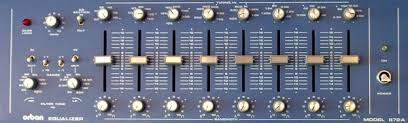
I'll offer a crazy idea. Long ago I used to biamp an SVT and a blackface Fender Twin loaded with JBL E120s. The crossover was set at 200hz so most of the tone was provided by the JBLs. I used quite a bit of EQ to get a sound that was very HiFi for the early 80s. My EQ/crossover was an Orban 672A
Perhaps a similar approach would be useful for the OP's design goals. I.E. use a bit larger and more effficient mid range driver that has just enough high frequency extension to give you the clean sound you want with a bit of EQ. Then for your dirty sounds, bypass the EQ and use the natural roll off of the mid driver(s) to get a naturally awesome OD sound. My feeling is a single 6" mid driver maybe insufficient given the stated goal. I am not an engineer, but I would at least consider adding a second 6"
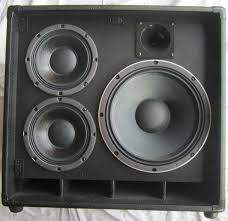
The Genz Benz 1288T Uber Quad is a single 12", two 8s, and a horn. The horn has an attenuator and my impression is these cabs don't really even need the horn because the 8s go high enough to cover the range of the bass...and I like crisp extended highs.
Perhaps a similar approach would be useful for the OP's design goals. I.E. use a bit larger and more effficient mid range driver that has just enough high frequency extension to give you the clean sound you want with a bit of EQ. Then for your dirty sounds, bypass the EQ and use the natural roll off of the mid driver(s) to get a naturally awesome OD sound. My feeling is a single 6" mid driver maybe insufficient given the stated goal. I am not an engineer, but I would at least consider adding a second 6"
The Genz Benz 1288T Uber Quad is a single 12", two 8s, and a horn. The horn has an attenuator and my impression is these cabs don't really even need the horn because the 8s go high enough to cover the range of the bass...and I like crisp extended highs.
Again this is why 450 watt LF dont work with 150 watt mids.
Maybe I just don't push my cab hard enough, but from my personal experience I've yet to have an issue with the mid keeping up.
No need for any charts; it sounds excellent - including with distortion, I might add. I always have some level of touch-sensitive distortion (and cab sim) perma-engaged.

- Feb 12, 2006
- 60,977
- 5
- 220,732
- Disclosures
- Development Engineer-Mesa Boogie, Development Engineer-Genzler (pedals), Product Support-Genz Benz
I'll offer a crazy idea. Long ago I used to biamp an SVT and a blackface Fender Twin loaded with JBL E120s. The crossover was set at 200hz so most of the tone was provided by the JBLs. I used quite a bit of EQ to get a sound that was very HiFi for the early 80s. My EQ/crossover was an Orban 672A
Perhaps a similar approach would be useful for the OP's design goals. I.E. use a bit larger and more effficient mid range driver that has just enough high frequency extension to give you the clean sound you want with a bit of EQ. Then for your dirty sounds, bypass the EQ and use the natural roll off of the mid driver(s) to get a naturally awesome OD sound. My feeling is a single 6" mid driver maybe insufficient given the stated goal. I am not an engineer, but I would at least consider adding a second 6"
The Genz Benz 1288T Uber Quad is a single 12", two 8s, and a horn. The horn has an attenuator and my impression is these cabs don't really even need the horn because the 8s go high enough to cover the range of the bass...and I like crisp extended highs.
View attachment 3803544
There are guys playing who are looking for the edge that the tweeter provides. Not mu cup of tea, but I know that it's often used in that context.
Maybe I just don't push my cab hard enough, but from my personal experience I've yet to have an issue with the mid keeping up.
No need for any charts; it sounds excellent - including with distortion, I might add. I always have some level of touch-sensitive distortion (and cab sim) perma-engaged.
Yes, it's not going to be an issue. It really doesn't take all that much mid to support the low end in practice.
Jim Carr
Dr. Jim
- Jan 21, 2006
- 16,223
- 7,613
- 76
- Disclosures
- fEARful Kool-Aid dispensing liberal academic card-carrying union member Musicians Local 72-147
...Combine whatever eq/filtering there is on the amp and distortion pedal with a variable pad on the mid driver and IME you will have an effective solution that is reasonably adaptable to many styles of clean and distorted tones.
I guess that was what I was asking about. Thanks.
Jim Carr
Dr. Jim
- Jan 21, 2006
- 16,223
- 7,613
- 76
- Disclosures
- fEARful Kool-Aid dispensing liberal academic card-carrying union member Musicians Local 72-147
...At the heart of the original, I suppose, is whether or not overdrive and/or distortion simply sounds inherently bad through the midrange drivers most commonly seen in bass cabinets... be they of the more "FR/FR" types like the Greenboy / Fearless models, or the more vintage-voiced Bergantino NV215 and NV115. If one were to use either of these types and attempt to effectively "EQ-out" the midrange driver.... that is, to roll off treble and upper mids to the point at which there was little to no signal passing through the mid driver, that would leave one with a very dull sound indeed...
Ok, so your assertion is just that certain midrange drivers sound bad with overdrive/distortion. By "sound bad" does it mean they are rendering what is there, or they are further distorting the wave form they are sent?
I'm not disputing, I'm just trying to understand what seems somewhat incongruous.
Last edited:
Ok, so your assertion is just that certain midrange drivers sound bad with overdrive/distortion. By "sound bad" does it mean they are rendering what is there, or they are further distorting the wave form they are sent?
I'm not disputing, I'm just trying to understand what seems somewhat incongruous.
That's not my assertion.. that is, in fact, my question and the whole point of the original post.
The general consensus seems to be, in brief; no, they don't sound inherently bad with overdrive or distortion.
Jim Carr
Dr. Jim
- Jan 21, 2006
- 16,223
- 7,613
- 76
- Disclosures
- fEARful Kool-Aid dispensing liberal academic card-carrying union member Musicians Local 72-147
That's not my assertion.. that is, in fact, my question and the whole point of the original post.
The general consensus seems to be, in brief; no, they don't sound inherently bad with overdrive or distortion.
You are correct. I seem to have lost track of your original request, so here it is below (excerpted).
...I do remember some conversation about these mid-driver equipped cabinets not being particularly well suited to overdrive, but I was hoping to get some contemporary opinions and experience...Opinions appreciated!
My error. Thanks!

Last edited:


