Playing a 35" 5 string bass, Hipshot Kickass bridge, and the A tuner is 145mm or so from the nut (farthest tuner). Should I uae 34" long scale or 36" super long scale?

Enjoy the benefits of a premium membership!
Upgrade Account
-
TalkBass has been independent since 1998. Add your voice.
Create a free account to reply to discussions, view embedded media, and browse with fewer display ads.
Join free Log in
Want zero display ads or expanded classifieds tools? Compare plans.
You are using an out of date browser. It may not display this or other websites correctly.
You should upgrade or use an alternative browser.
You should upgrade or use an alternative browser.
35" scale bass. Which TI Jazz Flats- 34" or 36"?
- Thread starter RBrownBass
- Start date
More options
Who Replied?
Playing a 35" 5 string bass, Hipshot Kickass bridge, and the A tuner is 145mm or so from the nut (farthest tuner). Should I uae 34" long scale or 36" super long scale?
The winding length on the E in JF344 set is 37" from ball end to the start of the silk at the tuner end. Would that be long enough for the start of the silk to go past the nut? If so, you can use the "long scale". 37" is usually long enough on a 35" scale as long as it's top-loaded and not thru-body.

Here's another way to look at this...
What's the measurement on your bass from where the ball end on the E is seated to the E tuner post? TI's "super long scale" is 39.75" from ball end to the start of the silk. If the measurement from ball end to E tuner post is less than 39.75", that would mean some of the full winding will end up wrapping around the post, which is something you would want to avoid if possible.
What's the measurement on your bass from where the ball end on the E is seated to the E tuner post? TI's "super long scale" is 39.75" from ball end to the start of the silk. If the measurement from ball end to E tuner post is less than 39.75", that would mean some of the full winding will end up wrapping around the post, which is something you would want to avoid if possible.

I have the normal scale length TI on a through body, 4-1 headstock, 35" scale bass.
You should be able to measure your bass and look up the wound length of the string set.

What kind of Headstock and tuning machines placement.
Measure the tuner closest to nut priority.
Or, email Thomastik customer service team request them to measure the length of 36 ' set from ball end to string warp end.
Measure the tuner closest to nut priority.
Or, email Thomastik customer service team request them to measure the length of 36 ' set from ball end to string warp end.
Last edited:

Go for 36", you will sleep in peace... 34" is the risk that the silk are appearing in between the nut and first frtet
D
Like others have said, you'll need to measure the distance from ball end to nut.
However... If it turns out you can use BOTH sets (which could very well be the case) you should be aware that the gauges in the long scale and super long scale set are different. The super long scale set has (seemingly) the same B-string, slightly heavier A-D-G and a lighter E-string. Looking at the tension figures the super long scale set looks much better balanced. A slightly heavier A-string would definitely be an improvement over the regular long scale set. I've always found the rather floppy A-string to be the weak link with the regular long scale TIJFs.
However, the tension figures Thomastik provide for the B-string doesn't make sense. Both sets have the same .136 B-string but they're listed with the same tension??? This would be physically impossible unless have a different core/wrapping ratio, which I somehow doubt (but please correct me if I'm wrong).
Thomastik make excellent strings but their choice of gauges don't always make sense. The short scale Jazz Flats are RUBBISH:
A-D-G are the same gauges as the long scale set (which makes them even floppier) but the E-string is much heavier gauge, making it rather stiff. The insane jump in tension between E and A make them unplayable IMO.
However... If it turns out you can use BOTH sets (which could very well be the case) you should be aware that the gauges in the long scale and super long scale set are different. The super long scale set has (seemingly) the same B-string, slightly heavier A-D-G and a lighter E-string. Looking at the tension figures the super long scale set looks much better balanced. A slightly heavier A-string would definitely be an improvement over the regular long scale set. I've always found the rather floppy A-string to be the weak link with the regular long scale TIJFs.
However, the tension figures Thomastik provide for the B-string doesn't make sense. Both sets have the same .136 B-string but they're listed with the same tension??? This would be physically impossible unless have a different core/wrapping ratio, which I somehow doubt (but please correct me if I'm wrong).
Thomastik make excellent strings but their choice of gauges don't always make sense. The short scale Jazz Flats are RUBBISH:
A-D-G are the same gauges as the long scale set (which makes them even floppier) but the E-string is much heavier gauge, making it rather stiff. The insane jump in tension between E and A make them unplayable IMO.
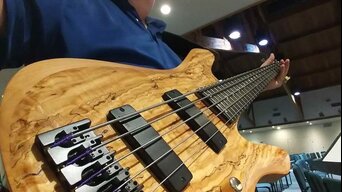
You're probably interested in the distance between the silks. I could measure mine but it's like 1:50AM here and I don't want to make noise and wake people up. Maybe tomorrow morning if I remember. TI Jazz flats are great strings and very playable.
The bass in my avatar is the one that has TI Jazz flats installed, long scale. Not through the body, but the strings are installed through the bridge. I believe that picture is older and has the pressure wounds on it at the time.
The bass in my avatar is the one that has TI Jazz flats installed, long scale. Not through the body, but the strings are installed through the bridge. I believe that picture is older and has the pressure wounds on it at the time.

The improved balance you speak of is just the lower-gauge E reducing the jumps in tension to only one (A to D) instead of two (E to A and A to D).slightly heavier A-D-G and a lighter E-string. Looking at the tension figures the super long scale set looks much better balanced. A slightly heavier A-string would definitely be an improvement over the regular long scale set.
Also, the slightly larger G - D - A are "heavier" in gauge only: if you check their tensions, and those of the regular set, recalculating* for one scale length (35" in this case)
the longies are 39.24 - 39.7 - 33.16 pounds respectively, while the superlongies would be 39.58 - 40 - 33.75 lbs.
As you can see, the differences are minimal, and undetectable to either hand.
My hypothesis, which I've expounded elsewhere, is that the super-long G-D-A only have a thicker silk inlay in order to make them slightly less twangy on a 36" bass, but the core, metal underwindings and ribbon are the same as their long-scale counterparts.
* [the quick way to do this is multiplying each value for the ratio of scale lengths (with the target one at the numerator), squared:
(35/34)^2 = 1.059688581314879 for the long-scale versions (JF34043, JF34056, JF34070)
(35/36)^2 = .945216049382716 for the long-scale versions (JF36044, JF36057, JF36072).]

If it's helpful, I have a 5 string set of the TI 36" "super long-scale" flats here and actual measurement on the B string from ball end to the beginning of the silk is 98.5 cm / 38 3/4" (it steps down from that point to where the outer metal wrap ends within about 1/2" - so as to avoid wrapping the outer wrap around the tuning machine post).
A string is 100 cm ball end to silk. Not sure if there's 145 mm beyond that as the sting has been cut/installed - but I think so (I have about 7 cm before the post + three full wraps and the crimped part and that's after having been cut).
I don't love the .136 B string but YMMV, et al.
A string is 100 cm ball end to silk. Not sure if there's 145 mm beyond that as the sting has been cut/installed - but I think so (I have about 7 cm before the post + three full wraps and the crimped part and that's after having been cut).
I don't love the .136 B string but YMMV, et al.
Last edited:

Let us all repeat the mantra:
1) measure from the ball anchor to the tuner side of the nut;
2) measure from the ball anchor to the middle of the lowest tuner post (in this case, the B string)
3) purchase a set of strings that the winding or speaking length is between these two measurements.
1) measure from the ball anchor to the tuner side of the nut;
2) measure from the ball anchor to the middle of the lowest tuner post (in this case, the B string)
3) purchase a set of strings that the winding or speaking length is between these two measurements.


Thomastik-Infeld Bass Strings Winding Lengths:
- Short Scale = 35.5" Ball to Silk
- Long Scale = 37" Ball to Silk
- Super Long Scale = 39.75" Ball to Silk
The published number is different than the actual measurement (on the super long, at least - I have regular long scale as well).
Actual measurement - off the bass:
B 38.75" ball to silk
E 39.5" ball to silk

Playing a 35" 5 string bass, Hipshot Kickass bridge, and the A tuner is 145mm or so from the nut (farthest tuner). Should I uae 34" long scale or 36" super long scale?
The tuner where the issue arises is the E or B String - guessing it's a 5, so the B string, which is typically the closest tuner - you want to make certain that the distance from where the string anchors in the the bridge to that tuner is longer than the wound length of the string. If the wound length of the string is longer than that you'll be winding the fat part of the string around the tuner post, which you don't want to do an a B string. You need to allow that the string will grow about a quarter inch under tension as well - add a quarter inch to the stated wound length. This is rarely an issue with a 34" set on a 35" bass, but with a 36" set, you could have that problem.
D
The improved balance you speak of is just the lower-gauge E reducing the jumps in tension to only one (A to D) instead of two (E to A and A to D).
Also, the slightly larger G - D - A are "heavier" in gauge only: if you check their tensions, and those of the regular set, recalculating* for one scale length (35" in this case)
the longies are 39.24 - 39.7 - 33.16 pounds respectively, while the superlongies would be 39.58 - 40 - 33.75 lbs.
As you can see, the differences are minimal, and undetectable to either hand.
My hypothesis, which I've expounded elsewhere, is that the super-long G-D-A only have a thicker silk inlay in order to make them slightly less twangy on a 36" bass, but the core, metal underwindings and ribbon are the same as their long-scale counterparts.
* [the quick way to do this is multiplying each value for the ratio of scale lengths (with the target one at the numerator), squared:
(35/34)^2 = 1.059688581314879 for the long-scale versions (JF34043, JF34056, JF34070)
(35/36)^2 = .945216049382716 for the long-scale versions (JF36044, JF36057, JF36072).]
Ah, yes, you're right of course. My brain somehow automatically expected 35" tension values for the super long scale set but yeah, the listed values are probably for 36". It's a bit unusual to list values for 36" though, isn't it? I mean, most longer scale basses are 35", aren't they? Personally I only use 34" or shorter so I'm not very familiar with most common specs for longer scale basses to be honest.
If possible I would still go with the set that has the higher tension A-string, even if it's just a marginal difference. The A-string really is the weak link with the regular long scale TIJFs in my opinion.
Then again, you might be right that they're exactly the same string with more silk... but that doesn't explain the differences in (recalculated) tension values, even thought the differences are rather small???
You are absolutely right regarding 36" scale basses no being all that common, but I had to take the tension values for the superlongs as valid for 36" because they say as much (also in the product name: JF364).Ah, yes, you're right of course. My brain somehow automatically expected 35" tension values for the super long scale set but yeah, the listed values are probably for 36". It's a bit unusual to list values for 36" though, isn't it? I mean, most longer scale basses are 35", aren't they? Personally I only use 34" or shorter so I'm not very familiar with most common specs for longer scale basses to be honest.
If possible I would still go with the set that has the higher tension A-string, even if it's just a marginal difference. The A-string really is the weak link with the regular long scale TIJFs in my opinion.
Then again, you might be right that they're exactly the same string with more silk... but that doesn't explain the differences in (recalculated) tension values, even thought the differences are rather small???
_
Barring small cumulative errors (rounding of small decimals), and again assuming I am right in assuming the string pairs are identical component-wise - core, underwinding wires, flat ribbon - except for a thicker silk inlay in the superlong:
the marginally higher tension of the latter (apart from the mass of the added silk itself, which is even...marginaller) should be due to the fact that, applying the same winding wire/ribbon onto a slightly wider-gauge cylinder (core+silk), you end up with a smidgen more metal per linear inch of string, because, well, pi.


