I hope this is not a repost, cuz I looked around. But anyway, I am assuming I can rewire my 4 ohm cab to 8 ohm without to much trouble, right? I have a 2-12 cab that has 2 8 ohm speakers wired to 4 ohms. I just picked up a 15 cab I want to run with it. That has a 4 ohm speaker in it. I think if I just plug er in, I'd be running only 2 ohms and mught damage my head. What do you guys think?

Enjoy the benefits of a premium membership!
Upgrade Account
-
TalkBass has been independent since 1998. Add your voice.
Create a free account to reply to discussions, view embedded media, and browse with fewer display ads.
Join free Log in
Want zero display ads or expanded classifieds tools? Compare plans.
You are using an out of date browser. It may not display this or other websites correctly.
You should upgrade or use an alternative browser.
You should upgrade or use an alternative browser.
4 ohm cab to 8ohm?
- Thread starter dfinnegan71
- Start date
More options
Who Replied?
bongomania
Commercial User
Two 8 ohm speakers can only be wired as 4 ohms or 16 ohms. There is no way to make two 8 ohm speakers into an 8 ohm load, other than removing one of them.
Most amps will burn up at 2 ohms, but there are exceptions, so be sure to look up your specific amp.
Most amps will burn up at 2 ohms, but there are exceptions, so be sure to look up your specific amp.
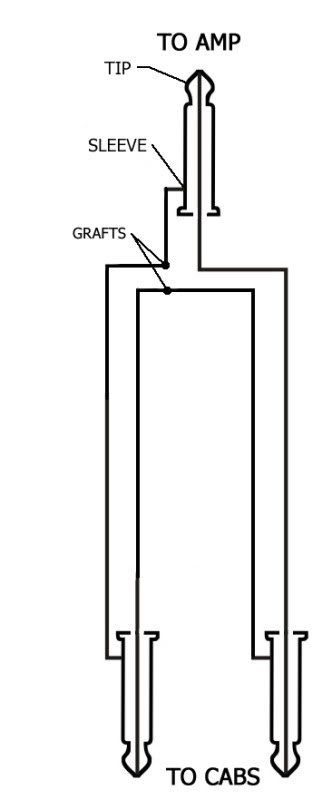
Notwithstanding what Bongo posted, even if you could get your 2x12 to 8 ohms, if you'd be running a 4 ohm cab and an 8 ohm cab in parallel, you'd be at 2.67 ohms, which is likely to burn up most heads as well. You could run them in series at 12 ohms, but what's the point other than having the 15 moving more air but at reduced output? I can't comment on the loudness differences there.

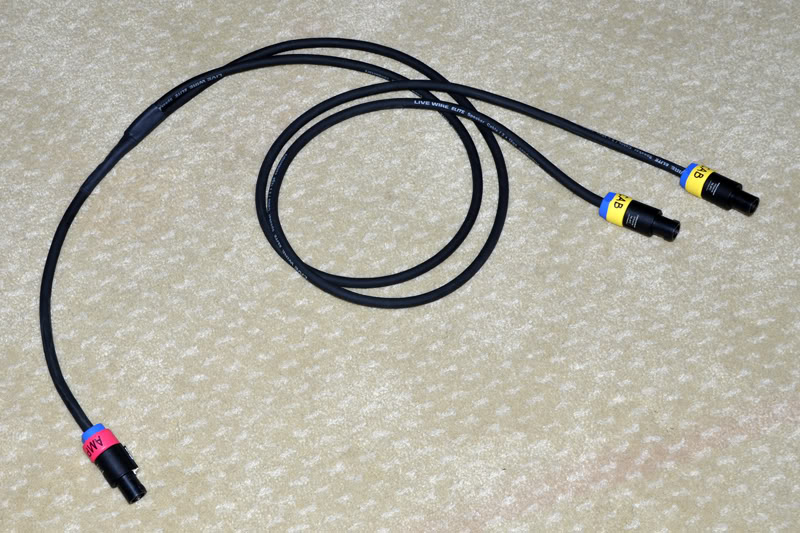
Not possible, even with trouble. The series cable idea is a pretty good one, though. Here's a schematic and a picture of one. If you're using Speakon® plugs, tip=1+ and sleeve=1-.

Sorry for the late, really late delay in getting back to you. I use a Genz Benz shuttle 9.0 it makes 900watts @4ohms and 500 watts @8 ohms.

- Feb 12, 2006
- 61,030
- 5
- 220,912
- Disclosures
- Development Engineer-Mesa Boogie, Development Engineer-Genzler (pedals), Product Support-Genz Benz
Sorry for the late, really late delay in getting back to you. I use a Genz Benz shuttle 9.0 it makes 900watts @4ohms and 500 watts @8 ohms.
Your amp is capable of operating into a minimum 4 ohm load.
Your best bet is to find a more suitable speaker cabinet combination.

Your amp is capable of operating into a minimum 4 ohm load.
Your best bet is to find a more suitable speaker cabinet combination.
+1 I agree with both statements. The rig you describe is not an optimal pairing for several reasons, but the biggest reason is the impedances of your drivers just don't give you many good choices.
I also can not help but respectfully recommend you read up on mixed driver rigs. A subject that is regularly argued here on TB but that has a clear answer if you are willing to listen. The arguments persist because many bassists listen with their eyes and not their ears, or don't like being told that their expensive mixed driver rig could sound much better than it does, or don't consider physics to be relevant to bass playing...

I like the idea of building the series cable the best. 500 watts to 2-12's and a 15 would be plenty for any situation. Not to mention, the series cable is a lot cheaper than buying a new cab.
Here we go again on the mixed driver thing. Wow!
the series cable is much easier...
- Feb 12, 2006
- 61,030
- 5
- 220,912
- Disclosures
- Development Engineer-Mesa Boogie, Development Engineer-Genzler (pedals), Product Support-Genz Benz
+1 I agree with both statements. The rig you describe is not an optimal pairing for several reasons, but the biggest reason is the impedances of your drivers just don't give you many good choices.
I also can not help but respectfully recommend you read up on mixed driver rigs. A subject that is regularly argued here on TB but that has a clear answer if you are willing to listen. The arguments persist because many bassists listen with their eyes and not their ears, or don't like being told that their expensive mixed driver rig could sound much better than it does, or don't consider physics to be relevant to bass playing...
If the cabinets are from our company, they have been designed from the ground up to be compatible between driver sizes. The phase response and relative sensitivities are compatible by design.
Not knowing what cabinets the OP has, I can not provide more accurate information.
With all due respect sir I believe your company has done its best to make a bad idea work. That doesn't mean it is now a good idea.

With all due respect sir I believe your company has done its best to make a bad idea work. That doesn't mean it is now a good idea.
If it sells and people like it, is it still a bad idea?

- Feb 12, 2006
- 61,030
- 5
- 220,912
- Disclosures
- Development Engineer-Mesa Boogie, Development Engineer-Genzler (pedals), Product Support-Genz Benz
With all due respect sir I believe your company has done its best to make a bad idea work. That doesn't mean it is now a good idea.
It also does not mean that it violates any laws of physics.
IMPO, the entire (poplular) argument against mixing driver sizes has ignored much of the math, analysis and testing. When the design provides acceptable analysis results and phase coherency, offers no negative artifacts and customers like how they sound, why is this so bad. In fact, if you were to participate in a double-blind listening test, you would not be able to identify a mixed size pair of cabinets... confirming that the myth is generally stronger than fact when I have been involved in such tests.
Before you suggest again that I read up on the subject and learn something, you should be aware that I am an EE, I understand the math, and have many, many years of experience in commercial speaker design, transducer development as well as DSP algorithems. This is not my first rodeo
 .
. Also note that my comments assume a proper design using like topology cabinets (ie. not combining a sealed box with a ported box, etc.) where a common response family between driver sizes was a specific design approach and not just happenstance.
I understand people have strong feelings , but TRY to keep it civil bassmeknik. Insulting people and thier professional credentials only hurts your case.


father of fires
Commercial User
Holy crap people. Take that **** elsewhere.
The series cable is your best bet.
You could sell both cabs for one nice one too.
Also...the only thing BFM ever said is that mixing speakers can have unexpected results.
A properly designed system can make use of multiple speaker sizes. And yes...you can design a 15 for strong lows and you can design a 10 for fast highs.
The series cable is your best bet.
You could sell both cabs for one nice one too.
Also...the only thing BFM ever said is that mixing speakers can have unexpected results.
A properly designed system can make use of multiple speaker sizes. And yes...you can design a 15 for strong lows and you can design a 10 for fast highs.


