• TalkBass has been independent since 1998. Add your voice.
    Create a free account to reply to discussions, view embedded media, and browse with fewer display ads.
    Join freeLog in
    Want zero display ads or expanded classifieds tools? Compare plans.

4 strings only?

That's different, starting out with a 6er and all. If I started with one, I would've probably quit! I can't stand the feel of a 6!

There are a lot of six-strings that I can't stand the feel of either. The thing to remember is that the more strings you add, the more the little nuances of how a bass is built start to show themselves. A narrow nut and a wide nut may not make too much of a difference in feel on a four-string, but may make a six-string either comfortable or completely unplayable. You usually have to try a lot of different sixes before you start to find what is comfortable.
 
Oh c'mon guys.......ya mean ya don't like those 17 string basses?

I was thinking of making an 89 string bass, but I didn't have enough wood, so I had to settle for a 63 string bass. It rocks! I like to take it over to the nearest Guitar Center and sit in the bass section and slap and pop it all day long, hoping that I will impress someone. I still can't figure out why I never get asked to be in anyone's band.

numbers of strings divisible by 9 are generally looked down upon in the music world.
 
Who out there owns only 4-string basses?

I own only 4 strings just because I love 'em. I'm not docking 5+ stringers, they just aren't for me. I love the feel of a four.

So do any of you own only 4 bangers?

It's a good thing you have a supply of them. So many people have switched to 5-strings that most manufacturers are going to stop producing fours, including Fender.
 
It's a good thing you have a supply of them. So many people have switched to 5-strings that most manufacturers are going to stop producing fours, including Fender.

I do not think that will ever happen. 4-string basses greatly outnumber 5- and 6-string basses.

Case in point: I did a search for various bass types offered by a popular music shop site I like to shop from, and these are the results:

4-string basses -- 449 different models
5-string basses -- 203 different models
6+ string basses -- 33 different models

I also checked the top 20 bestselling basses this site offers, and only ONE of them was a 5-string; the rest were 4-string. And among these top sellers are the Fender P, J, and Jag basses, the Hofner Violin bass, the Rickenbacker 4003, and the Thunderbird IV. Expand the list to the top 40 bestselling basses they offer, and you get a total of only FOUR 5-strings and TWO 6-strings.

I think that blows your whole theory out of the water.
 
I do not think that will ever happen. 4-string basses greatly outnumber 5- and 6-string basses.

Case in point: I did a search for various bass types offered by a popular music shop site I like to shop from, and these are the results:

4-string basses -- 449 different models
5-string basses -- 203 different models
6+ string basses -- 33 different models

I also checked the top 20 bestselling basses this site offers, and only ONE of them was a 5-string; the rest were 4-string. And among these top sellers are the Fender P, J, and Jag basses, the Hofner Violin bass, the Rickenbacker 4003, and the Thunderbird IV. Expand the list to the top 40 bestselling basses they offer, and you get a total of only FOUR 5-strings and TWO 6-strings.

I think that blows your whole theory out of the water.

I think you failed to see his sarcasm


Anyway, anything with more than 4 strings, active electronics, coffee table tops, and everything that's less than 50 years old by designs simply are not good and those bassists suck. It's true and all non-Fenders will not sit in the mix.
 
This guy's in and knows no one gives a crap.

I've owned two fivers in the past... one with a low B, the other with a high C.

Based on the results, if I were EVER to go back to a five... (which I NEVER will) I would go with a high C setup.

I love 4's, and as previously mentioned multiple times, I have found nothing so far in my taste range that calls for anything more than a 4... plus, I started on one... so, it's a home sweet home kinda deal/feel.

Party on guys... Happy Bassin' and Happy Holidays!! :bassist:
 
I have an opinion I would like to share:

I think that if you feel you NEED more than 4 strings, you're either doing something wrong, or you should be a "lead bassist."

Reasons:
1) The range of a standard 4 string is 3 octaves, E (open)-E (21st fret on G). This will give you at a 2 two octave range for any key you play in, no problem. Most stringed instruments in an orchestra will have a similar range. (With a couple of exceptions)

2) Since most melodies only range within an octave to octave and a half, you should have no problems keeping up with providing harmonic structure and counterpoint.

3) Most, if not all, metal bassists I have seen who play 5 strings, don't need the extended range so much as they need the 35 in. scale so they can down tune/ drop tune. I never see them use the G string unless they are doing some kind of solo work. Still not that common in metal.

4) The extended range issue can be fixed by tuning the bass to 5th's. It is similar in scale to a cello, so this would be fairly easy to achieve. Plus, you only get an extra fourth anyhow, so the utility is questionable.

5) Many, many very great bass players can eek out some great stuff on only 4, even when playing "lead" work. This tells me that the bass, though only 4 strings, is still a very flexible instrument.

6) Never carry what you don't need. If you're not doing some crazy Claypool stuff, or some Jeff Shcmidt insanity, the extra strings don't really add anything but bulk to your instrument. So if you're doing structure and counterpoint work, the extra bulk will present more technical challenges than a bass player really needs.

7) If you really want the thunder of a low B, you can get plenty of balls with a good low boost at 40Hz, or a sub-octave pedal that's dialed in just right. Or both!

P.S. Keep this in mind: I learned how to play bass on a 6 string. Queer way to start, eh?
 
1) The range of a standard 4 string is 3 octaves, E (open)-E (21st fret on G). This will give you at a 2 two octave range for any key you play in, no problem. Most stringed instruments in an orchestra will have a similar range. (With a couple of exceptions)

You are aware that the 5 string with low B has been in doublebass form for well over 100 years right? And a LOT of classical bassists use C and B extensions right?
 
That was why I said things like "standard" and "a couple of exceptions." Because I was just musing my opinion as a general thing.

But I still wonder if they would have done the extentions if they had amplification. Or to put it another way, was the idea of the extension to extend the range to play more easily in certain keys, or to get more resonance out of the room since the lower frequencies would more closely match the room's resonant frequency? I'd love to know. I have been curious about that.
 
I have an opinion I would like to share:

I think that if you feel you NEED more than 4 strings, you're either doing something wrong, or you should be a "lead bassist."

Reasons:
1) The range of a standard 4 string is 3 octaves, E (open)-E (21st fret on G). This will give you at a 2 two octave range for any key you play in, no problem. Most stringed instruments in an orchestra will have a similar range. (With a couple of exceptions)

2) Since most melodies only range within an octave to octave and a half, you should have no problems keeping up with providing harmonic structure and counterpoint.

3) Most, if not all, metal bassists I have seen who play 5 strings, don't need the extended range so much as they need the 35 in. scale so they can down tune/ drop tune. I never see them use the G string unless they are doing some kind of solo work. Still not that common in metal.

4) The extended range issue can be fixed by tuning the bass to 5th's. It is similar in scale to a cello, so this would be fairly easy to achieve. Plus, you only get an extra fourth anyhow, so the utility is questionable.

5) Many, many very great bass players can eek out some great stuff on only 4, even when playing "lead" work. This tells me that the bass, though only 4 strings, is still a very flexible instrument.

6) Never carry what you don't need. If you're not doing some crazy Claypool stuff, or some Jeff Shcmidt insanity, the extra strings don't really add anything but bulk to your instrument. So if you're doing structure and counterpoint work, the extra bulk will present more technical challenges than a bass player really needs.

7) If you really want the thunder of a low B, you can get plenty of balls with a good low boost at 40Hz, or a sub-octave pedal that's dialed in just right. Or both!


I have a two-word answer that actually rebuffs all of your points perfectly:
Anthony Jackson
:)

Simple answer, but he does it. But to be more specific:
1. Covering a 3-octave range presents far more technical difficulty on a 4 than on a 6. A 6 also gives you a greater range, and to be frank, who cares what range other instrumentalists use- unless your plan is to play their music rather than write your own that is.

2. If you're only worried about providing harmonic or melodic playing within a 1 to 1 1/2 octave range, then you really only need a one-string bass. Pianists only need 18 keys. Etc. Or you could just rid yourself of the arbitrary limits that someone else places on you and play the notes you want to play. Imagine if someone came on the forum telling you that you're doing it wrong because you play with a four-string rather than a one-string :) Your idea also implies again that you're playing someone else's music rather than your own.

3. Okaaayyy...how the metal players you've seen play their basses doesn't have much to do with anything, including the metal bassists on TalkBass that DO utilize all of their strings.

4. If you're focusing solely on the extended note range that an extended range bass offers, then you're missing most of the picture. Not only will tuning in 5ths make playing more difficult due to the extended reaches you would have to make, but it would not offer the ease of transitions a 5/6/7/etc. offers, it will not offer the different note tones you get by playing the same notes on different strings, it will not give you the extra harmonics, etc. The list goes on.

5. Most guitarists could probably eek out great stuff with only three strings. I've heard soulful sax solos that only use four notes. Does that mean they should limit any further flexibility? Mark Sandman did a great job in Morphine using only a two-string bass. Are you ready to cut off two strings on your basses from now on?

6. That's kind of a silly statement- if someone is using their extra strings just for craziness, then they simply don't know how to play their instrument. If they can't work the extra strings into their regular playing, then it is their failure as a player, not a failure of the instrument. It would also mean that most pianists are doing it wrong in your opinion, because most pianists won't hit a fair portion of their keyboard during a set.

7. Boosting the 40hz range will not transform an E to a B, or any other note for that matter. An octaver also does not sound the same as the actual note- I've owned several analog and digital octavers and can attest to that.


P.S. Keep this in mind: I learned how to play bass on a 6 string. Queer way to start, eh?

Definitely an uncommon way to start. Unfortunately, from your post, it shows that you never learned its functionality in a musical sense at all. Playing a six and finding it doesn't work for you or offers you options you don't need is fine. Thinking those options aren't necessary for others is not.
 
Once you get hooked on a 5 string bass playing a bass without a low B is like you 4 string players removing your E string. Any 3 string bass players out there? 50 years ago pretty much 100% of the basses were 4 stringers. 25 years ago 90% of the basses were 4 stringers. Today more and more 5, 6, 7 and more stringed basses are out there. ANY serious professional bass player HAS to have at least one bass with extended range simply because there are songs that REQUIRE it.

What will the percentage of 4 string basses be 25 or 50 years from now? More and more players are buying basses with more than 4 strings. I don't think that 4 string basses will go away but the 5 will continue to gain ground.

The truth is the low D just sounds so damn good and so much music requires it that we as bass players need to have that note on our bass neck. And playing the higher D and turning up the bass does not sound the same.
 
The average bassist -- and I mean average in the pedestrian/everyday sense rather than the level of skill -- really only NEEDS 4 strings. Unless you really MUST have a low B and/or a high C, a 5th, 6th, or more strings (and other nontraditional bass hardware, for that matter) are simply a matter of preference. I'm sure Les Claypool can rock a fretted 4-stringer just as hard as he can a fretless 6-string with a whammy bar; he simply prefers a 6th string because he feels he can get more mileage out of it based on his technique.

Myself, by contrast, I wouldn't even know what to do with a 5-string even if my hands were big enough for the added neck width, and I feel the same way about 7-string electric guitars.

But I don't think you really need a 5th or 6th string to be considered a good bassist. Rather than buy a 5-string, a friend of mine downtunes his E string when he absolutely must get a note that low. Me, I just transpose any notes that would fall on the B-string up an octave, and people can't tell the difference. I even played a song with octaved notes like this, and the drummer I was playing with recognized the tune immediately regardless.

Basically it all boils down to player preference, because the audience probably won't tell a different one way or another. Some people who do B/W line art illustration like using a quill pen, and others like using a brush, yet the average person can't tell what tool was used. Same destination, different ways of getting there.
 
started on a four
moved to a 5
moved back to only fours
recently bought a 6, and own a 5,
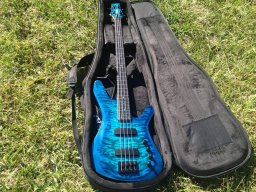
but lately I'm feeling that I don't really need anything but one 4.

This one:

spector7.JPG
 
Count me in. I think the next bass I'm going to get will be a 5 string (probably an L2500, be it a Tribute or a used USA), mainly because I need to learn how to use one. However, I just can't get around the feel of the 5 stringers, regardless of make or model.

But yeah, currently I'm 4 strings only.