• TalkBass has been independent since 1998. Add your voice.
    Create a free account to reply to discussions, view embedded media, and browse with fewer display ads.
    Join freeLog in
    Want zero display ads or expanded classifieds tools? Compare plans.

4001 Mashup

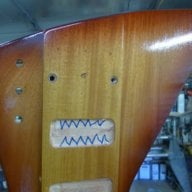
I think you should probably plug the tuner holes, veneer the headstock, and drill it as a 3+2 instead of a 2+3 headstock. The tuner bushing is going to hang over your truss rod access, and there will definitely be problems with a truss rod cover.

I tried doing the 3+2 layout during the design phase. It wasn't happening as I couldn't get the straight string paths. But you're right about the truss rod cover. That won't happen in its current state.
 
34y4h34.jpg


Close up of the headstock with the G tuner installed. I'll think about it for now, but I think it'll be more trouble to try to "fix" it, than just leaving it as a learning experience.
 
I clamped the bridge in place to check string height. @Gilmourisgod got me nervous.

xauyhz.jpg


No frets yet obviously, but seems ok with plenty of adjustment left.

f52hds.jpg


I did a little more general shaping on the headstock and neck/body transition. Still much left to do but coming along.

I also ordered fret wire - 2 different sizes, one for the zero fret and one for the rest, and side markers and dot fret markers. Shipped on Friday, should be here at the end of next week.
 
  • Like
Reactions: Gilmourisgod
I think you should probably plug the tuner holes, veneer the headstock, and drill it as a 3+2 instead of a 2+3 headstock. The tuner bushing is going to hang over your truss rod access, and there will definitely be problems with a truss rod cover.

Next time you might consider using Hipshot 3/8" tuners, they require smaller holes in the headstock. I'd also be concerned how little wood is left in the G string tuner/ trussrod access route area. Other than that, KILLER!
 
  • Like
Reactions: mapleglo
Looks like someone just got a router table ;)

Great idea!

Next time you might consider using Hipshot 3/8" tuners, they require smaller holes in the headstock. I'd also be concerned how little wood is left in the G string tuner/ trussrod access route area. Other than that, KILLER!

Thanks, yeah, it does seem a little thin there. I think I'll leave the volute pretty thick, in an effort to compensate.

jq1hg0.jpg
 
  • Like
Reactions: JIO and Dadagoboi
Did a little more work on the neck.

2607crm.jpg


Getting there. A few more rasping sessions I think. Though I do wish I had a more aggressive rasp...

And those red splotches toward the left of the work bench - I guess they appeared when the jig saw smashed my left pointer finger the other day. Ouch.

And the fret wire and dot markers arrived from LMII.

38vav.jpg


A little smaller than I expected, but I think they'll work. I didn't realize they are in California. Next business day delivery. I think I'll be ordering more from them.
 
  • Like
Reactions: JIO
Great idea!
Thanks, yeah, it does seem a little thin there. I think I'll leave the volute pretty thick, in an effort to compensate.
jq1hg0.jpg

Well, it's not orthodox - but as long as it achieves the goal. Same with the front G placement… just an area to get creative with. (as far as the cursed trc!) :bag:
 
  • Like
Reactions: mapleglo
2ev6rva.jpg


My first "inlay" attempt :p I can't wait to do the side markers. I might even start the radius on the fretboard.

I already see an advantage of that heal-hump; you can lay the bass down and it rests on it, and not the tuners which saves them from being whacked out of tune. :thumbsup:

Also - positioning of fb dots is harder than it looks, especially if they are closer to each other (12th/24th frets) wood grain can minutely shift the bit, resulting in a close but just-off pairing. Looks like you had smooth sailing on maple.
 
  • Like
Reactions: mapleglo
I already see an advantage of that heal-hump; you can lay the bass down and it rests on it, and not the tuners which saves them from being whacked out of tune. :thumbsup:

Also - positioning of fb dots is harder than it looks, especially if they are closer to each other (12th/24th frets) wood grain can minutely shift the bit, resulting in a close but just-off pairing. Looks like you had smooth sailing on maple.

I'm actually beginning to like the heal-hump as it also helps to keep the fretboard level. I hadn't thought about the whacked out of tune issue. The dot positioning did come out pretty well. I measured carefully, and used an awl to start each hole, which helped prevent the drill bit from wandering. Misaligned dots would have played havoc with my OCD.
 
  • Like
Reactions: Robert Canfield
Maple,
Do you have a sense for how much wood is left between the bottom of trussrods and back of neck? I'm really paranoid about my double-action rod blowing out the back of the neck. The figure I keep seeing as minimum safe distance is about 3/16". This leaves me with a neck thickness somewhere between 7/8" and 1" neck thickness at the first fret. I'd shave another 1/16" off if I thought it was safe.
 
Maple,
Do you have a sense for how much wood is left between the bottom of trussrods and back of neck? I'm really paranoid about my double-action rod blowing out the back of the neck. The figure I keep seeing as minimum safe distance is about 3/16". This leaves me with a neck thickness somewhere between 7/8" and 1" neck thickness at the first fret. I'd shave another 1/16" off if I thought it was safe.

The neck is just about 7/8" thick, and I was careful not to take that down during shaping. The fretboard is about 1/4" thick, the truss rods are about 3/8" thick, which leaves about 1/4" on the back side between the bottom of the truss rods and the back of the neck.

I'm going with a 10" radius on the fretboard, so that will thin the top a little, and final sanding on the back may bring it down another 1/16th or so. I'm hoping that'll be ok. The neck feels nice now, though I wouldn't mind it being just a tad thinner. Like you, I don't want to thin it down too much more, for the same fears you have.