
So adding a 1x15 to a 4x10 is less effective than adding another 4x10.
It's also less effective on my back.

TalkBass has been independent since 1998. Add your voice.
Create a free account to reply to discussions, view embedded media, and browse with fewer display ads.
Join free Log in
Want zero display ads or expanded classifieds tools? Compare plans.
So adding a 1x15 to a 4x10 is less effective than adding another 4x10.
I may be missing what your asking, but the larger the speaker, the farther back the audience needs to be to hear it properly. And 10's with 15's sounds killer. Even some 12's thrown in there to boost up the mids fits into the mix quite well.
Really? I don't know about the audience, but it seems I have to be farther away from my rig to hear myself when I am using 10's. I bought an Eden 15 XLT last year and I feel I'm able to hear myself better when I am close to the cabinet as compared with the 2x10 cab I used to use.
That may well be, but it has nothing to do with the size of the driver in and of itself.Really? I don't know about the audience, but it seems I have to be farther away from my rig to hear myself when I am using 10's. I bought an Eden 15 XLT last year and I feel I'm able to hear myself better when I am close to the cabinet as compared with the 2x10 cab I used to use.
Oh, just play the damn bass already, people
Its only rock'n'roll...

Oh sure, no doubt. And in fairness, I've also heard vice versa. I think it's good that people know these things in order to make a more educated decision about what they buy. So if you're bummed about off axis response or phasing, or just not getting the sound you want in general, you can either do something about it, or if you're like me, choose to ignore itAnd I'm sure it sounds great. I will again post that the issues of beaming, comb filtering, etc. are just a SMALL part of what makes a cab sound good or bad. I have both vertically aligned 212 cabs and 410's, and the dispersion differences in the upper mids both on stage and out in the room is trivial IMO and IME.
Would you rather have a 'vertical stack' that sounds like dog, or a 410 that sounds gloriousTrust me, I've heard both.

I think this quote may have been misinterpreted. I think the OP's concern is the head being off balance at a height like that.
____.....one small push, or anything off balance would send the head tumbling down. dig?
[____]
| |
| |
| |
| |
that's what's made me nervous about stacking stuff high & thin like that...not about looks, more concern for my head than anything.
The 15/6 is typified by the barefaced cabs, or fEarfuls. It's a 3015LF (high displacement woofer, good from 40-1000hz up to around its full 450 watts) coupled with a high output midrange (Beyma 605nd or 18 sound 6nd410), crossed over usually around 600-800hz with a sturdy crossover (or a rack crossover, whichever).
You can add a horn or not.
In a sufficiently sized box (4cf or so) you can get a -10db point of around 35hz, and go up to 6+khz with very even frequency distribution, higher with a horn.
You get up around 125db maxspl out of a 45lb box, good down to 40hz (real, not imagined). An Ampeg Fridge is rated to 130db or so, which is significantly louder, but weighs close to 4 times as much, and rolls off drastically (-10 db at 60hz or so probably).
A six has far better midrange dispersion than a woofer, so it will be heard much better than a woofer at the same height. But it won't be heard as well as the top woofers in an 8x10, and a single point source can't duplicate the radiation pattern of the line source that an 8x10 presents in the upper mids.Looks interesting. Is the dispersion good enough that it doesn't matter that the speaker is at knee level?

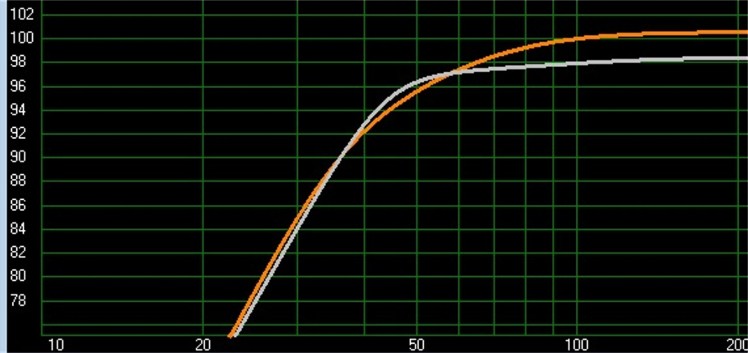
The rationale behind using a 1x15 and 4x10 is that the 1x15 goes lower and will give more bottom. In a word: Bull. This chart shows the frequency response of two 6 cu ft cabs, one loaded with a 2515, the other with four 2510 drivers. The 1x15 (grey trace) goes a bit lower, but barely measurably so, absolutely inaudibly so.
Now look at what really counts, both cabs driven to full power:
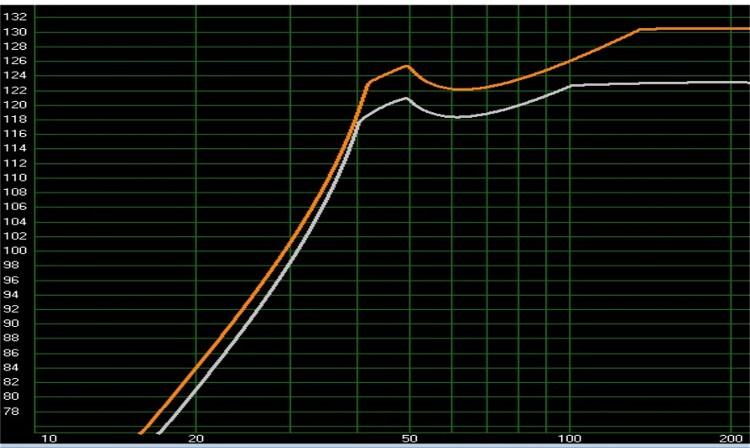
The 4x10 is louder and lower than the 1x15.
So adding a 1x15 to a 4x10 is less effective than adding another 4x10, and when you factor in the different phase responses of the two that results in them fighting each other as much as helping each other it's a poor combination.
And yes, many thousands of players have used this combination for decades. Why? Because they didn't know any better. Now you do.
Not that this absolves the 4x10 of the engineering sin of mounting drivers side by side, but a pair of vertical 2x10s, three if you mustcures that.
You're telling Bill this? The guy who has said that exact thing about 4x a week in the last year? And he's referring to your average commercial cabs with commonly found speakers with these charts.Nice charts, but nowadays the limiting factor on maximum output is almost always cone displacement. For the price of four S2010's, you can buy a 3015LF and save $100. The 3015 can displace about 846 mL, whereas four S2010's can only displace 560 mL. The 3015 would also be happier in a smaller box than four s2010's, which is nice when you have limited space to haul gear in your hatchback.

Nice charts, but nowadays the limiting factor on maximum output is almost always cone displacement.
The 3015LF can displace about 846 mL, whereas four S2010's can only displace 560 mL. The 3015LF {...}

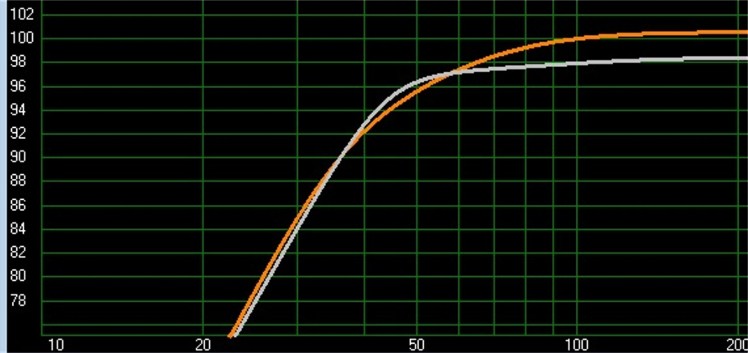
The rationale behind using a 1x15 and 4x10 is that the 1x15 goes lower and will give more bottom. In a word: Bull. This chart shows the frequency response of two 6 cu ft cabs, one loaded with a 2515, the other with four 2510 drivers. The 1x15 (grey trace) goes a bit lower, but barely measurably so, absolutely inaudibly so.
Now look at what really counts, both cabs driven to full power:
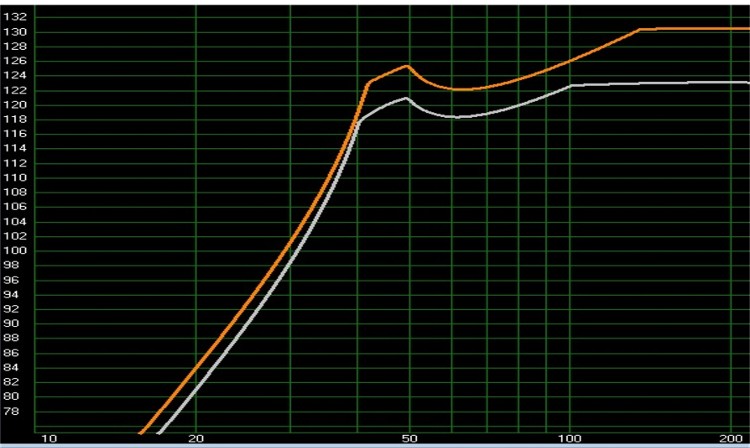
The 4x10 is louder and lower than the 1x15.
So adding a 1x15 to a 4x10 is less effective than adding another 4x10, and when you factor in the different phase responses of the two that results in them fighting each other as much as helping each other it's a poor combination.
And yes, many thousands of players have used this combination for decades. Why? Because they didn't know any better. Now you do.
Not that this absolves the 4x10 of the engineering sin of mounting drivers side by side, but a pair of vertical 2x10s, three if you must

You're telling Bill this? The guy who has said that exact thing about 4x a week in the last year? And he's referring to your average commercial cabs with commonly found speakers with these charts.

Sorry...I didn't know Ampeg was the only company that made cabsI'm sorry, I didn't know Ampeg had started using Deltalites in their cabinets.