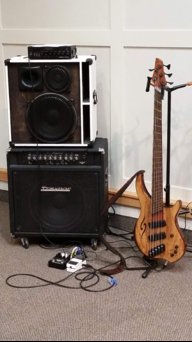
So if 15s move slower, does that mean I'd have to tune higher if I'm playing through 15s and another guy's playing through 10s?...15's move more slowly and have more bottom than 10's...

TalkBass has been independent since 1998. Add your voice.
Create a free account to reply to discussions, view embedded media, and browse with fewer display ads.
Join free Log in
Want zero display ads or expanded classifieds tools? Compare plans.
So if 15s move slower, does that mean I'd have to tune higher if I'm playing through 15s and another guy's playing through 10s?...15's move more slowly and have more bottom than 10's...


So if 15s move slower, does that mean I'd have to tune higher if I'm playing through 15s and another guy's playing through 10s?

No wonder everyone on here says mixing cabs is bad.No, it means you have to play slower. It won't keep up with fast notes. If the other guy is playing 10's then you have to play ahead of the beat.
No, it means you have to play slower. It won't keep up with fast notes. If the other guy is playing 10's then you have to play ahead of the beat.

No, it means you have to play slower. It won't keep up with fast notes. If the other guy is playing 10's then you have to play ahead of the beat.
Also I'm using a Traynor 15+2x10(TC1510) cab right now. Talk about mixed drivers aside, I like how it sounds, I'm just not sure if it can fill a medium sized venue by itself.



210 157.08
112 113.09
212 226.19
115 176.71
210+112 270.17
210+212 383.27
410 314.16
210+410 471.24
Basic area calculations. All things being equal more speaker area = more volume. Of course all things are never equal but it should give you a starting point. Double the 212 and 115 to get your 412 and 215 areas.
 )...
)... . ***Bill Paxton's voice as Hudson in Aliens on*** "Game over, man!" ***Bill Paxton's voice as Hudson in Aliens off***

210 157.08
112 113.09
212 226.19
115 176.71
210+112 270.17
210+212 383.27
410 314.16
210+410 471.24
Basic area calculations. All things being equal more speaker area = more volume. Of course all things are never equal but it should give you a starting point. Double the 212 and 115 to get your 412 and 215 areas.
That is a great looking cabinet ! 103dB is a very high value for its sensitivity.
 . Almost certain they use a version (maybe even stock) of the 15PR400. If not, the Faital, then the Eminence 3015. 103 dB SPL would be exactly right for 2 of them.