“A 4x12 cabinet typically features four 12” speakers”. Well, no s***, AI.For a definitive answer, I asked the algorithm:
The choice between using a 4x10 speaker cabinet or a 4x12 speaker cabinet for bass or guitar is influenced by several factors, including the sonic characteristics of each setup and the specific needs of the musician. Here are some general considerations:
4x10 Speaker Cabinet for Bass:
4x12 Speaker Cabinet for Guitar:
- Surface Area: A 4x10 cabinet has four 10-inch speakers, providing a larger total surface area compared to a single 12-inch speaker. This allows for moving more air and producing a fuller low-end response, which is crucial for bass frequencies.
- Midrange Punch: 10-inch speakers often have a strong midrange punch, which can enhance the clarity and articulation of bass guitar tones.
- Portability: Compared to a 4x12 cabinet, a 4x10 cabinet is generally more compact and lighter, making it easier to transport.
It's essential to note that these are general trends, and individual preferences play a significant role in choosing speaker cabinets. Musicians often experiment with different configurations to find the combination that best suits their playing style and sonic preferences. Additionally, advancements in speaker design and technology have led to a wider variety of options for both bass and guitar players.
- Dispersion and Projection: A 4x12 cabinet typically features four 12-inch speakers, which can provide a wider dispersion and projection of sound. This is advantageous for guitarists who want their sound to fill larger spaces or to cut through a mix in a band setting.
- Full Range: While guitar doesn't require as much low-end response as bass, a 4x12 cabinet still offers a full range of frequencies. The larger speakers can handle the low end well while providing a well-rounded sound across the spectrum.
- Power Handling: 4x12 cabinets often have a higher power handling capacity, allowing guitarists to use high-wattage amplifiers without worrying about damaging the speakers.
- Iconic Sound: The 4x12 cabinet has become iconic in rock and metal genres, and many guitarists associate it with a classic, powerful sound. This historical influence has contributed to its popularity in guitar setups.

Enjoy the benefits of a premium membership!
Upgrade Account
-
TalkBass has been independent since 1998. Add your voice.
Create a free account to reply to discussions, view embedded media, and browse with fewer display ads.
Join free Log in
Want zero display ads or expanded classifieds tools? Compare plans.
You are using an out of date browser. It may not display this or other websites correctly.
You should upgrade or use an alternative browser.
You should upgrade or use an alternative browser.
4x10 and 4x12
- Thread starter themickster
- Start date
More options
Who Replied?Is that Bun E. Carlos on drums and Ron Mael on guitar?Even longer…
View attachment 5286903 View attachment 5286904
(Even though he’s in the back and obscured, that’s Billy Joel on keyboards)

I think the answer likely is due to the technology available at the time, driver capabilities, cabinet volume (cubic size) requirements, etc.
Take the ‘59 Fender Bassman guitar amp for example. It had a 4x10 speaker arrangement. Cabinet depth was 10”, and open back to boot.
Marshall’s renowned 4x12 guitar cabinet has a depth of 14” (and a closed back). For guitar application, cabinet depth was not as necessary.
For bass guitar however, cabinet depth became a science. Ampeg’s 8x10 fridge was 16” deep. Realizing the depth required for proper bass amplification, makers wanted to optimize the front speaker baffle. Using smaller drivers allows you to fill more of the speaker baffle. (just think of the coverage you’d get using 2” speakers!) So there’s a trade off in speaker size, capability, cabinet depth requirement, and finally practical packaging to allow customers to actually transport these cabinets.
Hence why maybe a guitar cab could have a wider 4x12 footprint, or stack 2 cabs for more volume, because they didn’t need to be as deep, and the magnets didn’t need to be as heavy as bass speakers. Meanwhile, Marshall probably discovered trying to make a similar 4x12 cab for bass just bumped the cabinet size too big for practical purposes, and stacking two was really not practical. (heavy!!)
Of course today with more modern tech and more knowledge, companies can design cabs in any configuration and come out with a result that meets the criteria - though I’m guessing the old 4x10 cab still works, and is a cheaper solution to Phil Jones cabs or other more complicated designs. Price is still a factor when selling to customers!
So that’s my theory of the evolution of speaker cab design. I’m sure we’ll progress further in the next 40 years and have smaller, lighter cabs that handle more power and have higher volume.
Take the ‘59 Fender Bassman guitar amp for example. It had a 4x10 speaker arrangement. Cabinet depth was 10”, and open back to boot.
Marshall’s renowned 4x12 guitar cabinet has a depth of 14” (and a closed back). For guitar application, cabinet depth was not as necessary.
For bass guitar however, cabinet depth became a science. Ampeg’s 8x10 fridge was 16” deep. Realizing the depth required for proper bass amplification, makers wanted to optimize the front speaker baffle. Using smaller drivers allows you to fill more of the speaker baffle. (just think of the coverage you’d get using 2” speakers!) So there’s a trade off in speaker size, capability, cabinet depth requirement, and finally practical packaging to allow customers to actually transport these cabinets.
Hence why maybe a guitar cab could have a wider 4x12 footprint, or stack 2 cabs for more volume, because they didn’t need to be as deep, and the magnets didn’t need to be as heavy as bass speakers. Meanwhile, Marshall probably discovered trying to make a similar 4x12 cab for bass just bumped the cabinet size too big for practical purposes, and stacking two was really not practical. (heavy!!)
Of course today with more modern tech and more knowledge, companies can design cabs in any configuration and come out with a result that meets the criteria - though I’m guessing the old 4x10 cab still works, and is a cheaper solution to Phil Jones cabs or other more complicated designs. Price is still a factor when selling to customers!
So that’s my theory of the evolution of speaker cab design. I’m sure we’ll progress further in the next 40 years and have smaller, lighter cabs that handle more power and have higher volume.
The B25 rig(55 watts)was roughly the equivalent/rival to the Fender Bassman with the larger upright 2x12, then 2x15, cab. It too was fairly shallow.

yes because the 15 wasn't loud enuff.. the bassman was one of the first 4x10sIIRC the first version was a 1x15 then the revised version was a 4x10

For bass guitar however, cabinet depth became a science. Ampeg’s 8x10 fridge was 16” deep. Realizing the depth required for proper bass amplification, makers wanted to optimize the front speaker baffle. Using smaller drivers allows you to fill more of the speaker baffle. (just think of the coverage you’d get using 2” speakers!)
If you do the math, the theoretical "coverage" using circular drivers on a rectangular baffle is independent of driver size - pi divided by 4 (the area of a circle inside a square is the same ratio of area regardless of size) is the best you can do in a rectangular array, no matter what size the drivers are. Practically speaking, as drivers get smaller, less of their overall area as a percentage is moving diaphragm - making the surround smaller and smaller is not practical, so four 5 inch drivers will usually have less moving cone area than a 10 inch driver (both strategies taking up the same baffle space) - things get worse as you get smaller, not better. You can (in theory) gain a bit if you use different sized drivers - filling in the gaps between big drivers with a few little ones, but again, practically speaking, that's not going to gain you anything in the low frequency region.

Nah, but they look like refugees from Spanky and Our Gang…Is that Bun E. Carlos on drums and Ron Mael on guitar?
The savvy bass players in that time would use Dual Showmans with 85 watts(!). Then Kustom and Sunn came along, then Acoustic, and then Ampeg upped their game.I’ve wondered the same seeing late 50’s to mid 60’s bands with Fender backlines where the guitarists have 2x15 cabs and the bassist a 2x12.

I’m not sure how Lemmy is even relevant to the question though.
Especially considering he didn't think of himself as a bass player and wasn't looking for a low-end sound. Using Marshalls made it easier for him to get the mid-rangy distorted sound he was after, and the cabs went with them, I guess.
Sorta like the internet.That’s a problem with AI, If it’s fed data that isn’t valid, what you get out is no better. Garbage in, garbage out. We ought not quote it as factual.
Sorta like the internet.
We humans are in charge of the internet. If we decide that is should be factual, it can be.
Ahh yes, the infamous ‘pyramid’ cab…4-10 came first…late 1950s Fender Bassman combo. 2-10 combos for bass were around in the 1960s.
4-12 arrived in the USA with Marshalls, US guitar stacks of the 60s were 2-12, 2-15, 3-15 (Kustom), 3-12 (Sunn).
Fender made a monster 4-12 front loaded horn cabinet for the Bassman 100 amp. I owned one of these, driving it with a 50 watt Bassman. I wondered why I got such a good deal on it ($180 used), well after moving that sucker around enough I figured it out
View attachment 5286984
The SVT of course was 8-10 and the 4-10 cabs (Hartke was the first as I recall, followed soon after by SWR) of the 1980s descended from that.
In a lot of ways guitar amp evolution stopped in the early 1970s, so the 4-12 still remains popular. Here’s a Fender 4-12 guitar combo…the Quad Reverb. And you thought a Twin Reverb was the heaviest combo ever
View attachment 5286985


…just one of Fender’s big mistakes of the 70’s. The angled baffle sections would rattle apart, resulting in this kind of repair…
Then there were the Bassman Ten and Studio Bass combos. The BT is currently used by Khruangbin’s Laura Lee, only 50 watts/4x10 in a sealed cab, not bad for low wattage, then the SB was all wrong-footed..great 185 watt amp(who needs that power for the studio, though?)into a single 15”; they tended to fall over frontwards. I have one in a head only configuration.
Last edited:
Humans are barely in charge of themselvesWe humans are in charge of the internet. If we decide that is should be factual, it can be.

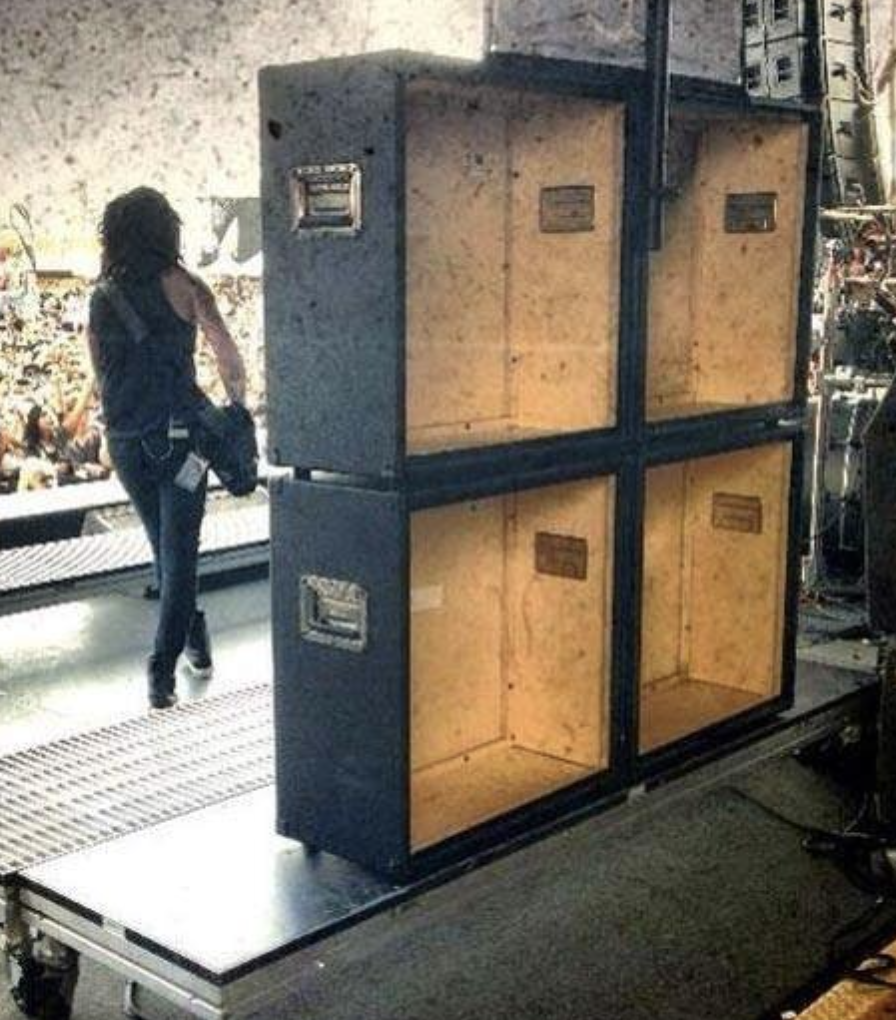
Meanwhile Mesa Boogies were singing through what is basically a Princeton combo stuffed with a 12 inch speaker and 90 watts - You did not really need a 4X12 to be loud
Humans are barely in charge of themselves
I understand the sentiment, but in the decades I've been on this rock, humans have made great strides in how we treat each other and technology. We are capable where we choose to be.
Last edited:
Ahh yes, the infamous ‘pyramid’ cab…
I used 2 of those cabs and 2 Acoustic 150s parallel in high school. Looked huge. Sounded like crap! lol.
I see it as, give ‘em enough rope…I understand the sentiment, but in the decades I've been on this rock, humans have mad great strides in how we treat each other and technology. We are capable where we choose to be.
As for Marshall bass amplification: I once opened for a legendary British guitarist at a local venue here. During set-up I chatted with the bass tech, noting that I hadn't seen many Marshall bass rigs (they brought them from the UK). He replied "yeah, I wish he'd get rid of it, it's a piece of junk" or words to that effect. I kinda took that to heart.
The Bar Band Bassman[/QUOTE]
i always get this kind of reaction with my Marshall dbs amp as well till they hear it
Might also mention they made a 4x12 and 2x15 cab of the same size , running two through the dbs 7400 makes the earth shake. The 4x12 with a driver swap to lighten it and increase its power handling could be a really formidable cab.
The Bar Band Bassman[/QUOTE]
i always get this kind of reaction with my Marshall dbs amp as well till they hear it
Might also mention they made a 4x12 and 2x15 cab of the same size , running two through the dbs 7400 makes the earth shake. The 4x12 with a driver swap to lighten it and increase its power handling could be a really formidable cab.
I think you misunderstood what I meant by the word 'more'. By 'made more for bass' I meant 'more often', not 'bigger'.
The answer to that question is easy (and I am not trying to be snarky), fewer bassists are willing to buy a 412 & thus companies less willing to produce them. Most of the posts above are people talking about why bassists generally do not prefer 412s.
A quick search of the local classifieds brings up 117 x 410 bass cabs for sale & 7 x 412 bass cabs, a few of the latter I have heard of before, some of the 412s are fairly new/recent some old. They have been & are still made, for a small audience.
FWIW: For outdoors I do use 2 * 212 bass cabs (normally just a single 212). Nothing wrong with four 12"ers, sounds great.
Would I buy a single 412 bass cab instead?
Nope, too big & unwieldy and not needed most of the time. I can just get the 2 x 212s (fairly compact & Neos) into a European station wagon when they are required, I doubt I could get most of the 412s for sale above in there... and would not enjoy schlepping something that size in one go or up/down stairs (I'm over 60 & no fitness studio will reverse that). So I am probably one of "those" people causing companies not to offer them more often. Justified or not, I avoid 410 bass cabs for similar reasons.
=> "why [...] 4x12 for guitar"
Some bassists are not unknown for having some strong opinions about a specific speaker size, but in the guitar world, except for a smaller group of people who adore 50's or early 60's amps (e.g. the old Vibroluxes) and a small group of 15" adherents, 12" is the doctrine & magic number/belief.
To be fair, most E2 guitar cabs are open back or sealed (normally not ported & tuned) and the speaker size/type can play a more important role to a degree than with a bass cab, it is less about the cab tuning at those frequencies and more about how the speaker is colored or breaks up. Swap around speakers like a guitarist in a E1/B1 bass intended cab not tuned for them can cause them to operate well over their specs & blow. Less of an issue with an E2 guitar speaker as longs as the power ratings are not being overly exceeded.
For those who like the heavier ultra High Gain side and turning up to 11, 412s are 4 times so and thus of course nirvana ... mainly due to Marshals and the musicians who used that setup or extended variants of it on stage, but not necessarily in the studio. Because of this (and being smaller at least than most bass 412s) they are popular & you see 412 guitar cabs with guitarists who don't have roadies quite often, they are still manageable to transport/carry.
I played guitar from the mid 70's up until shortly after the y2k when I switched to bass. Was not playing ultra HighGain music, a 110, 112 or 212 was sufficient and what I used. An E2 guitar at those frequencies (between 82.41 - 1318.51 Hz fundamentals on a 24 fretter) through a 212 with an appropriate amp can deafen you quickly and make your ears bleed (even true of a mere 30w Vox AC30 & openback 212... until it warms up, gets squishy and quiets down). If you stand in the general vicinity of someone futilely trying to overdrive a late 70's ultralinear 135w 212 Fender Twin Reverb into output section saturation, you will likely run, fast... I had that misfortune once and have sworn never to again. A lot of the 412 stack popularity/glamour is about expected tone, image and mystique & not about loudness (thus the endless stacks of empty Marshal 412 cabs seen on some stages). A UL Twin Reverb is louder than most 60-100w Marshal amps with a 412 (the Marshal will saturate quicker and get muddier not louder), but they will not sound the same played at the same volume.
Last edited:

JeezyMcNuggles
Inactive
- Feb 23, 2018
- 14,723
- 20,970
- Disclosures
- I suck, but nobody really notices
What you're missing is the fact that a 412 guitar cab is a half stack. Their amp was designed to push eight 12s as an on stage guitar rig.Why is the 4x10 made more for bass than for guitar, but the 4x12 is more for guitar?
A bass 410 is a quarter stack. Our amp was designed to push sixteen 10s as an on stage bass rig.


