• TalkBass has been independent since 1998. Add your voice.
    Create a free account to reply to discussions, view embedded media, and browse with fewer display ads.
    Join freeLog in
    Want zero display ads or expanded classifieds tools? Compare plans.

5-string bass going from 4-string: Does it get better?

Most forms of rock and country, including pretty nearly everything that canonically defines rock and country, was recorded before extended range basses (and the amplification systems that could support them) existed.

So depending on your genres (and the decades your music comes from, if you're in a cover band), there probably isn't any need for a bass that goes to B(0).

It's still really handy to have the option of playing across the neck, in which case you've effectively got a well-set-up 25.5" scale bass. And it's also really gratifying to be able to drop that occasional low-note bomb :smug:
 
  • Like
Reactions: rok51 and pbass2
For 25 years my main EBG was a 5-string, and it still is. But there is something undeniably comfortable about 4-string instruments. I mean, you play string instruments with four fingers on your left hand, it's no wonder that 4-string instruments are very common and popular, and always will be. So, yes, you will get more comfortable with 5-string and you will play it wonderfully, but don't be surprised if 4-string always kind of feels more natural - it's just human anatomy.
 
  • Like
Reactions: MrAB4003
It does take some time to become acquainted with a 5 and struggling with the left hand is the worst part. Comfort is key because you will hate playing 5 if it feels bad and you won’t get the practice you need for proficiency. Spend some quality time with an Ibanez Soundgear 5 in your hands. Fender-esque 5’s have a tendency to feel big and the 18mm string spacing ensures the neck is big too. Ibanez Soundgear 5’s have 16.5mm spacing at the bridge, which feels tight for the right hand but affords you the luxury of a 1.75” nut for the left.

If Fender-esque is your thing check out a G&L L2500. Absolute Fender DNA in the tone and body feel, 17mm string spacing and a slightly chunky but very playable neck.

Good luck and keep trying! Once you get cozy on a 5 you’ll feel naked on a 4. Don’t just use the B for the lowest 5 notes, frets 6-10 offer a ton of girth vs their E string counterparts that is worth exploring.
 
  • Like
Reactions: joeLowB
. . . . depending on your genres (and the decades your music comes from, if you're in a cover band), there probably isn't any need for a bass that goes to B(0). . . .

Why are the original recordings always mentioned? How does it matter what bass was used on the original? There is no rule that a Motown song has to be played on a 4 string s bass!!

. . . . there is something undeniably comfortable about 4-string instruments. I mean, you play string instruments with four fingers on your left hand, it's no wonder that 4-string instruments are very common and popular, and always will be. So, yes, you will get more comfortable with 5-string and you will play it wonderfully, but don't be surprised if 4-string always kind of feels more natural - it's just human anatomy.

Whaaat?!! Where do you start with this. . . . !
 
Learning to adapt to an extra string is nowhere in comparison to the changes we all overcame when starting out on 4 string basses.

Adding a B string is easy if you start with a good technique. Starting with a 4 string technique full of short cuts and get arounds will be more difficult. . . . and the bass gets the blame!
 
Why are the original recordings always mentioned? How does it matter what bass was used on the original? There is no rule that a Motown song has to be played on a 4 string s bass!!
I didn't say anything must be played on a 4-string, or that musicians are obligated to play replicas of the original instruments, or even anything about original recordings. I was making the point that most of rock history songs weren't written or arranged to go below E or maybe drop-D, so to play that music a low-B string is purely optional.

Plenty of people want to replicate original arrangements exactly. Some are even in tribute bands where they try to portray the band as convincingly as possible... I'm not at all interested in doing that but they are, and more power to them, but they're also not hanging out in this thread -- the topic isn't relevant to them.
 
  • Like
Reactions: Aric Bjorn
I play ONLY Ibanez SR 5 Strings. The spacing is closer than most basses, including fender Basses. I LIKE the narrow spacing (16.5 MM vs Like 19MM ish of most 4 strings).
I strongly prefer narrow spacing, too. My first experience with a 5-string was a bass with a 19mm spacing (although I didn't realize it at the time), and it felt very uncomfortable. I thought that 5-string might not be a good fit for me, but then I played a narrow-spaced one. It was hard at first and felt cramped, but I quickly adapted to it. My basses now have 16.5mm spacing.

I can and occasionally do perform with a 4-string, but the fiver has become my default and I feel totally comfortable now. It really helped me to commit only playing the five for an extended period.

I love the deep low notes of a 5-string, but the biggest benefit to me is the fat tone of the B-string when playing higher on the neck. Playing a low G on the B-string sounds different than the same note on the E-string, and I just love the fatness and heft.
 
  • Like
Reactions: GTHintz and joeLowB
Only took me about a week to adapt back in the year 1996 after acquisition of my first 5-string.... Carvin LB75. I approached it like it was a 4-string with an extra low string. Used the B as a thumb rest at first.... and gradually worked it in to my riffs and playing.
 
Last edited:
  • Like
Reactions: mcnach
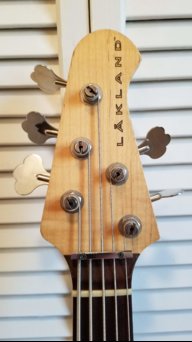
Coming from a Fender, I was converted the first time I ever touched a 5 string (a Lakland DJ5) and bought one the next day. I prefer 34" or 35" scale basses with 19mm spacing, and it's not a problem even with my small hands. It only took a few days to get comfortable as I already used floating thumb technique, and the layout of the notes was just a continuation of the pattern I knew. Now I play 5 strings almost exclusively.

Whenever I do rarely play my last 4 string now (a particularly good sounding Fender Jazz) I feel like something is missing. I have to conciously think ahead about not doing anything that would involve the B string. I strung it up with flats to help differentiate it in tone and feel from the others.
 
I think you might be overthinking this; you only spent a few minutes playing someone else’s bass and it might have just been a neck shape you didn’t care for.

I was able to adjust to a 5-er fairly quickly - and I currently switch back and forth between 5 and 4 without issues but…

…like nickpc, I definitely had to play a few before I found necks that I liked. I’m reasonably tolerant of neck shapes that aren’t my ideal when I play 4-strings but I’m fussier when it comes to 5-ers. I’ve sold several excellent 5-string basses because the necks just didn’t do it for me.

Shop around a little. When you find the neck you like you’ll know it instantly and you’ll find that five strings are no longer a problem.

Similar for me. I was "five curious" for a couple of years before I bought one, and it took awhile before I found a neck I liked. When I ordered a G&L L-1500 in 2006, I considered making it the five-string 1505, but the G&L five-string necks at the time were simply too thick for me, so I held off.

Then, in 2008, Fender slimmed down its five-string necks for the Am. Std. line, and I took the plunge on a Jazz V. I didn't experience much of a transition, and I played it interchangeably with my fours for several years. My fives are now a G&L M-2500--they slimmed down the necks, so I bought one in 2014-- and Sandberg TT-5 Superlight (J5).

Even though I've had fives for many years, I don't think I became a true five-string player until about two years ago. For a long time, I used the B string sparingly, and I still played my fours frequently so I would be able to cover a set on either.

But for the past couple of years, I've been in a Grateful Dead cover band, and all the improvisation has led to a much greater integration of the B string into my playing. I keep finding new opportunities to use it. In that band, it's all fives, all the time, and it would be a major adjustment to play a set on a four. (My other band plays very different material, and if I don't need the B string for anything, I'll use a four. But I usually end up using a five.)

And I think fives magnify the importance of some specs, which makes it more difficult to find one that feels right. Some examples are nut width, string spacing, rear profile, and fretboard radius. Like @Lo-E, I can be comfortable on lots of fours, but I'm picky about fives. For example, I don't like 19mm spacing at the bridge on fives, but it's standard on many fours, and I'm fine with it.

Fretboard radius is an even bigger deal for me. On fours (and guitars) I like 12" and flatter, but I'm OK with Fender's standard 9.5" radius if the instrument sets up with decently low action. I still love my Strat and Fender J, and I've even liked some fours with vintage 7.5" radius boards.

But on fives? Fuhgetaboutit! I can't stand reaching over a "hump" to access the lower strings, so it's gotta be 12" or flatter. I've had two fives with 9.5" radius fretboards, and they're both gone.
 
One reason I'm a big fan of my Yamaha TRBXs is their necks. Very comfortable for me, I don't like thick necks.

40mm on the trbx174, and 38mm (4-string) or 43mm (5-string) nut widths on the 600 series.

I find myself often going back to my four string because that's what the song was originally played on, but I think I'm going to try and adjust more to my five, for reasons already mentioned upthread. I'm still in the transition, myself, but enjoying it. It's nice to be able to switch back and forth, that's my vote. Have at least one of each :)
 
The biggest adjustment for me was muting. I expected the width. Now, switching from 5 to 4 feels like I just got out of my pickup and hopped into a sports car.

For me, and oddly enough, their purposes sort of boil down to work vs. “fun” (it’s all fun, of course), so the car analogy is perfect. If I’m going to play a jam, where I won’t know most/any of the material, or play technical, but slower music (as one of my bands does a lot every show), I reach for the 5 string. When I need to move fast, can think less, play for sheer fun, etc., the 4 gets the nodd. I usually make that call before, rather than take two basses; and I have had plenty of gigs, jams, etc. where I thought I’d bring the other the next time, but never had a real problem with the choice.

Some will like only one or the other, and others will do like I do and switch as it feels good to switch - sometimes just to be at something new, I’ll only play one for a while; then the other feels like a new bass, sort of!
 
Okay, so for a bit of background: I own and play 4-string basses only. One is a PJ-bass with 38 mm nut width, the other is a modern 2H bass with 40 mm nut width. I also play the guitar, and own two Ovations. One is a 6-string acoustic (43 mm nut width), the other is a 6-string classic (48 mm nut width). I find all of these very comfortable to play.
There is a reason why I'm mentioning nut widths, bear with me.

I usually play bass with a different group, but a friend is organizing a group for an upcoming event and I will be doing PA and vocals, while his friend is playing bass on this one.
He brought a Markbass J-type 5-string and I asked to try it yesterday. I played it for a moment, or rather tried to play it for a moment, and it was an extremely strange experience.

The neck felt so wide and so thick that I had to do a double take. Nope, the specs say it's 45 mm nut width. But it feels both thicker and wider than the 46 mm nut Ovation, even though specs say it's not.
When I compared the guitars to the basses, I thought that it makes a lot of sense since the bass necks don't feel any thinner than the guitar necks, so I was probably expecting too much from the 45 mm 5-string neck if I thought it would feel right.

Everything about a 5-string made me think it's a perfect fit and that I'd love it, but I realized it would be a very toxic kind of love where she would constantly berate me for the small… hands and their lack of girth, and I'd tell her I'm sorry, I'll improve, I'll get better, I'll grow… as a musician.
But I'm not sure.

So the questions are: Is my experience common? Did any of you have the same feeling when you tried a 5-string? Does it get better, did you give up on it or do you soldier on?
My advice is as much as possible through this acclamation phase, avoid playing the same song on both. muscle memory is a bear. But eventually you will be fine.
 
For me it was a matter of trying the right five string. I owned a couple that had me struggling to get comfortable. The ended up finding a five that immediately felt like it was designed for me. I would suggest going to a shop that has a selection of fives (if there are any around you) and trying out a bunch.
 
  • Like
Reactions: mcnach
Only took me about a week to adapt back in the year 1996 after acquisition of my first 5-string.... Carvin LB75. I approached it like it was a 4-string with an extra low string. Used the B as a thumb rest at first.... and gradually worked it in to my riffs and playing.


That's what I did. I started using it just like a 4 string with a loooong thumbrest, playing what I was used to playing. I didn't force it, I just started incorporating notes from the B string into my playing whenever it felt right.

At first it would be things like playing an F at the first fret of the E string vs sixth fret on the B string, and realising that I liked not needing to jump around the neck as much... and it just sort of happened.

It didn't take very long either, but I didn't touch a 4-string bass until I was comfortable with the 5er. Once I got comfy with the 5-string I could switch back and forth. Right now I pretty much only play 5-string basses, but I do use a 4 from time to time (I only have fretless in 4 strings, I keep a Precision with flats, etc).

But for me, I just had to NEED it. I owned 5-string basses on and off for years, never really getting on with them. It was only when I started doing a lot of dep work and found that a lot of times I was given the wrong key, or they just switched it at the gig... transposing on teh fly is a lot easier with a 5-string. Once I had a need, I just put away my 4-string basses for a bit and used the 5er exclusively, until I played a couple of gigs on it and felt right.
 
My advice is as much as possible through this acclamation phase, avoid playing the same song on both. muscle memory is a bear. But eventually you will be fine.

While this may make things easier punctually, I think it's better to just think of the notes you're wanting to play, and where on the fretboard they are.

Relying on memory can backfire spectacularly. At least for me.
 
It's still really handy to have the option of playing across the neck, in which case you've effectively got a well-set-up 25.5" scale bass.
That's what I'm talkin' bout when I explain how useful the different timbre is, when playing parts you'd normally play down low towards the nut on a four string up higher on the E and B string. It is PHAT. I'll deliberately play up there at times just for that sound. We do this all the time on four strings too of course--playing up higher on the low strings because it's a different, rounder tone than the same thing played down low on the D and G string. Especially recording, where you really get into the weeds crafting a tone for a particular bass part, it just gives you this extra layer of versatility.
 
5 strings are great, but can make you insane in the first moments of playing one. I recall the first time I had to play a 5er it was almost like I never played bass at all. Transitionsing to a five string bass needs COMMITTMENT. Being a guitar player, you (we) tend to orient our left hands from the 6th string on guitar. It is natural to be disoriented. A bass player friend gave me some great advice and I benefitted from listening. He said:
"PUT YOUR 4 STRING BASS UNDER THE BED FOR 6 MONTHS".
Within that time, without playing my 4 string I became comfortable with the 5 string. Within a year it became incredibly natural. My 4 string now lives at my daughter's house for recording. [FWIW, the 4 string has a drop D tuner, but I always thought it to be clumsy.]

The 5 string bass has some advantages which you will take advantage of within the stated 6 month period. Is there anything a 4 string can do that a 5 string can't? In a way, I'm surprised that the number of 5 string basses on store shelves are still outnumbered by 4 string basses. I guess 4 strings are more ideal for guitar cross-over players (like I was).

If you are sincere about adapting to 5 string, again... all it needs is COMMITTMENT. You won't be sorry. Once you adapt to a 5er your 4 string basses will grow very lonely.
 
I committed to it as was hearing the possibilities it would bring.
I couldn't find one so had one built.
I then realised all my 4 strings were redundant..not least because going back and forth wasn't possible. So I transferred all my skills and techniques to the 5 and never looked back. I've been asked to try a couple of 4's that were around ..typically studios...but too much hassle.
So all my basses are 5st. Just not interested in 4's.. and its been that way for over 30yrs.
 
  • Like
Reactions: GTHintz

Latest posts