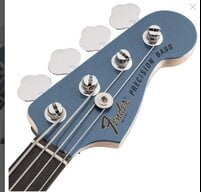
The active basses have a passive tone control in addition to the active circuitry so you still have a passive bass if you decide the active mode is not for you.
TalkBass has been independent since 1998. Add your voice.
Create a free account to reply to discussions, view embedded media, and browse with fewer display ads.
Join free Log in
Want zero display ads or expanded classifieds tools? Compare plans.
Yeah, I can see the advantage of that. But for me personally, I prefer controls on the actual bass to be pretty minimal. I just feel things are redundant if I have a 2 or 3 band EQ on the bass, more EQ on a pre amp pedal and more on my amp head. I’m a bit of a minimalist in that respect.Yes, you are right, I like the ability to adjust the tone a little without walking back to the amp. I like a big low with a little punch on top.
what’s the big deal with the rolled fretboard edges? Can someone enlighten me? (serious question).
Sounds good! I have never used a pedal. I want to get a 3 band eq for my fender p. Hoping to clean up the sound on it a little.Yeah, I can see the advantage of that. But for me personally, I prefer controls on the actual bass to be pretty minimal. I just feel things are redundant if I have a 2 or 3 band EQ on the bass, more EQ on a pre amp pedal and more on my amp head. I’m a bit of a minimalist in that respect.
At the moment, despite owning more than enough active and psssive basses, my ideal set up is a passive PJ with the normal VVT controls, the bass Flyrig for tone shaping (with the Sansamp section), and my GR Bass Pure Amp 800 (no EQ) into an AT212 graphite cab.
If you’re after a three band onboard EQ, May I suggest you check out P-RETRO | East UK (when it’s available?) @John EastSounds good! I have never used a pedal. I want to get a 3 band eq for my fender p. Hoping to clean up the sound on it a little.
View attachment 5120133
Left is unrolled, right is rolled, if you were looking at a neck from the top or bottom from it being sawn in half. Basically, since your fingers and thumb typically will come over the edges of the fretboard and apply pressure, pointy edges in general don't feel great. What used to be a higher end feature is now becoming more common with affordable instruments as well, because it means they need to spend more time sanding down the edges of the fingerboard and frets to match.
Also, a really well played guitar or bass fingerboard that had square edges, will typically wear down from erosion over time, so it also gives a more "worn in" feel to the neck.. but at the end of the day.. softer edges just feel better against the fingers and bones than sharp ones and its just objectively more comfortable.