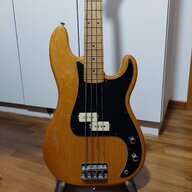
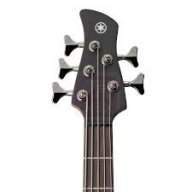
One thing to ponder: There is a tradeoff between string spacing and reach - on both ends of the fretboard. The wider the spacing on the bridge side, the further your fingers have to go to reach the G string. For a lot of folks, that means learning floating thumb. In my case, I have ginormous hands, and my basses are 17.5 mm spacing - yes, that means re-learning a bit about right hand technique (you need more precision with narrower spacings), but it also means the reach isn't that much bigger, and with my hands, I can reach easily without floating my thumb. In that sense, going to a tighter string spacing at the bridge makes the transition easier, not harder.
For me, the toughest part of learning to play on a 5 wasn't the different spacing on my plucking hand - it was actually the tighter spacing on my fretting hand. My 5's have wide necks (1 7/8ths at the nut), and with that width, the string spacing is the same as J width 4 - I liked P width 4's, because I wasn't as cramped; I could actually play faster on a wider neck. No matter what spacing you get at the bridge, that challenge awaits you - you're either going to have to get used to a tighter fretting hand spacing, or you're boing to have a much wider neck - there isn't really a way out of it. Everyone seems to focus on the string spacing at the bridge, and yes, that is a thing to ponder, but the other end is just as much of an issue to think about.
The point is, whatever spacing you pick, you're going to have to adjust to play well on a 5'er - getting the same spacing at the bridge doesn't actually mean it's easier, it's just a different set of adjustments to make. You're going to be "fumble fingers" for a while, with or without a change in string spacing - Every string is going to move on you - the G is way out there (a tighter string spacing makes that adjustment easier), the D is about where the G used to be, etc. - keeping the same string spacing isn't going to fix all that. At some point, you may look down in bewilderment, like I did once, and think "I have a middle string?" - there are mental as well as physical challenges to overcome. You will also end up "re-harmonizing" a line or two here or there (playing things on the wrong string) - that's just part of learning a 5.
For the time that I was using both 4's and 5's (I'm all 5's now), once I got some proficiency on a 5, going back and forth wasn't difficult - your brain ends up with a "4" program and a "5" program, and can run either pretty easily.