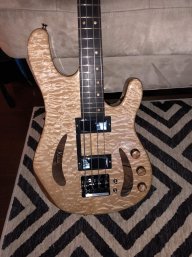
If you compare the various sized pianos in a typical showroom, play a low b on several different ones. The longer pianos use a thinner string, which according to my research, is a more harmonically 'in tune' string, for a given length, in reproducing lower frequencies. The shorter pianos use a shorter, thicker gauge string, and they sound 'tubby' or, kinda 'off' to me. I have experimented with many different gauges for my low 'B' strings. I use 34" scale in my builds. If you build a good strong neck, and engineer the 'B' side of the fingerboard to provide some clearance beyond the 12th. fret, for that thick string- a .125 low 'B' string will sound as good as any 35" boutique bass out there. I have played some 35" scale basses, and do not really hear a significant difference from my own instruments. If you feel 35" is a must, so be it. Bass builders, mainly large commercial ones- seem to think 1-3/4" is the standard nut width that a 5 string bass 'should be.' I strongly disagree. The first five I built, was in 1983, and I decided that a 2" nut width was ideal. That bass is in my profile avatar. I still play it, it fits like a glove. I've built 2-1/4" nut widths, and a 2-1/8" widths. All of them work great for my big hands. I just ordered a Sire 5- with a 1-3/4" nut. Carl Thompson once said to me- after I compared, and expressed concern of acclimating to the 1-11/16" nut on the bass he built me- to my '71 Jazz bass- "Dave, you can get used to anything" He was right. For a 34" scale 5- the absolute never exceed gauge for me is .130, and in truth, I only use that if I have no other choice. A .125 is a good gauge for me, and I'd suspect, a .120 would sound even better. Just adjust the string until it 'speaks' like you think it should.