• TalkBass has been independent since 1998. Add your voice.
    Create a free account to reply to discussions, view embedded media, and browse with fewer display ads.
    Join freeLog in
    Want zero display ads or expanded classifieds tools? Compare plans.

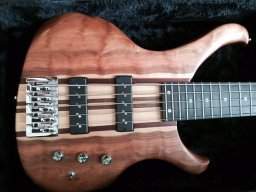
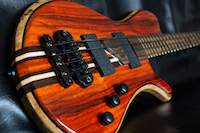
5 string buckeye burl/mahogany neck through

Yeah, I now use the pull-truded rods like HaMMerHeD. With anything in the neck I think you should be cognizant of how the neck carve might interfere with it. I used to use 1/8" x 3/8" bars, but the 0.254" pull-truded rods give more room to work with as far as carving goes. The only place I've run into any issues is with some more exotic neck carve profiles.
 
Thanks for all of the info everyone!

I got steel because that's what the future owner of the bass asked for. They are really small (1/8" wide, by 1/4" high) and are still very light weight. Warmoth states on their website that they prefer steel, so I think that's why he wanted it. $4 for a pair. Invalid Link Removed ...but, they have a minimum purchase of like $35 or something like that, so I ended up ordering the string ferrules and strap locks from them too. I'll look around more next time and see what all of my options are.

I will be very conscious of where they are when I carve the neck. He wants kind of a medium thickness with an asymmetrical carve. Is there any optimal placement of the rods? I know I wouldn't want them close enough to the outer edges to become an issue with carving and I assume it'd be a good idea to not have them go all the way up towards the 1st fret area, for reasons mentioned by Lonny.
 
Lisa - I think you should actually make sure the rods extend all the way up to the nut...this is the area where the neck is under the most stress, and therefore benefiting the most from added reinforcement and stability. My mistake years ago when I was first starting out was routing the channels too far to the left or right of the center truss rod channel, so that when I shaped the neck, it revealed an edge of the embedded carbon fiber because the channels were too close to the outside of the neck profile.

Lots of guys probably have different opinions on where exactly the rods should be located and unfortunately I can't say there is any "right" answer. So long as you have a solid, movement-free fit and you take into consideration the various components of your neck lamination design, I think you'll be in good shape.
 
You can also set the reinforcement rods at an angle to the truss rod, parallel to the edges of the neck. I'm not sure what effect it has on strength or stability, but it'd make it easier to calculate how deep and round you can carve the neck.
 
You'd have to carve really thin, and get close to intruding on the truss rod before the carbon rods became a problem.

I agree. However, the way I install is slightly different than yours. I do it parallel with the sides of the neck instead of the truss rod, like below

IMG_20140218_141145_zpsdxn4aqao.jpg


Also, some people like to do this V shaped neck, which can cause issues.

It could be me being too paranoid :D:D
It is because in the arly days, I carved through the truss rod channel once. Since then, it has always been a little pressure when carving a neck.
 
Lisa - I think you should actually make sure the rods extend all the way up to the nut...this is the area where the neck is under the most stress, and therefore benefiting the most from added reinforcement and stability.

I think so too.

You can also set the reinforcement rods at an angle to the truss rod, parallel to the edges of the neck. I'm not sure what effect it has on strength or stability, but it'd make it easier to calculate how deep and round you can carve the neck.

I'm not sure whether it is easier, because I need to memorise the position/angle of the bars, so I don't remove too much wood.

I prefer to put it in an angle because IMHO, it can help with neck twisting problem.
 
There's a great post in TB (I'm looking for it) from Bruce Johnson in which he mentions about neck relief that the neck under the top two frets (closest to the nut) does not bend with the rest, causing the profile of the relief to be imperfect. If he's right as he is very likely to be, having built like 1000 necks over the past 40 years (and I'm convinced), then that suggests to me that you don't want or need extra strengthening in that area. But I see Lonnybass's point that stresses seem to be at the max there; it's where the neck is narrowest and thinnest and where it'll break if the bass falls. So what to do?

But since different builders do it both ways, and their basses hold up okay, I'd say just use your intuition and expect that it'll turn out great. I really enjoy following your builds!
 
There's a great post in TB (I'm looking for it) from Bruce Johnson in which he mentions about neck relief that the neck under the top two frets (closest to the nut) does not bend with the rest, causing the profile of the relief to be imperfect. If he's right as he is very likely to be, having built like 1000 necks over the past 40 years (and I'm convinced), then that suggests to me that you don't want or need extra strengthening in that area. But I see Lonnybass's point that stresses seem to be at the max there; it's where the neck is narrowest and thinnest and where it'll break if the bass falls. So what to do?

But since different builders do it both ways, and their basses hold up okay, I'd say just use your intuition and expect that it'll turn out great. I really enjoy following your builds!

Here is the post http://www.talkbass.com/threads/zero-fret-question.1082982/page-2#post-16865916
 
  • Like
Reactions: lbridenstine

There's a great post in TB (I'm looking for it) from Bruce Johnson in which he mentions about neck relief that the neck under the top two frets (closest to the nut) does not bend with the rest, causing the profile of the relief to be imperfect. If he's right as he is very likely to be, having built like 1000 necks over the past 40 years (and I'm convinced), then that suggests to me that you don't want or need extra strengthening in that area. But I see Lonnybass's point that stresses seem to be at the max there; it's where the neck is narrowest and thinnest and where it'll break if the bass falls. So what to do?

But since different builders do it both ways, and their basses hold up okay, I'd say just use your intuition and expect that it'll turn out great. I really enjoy following your builds!

This is a great post, and Bruce is certainly one of the most experienced and knowledgeable builders on Talkbass.

I re-read it this morning - and the past day of discussion here on this topic - and I think I see where the confusion has arisen.

As Jay described it, when Bruce mentioned that the end of the fingerboard (nut/first and second fret) is unlikely to bend with the rest of the neck, and therefore not in need of extra strengthening - it's because Bruce is describing neck designs with a volute at the end of the neck/headstock area, which is providing the extra strength.

However, not all necks incorporate a volute - so this must be taken into consideration. I seem to remember a good thread on volutes and neck reinforcement in the Luthier's Roundtable section of Bass Gear magazine a few years back which may be worth checking out.

Lonnybass
 
  • Like
Reactions: lbridenstine
I need to keep an eye out for Bruce's posts more often.

This bass won't have a volute, so that may not apply, but I could also see how since the adjustment end of the truss rod is underneath that area, there would also be that little area where the nut of the truss rod is that wouldn't bend with the rest of the truss rod when it's adjusted, right? And maybe even if that section doesn't bend with the rest, the stiffening rods would be helpful to go there to keep it all even? I don't know, I'm just thinking out loud.

I'll try to lay out the rods later and see what I can do with the placement and get a picture.
 
I get my rods at the local hobby store. RC plane guys use CF to build their wigs and such. Fairly inexpensive. The reason you use CF rod isnt necessarily for neck stiffness as far as warping back and forth goes. What it is really for is to eliminate dead spot on the fingerboard. Im not sure metal rods will accomplish the same thing....
 
I get my rods at the local hobby store. RC plane guys use CF to build their wigs and such. Fairly inexpensive. The reason you use CF rod isnt necessarily for neck stiffness as far as warping back and forth goes. What it is really for is to eliminate dead spot on the fingerboard. Im not sure metal rods will accomplish the same thing....

Like I said, I don't really know anything about using rods yet. Warmoth uses the steel rods as a standard on their "Super bass necks" and say they prefer it over graphite for counteracting dead spots. Here's the link: Invalid Link Removed

We continued our research by experimenting with different types of stiffening rods. First we tried graphite which we found to be expensive and not a cure-all. Then we tried hardened T-6 aluminum which was much less expensive but still did not yield the desire result. Finally, we tried steel bars. Steel provided very even responsiveness with virtually no dead notes. The conclusion we reached is that neck rigidity is not the sole factor in eliminating dead spots. Additional mass plays a significant role as well.

Due to ongoing customer requests, we have begun offering graphite stiffening rods in place of our standard steel rods. We still believe steel yields a superior neck, but we're happy to oblige our customers and give you the choice!
I don't know how true all of that is, but this is what convinced the future owner of this bass to request the steel rods.
 
  • Like
Reactions: KramerDon
Well, I thought I'd be able to work on the bass a lot now, but then this happened:

Invalid Link Removed

Michigan is under there somewhere...


It has just been too cold to get out in the garage and work on anything and the 10 day forecast isn't looking any better. :-/

But, I've made a list of some things that I can do in the basement while I'm waiting for some decent weather, so I'm planning on getting that stuff done this week and maybe next week in between applying for jobs. I'll update soon.
 
I cut out the frets, not installed yet since the fretboard isn't ready.

Invalid Link Removed

tumblr_njxsgtHNrl1qi8q1ao1_1280.jpg


Got the pieces of wood ready for the headstock and truss rod cover.

tumblr_njxsgtHNrl1qi8q1ao3_1280.jpg


Headstock pieces glued together. I was going to glue up the truss rod cover at the same time, but there's a clamp and piece of wood in the way, so I'll wait until I un-clamp this.

tumblr_njxsgtHNrl1qi8q1ao4_1280.jpg


I also drew out the bridge block on that piece of mahogany and marked where to drill the string holes and came up with a truss rod cover shape.