• TalkBass has been independent since 1998. Add your voice.
    Create a free account to reply to discussions, view embedded media, and browse with fewer display ads.
    Join freeLog in
    Want zero display ads or expanded classifieds tools? Compare plans.

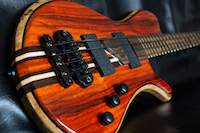
5 string buckeye burl/mahogany neck through

I e-mailed Warmoth to ask if the steel stiffening rods need to be glued/epoxied in or if I should treat it like a truss rod and put a little silicone in the bottom of the channel and this was the response.

Hi Lisa,

The stiffening rods and truss rods we sell are raw materials that can be used in a variety of ways, and in general we do not provide instructions for their use - that really depends on the neck design and construction that you are pursuing, and you are in the best position to gauge the specific needs of your project. Our experience is limited to our own processes and designs, and we generally do not discuss them in detail. In our construction, the rods fit precisely and are capped as the fingerboard is glued on, so further rattle-mitigating measures are typically not necessary in our necks. Loose-fitting rods, or rods held in place with a flexible material, might negate some of the benefit.
So... okay. What I got from that is "I can't tell you what we do, but here's what we do, but I'm not going to actually answer your question."

I'm assuming I should put a tiny bit of silicone on each end to be safe. I'd hate to get it all together and hear any rattling.
 
I e-mailed Warmoth to ask if the steel stiffening rods need to be glued/epoxied in or if I should treat it like a truss rod and put a little silicone in the bottom of the channel and this was the response.

Hi Lisa,

The stiffening rods and truss rods we sell are raw materials that can be used in a variety of ways, and in general we do not provide instructions for their use - that really depends on the neck design and construction that you are pursuing, and you are in the best position to gauge the specific needs of your project. Our experience is limited to our own processes and designs, and we generally do not discuss them in detail. In our construction, the rods fit precisely and are capped as the fingerboard is glued on, so further rattle-mitigating measures are typically not necessary in our necks. Loose-fitting rods, or rods held in place with a flexible material, might negate some of the benefit.
So... okay. What I got from that is "I can't tell you what we do, but here's what we do, but I'm not going to actually answer your question."

I'm assuming I should put a tiny bit of silicone on each end to be safe. I'd hate to get it all together and hear any rattling.

Hey Lisa

If I may be so forward - Bruce Johnson is a bit of a high end custom neck guy - who has built over 1000 necks - mostly for high end basses. He happens to describe his process on the neck he built for me in pretty specific detail at the link below - scroll down as the relevant post with many photos is the last post on the page.

Maybe some of the info about how he does his necks and truss rods may strike a chord with you, or be helpful in some way.

http://www.talkbass.com/threads/fender-performer-build.1103935/page-5

Everything is looking good, I enjoyed the video - and I must say - I continue to be a devoted follower of this thread!
 
Last edited:
  • Like
Reactions: lbridenstine
Hey Lisa

If I may be so forward - Bruce Johnson is a bit of a high end custom neck guy - who has built over 1000 necks - mostly for high end basses. He happens to describe his process on the neck he built for me in pretty specific detail at the link below - scroll down as the relevant post with many photos is the last post on the page.

Maybe some of the info about how he does his necks and truss rods may strike a chord with you, or be helpful in some way.

http://www.talkbass.com/threads/fender-performer-build.1103935/page-5

Everything is looking good, I enjoyed the video - and I must say - I continue to be a devoted follower of this thread!


Thanks for the link! Bruce definitely knows what he's doing and if I were using the same type of rod, I'd definitely follow his directions, but I'm using a different style of truss rod. The one I have it really simple - just route a flat channel down the middle of the neck the same size as the rod.

What I was trying to ask Warmoth was if epoxy needs to be used when installing the stiffening rods. I haven't used stiffening rods before and I've seen people epoxy in carbon fiber rods, but I assume that with the ones I have being steel and not carbon fiber, they don't need to be epoxied. I just wanted to make sure before I don't do it, basically.

The reason I brought up silicon was that I've learned from several people here that it's a good idea to put 3 small dabs of silicon caulking in the truss rod channel to make sure that it won't have a chance to rattle inside the neck, so I was just kind of thinking, maybe that would be a good idea with the steel rods too.
 
  • Like
Reactions: BassHappy
I don't see why you wouldn't want to bed the steel rods in epoxy.

What does the epoxy do in this case and what kind of epoxy would be best if I used it? Like I said, I've never used stiffening rods before, so I don't really know much about them. I don't really think that this neck necessarily needs them with this stiff maple, but the future owner requested them, so might as well. I'm thinking that I will probably start using them regularly just for extra reinforcement.
 
The epoxy would bond the stiffening rods to the wood, fill any gaps, and just generally make them more effective. You'll want to scuff-sand the steel before you do that for maximal adhesion. I would use something like System 3 T-88 or Quick-15, because that's what I have.
 
The epoxy would bond the stiffening rods to the wood, fill any gaps, and just generally make them more effective. You'll want to scuff-sand the steel before you do that for maximal adhesion. I would use something like System 3 T-88 or Quick-15, because that's what I have.

I agree, stiffening rods only work if they are one with the wood. Use epoxy. Also keep on mind that the rods will float, so you need a means of keeping them down til the epoxy sets up.


Good thing I asked!

I have some T-88. Do I need to let it cure 72 hours before gluing the fretboard on??

Should the route be a little over-sized to allow room for the epoxy, or is the rod just squeezed in there with a thin film of epoxy around it?
 
Let it cure fully, and then scrape the excess clean off of the top. I would line the slot with epoxy, and then squeeze the bar in with clamps and cauls (use parchment paper on the cauls so the squeeze-out doesn't stick) to hold it down while the epoxy cures.
 
Let it cure fully, and then scrape the excess clean off of the top. I would line the slot with epoxy, and then squeeze the bar in with clamps and cauls (use parchment paper on the cauls so the squeeze-out doesn't stick) to hold it down while the epoxy cures.

Okay, thanks. The rods are 1/8" wide, should I use an 1/8" bit or try to make it just slightly wider to make room for the epoxy?
 
What does the epoxy do in this case and what kind of epoxy would be best if I used it? Like I said, I've never used stiffening rods before, so I don't really know much about them. I don't really think that this neck necessarily needs them with this stiff maple, but the future owner requested them, so might as well. I'm thinking that I will probably start using them regularly just for extra reinforcement.

Once you use it, you wouldn't build a neck without it :D:D:D. Just curious, why didn't you use carbon fiber instead? Carbon fiber is much lighter than steel. If the slots are routed to the exact size, titebond would be good enough, otherwise you need to use epoxy.

All the best.

Harry
 
Yeah. I use LMII's pultruded carbon fiber rods. They are cheap (~$11 for two 24" long rods), very stiff, and very light. They are hollow round tubes, so I use a 1/4" round-nose bit to route the slot, and epoxy to glue them in.
 
Yeah. I use LMII's pultruded carbon fiber rods. They are cheap (~$11 for two 24" long rods), very stiff, and very light. They are hollow round tubes, so I use a 1/4" round-nose bit to route the slot, and epoxy to glue them in.

$11 for a pair, thats cheap. I use BestBassGear's ones. They are more expensive but slimmer. I use 1/8" straight bit. It will be snug fit to the point that it is very hard to take out, even before applying any glue.
Just be mindful when carving the neck. The wider the rods/bars the more careful you need to be.
 
Lisa-

I agree with what everyone is saying, epoxy is a good means to help seal the rods in place and prevent movement.

Harry makes a good point worth elaborating on - be aware of where the rods are located so that you don't hit the carbon rods when you carve down the neck, especially the area around the volute/first fret. I made this mistake on a neck awhile back and it's not fun.

Lonnybass
 
$11 for a pair, thats cheap. I use BestBassGear's ones. They are more expensive but slimmer. I use 1/8" straight bit. It will be snug fit to the point that it is very hard to take out, even before applying any glue.
Just be mindful when carving the neck. The wider the rods/bars the more careful you need to be.

I know it is a potential issue, and of course I consider it when carving, but in practice it has never been even close to becoming a problem. Here's a rough diagram of a cross-section.

fX6HQXD.png


You'd have to carve really thin, and get close to intruding on the truss rod before the carbon rods became a problem.
 

Latest posts