• TalkBass has been independent since 1998. Add your voice.
    Create a free account to reply to discussions, view embedded media, and browse with fewer display ads.
    Join freeLog in
    Want zero display ads or expanded classifieds tools? Compare plans.

5 string Ricken-Musicman Bass.

I don't understand "binding" and "inlay" used together.

Binding goes on exposed edges.

Fretboard inlays are just - inlaid into the fretboard.

What uncharted territory are you charging into??
 
  • Like
Reactions: Videojunkie
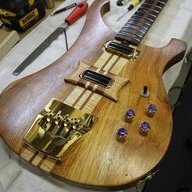
A teaser of the bindings.

Black, cream, abalone

For the inlays, border: black then cream, inlay: abalone. So the black goes next to the maple to set off the other colors.

I'm a little concerned when I get above the 12th fret that losing 6mm to the border will be problematic, so I might just do Black/Abalone and drop the cream on the narrower inlays.

20220817_213132.jpg
 
Last edited:
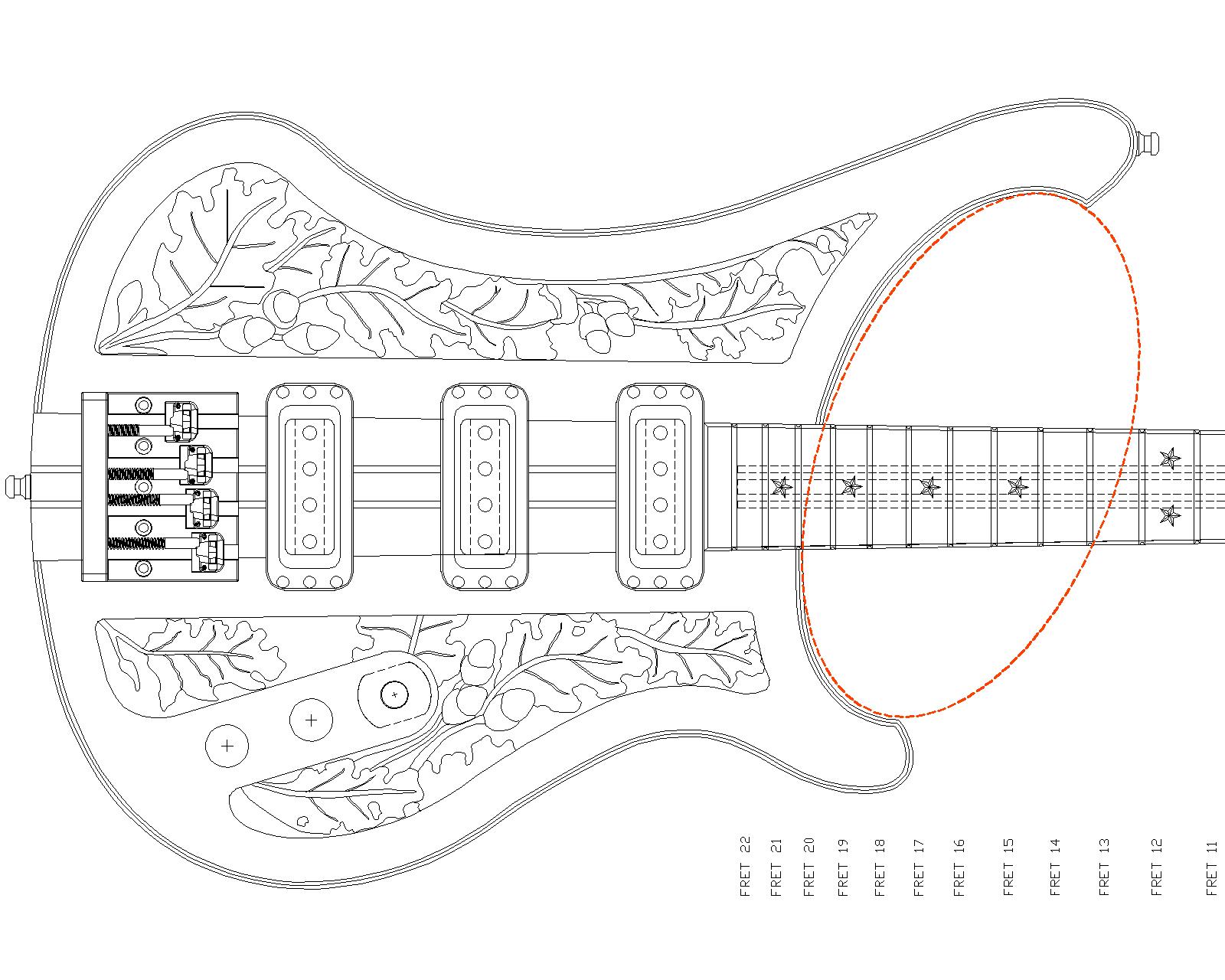
In other news, I got a good deal of work done on the AutoCAD drawings, and I am pretty happy with how this is coming together.

Based on this though, I may wind up going with the Gotoh 707 tuners again, as I am not exactly thrilled about the way the headstock is coming together. but I'll play with it and see if I can get it to something I am happy with.

One of my challenges is that the walnut board is only 44" long. and to do the neck through any longer than this, I will either need to splice 2 boards together (not ideal) or make it a set neck bass.

If I change the design to a set neck, it does greatly simplify the binding installation...

hmmm...

Screenshot 2022-08-17 221300.png
 
Last edited:
In other news, I got a good deal of work done on the AutoCAD drawings, and I am pretty happy with how this is coming together.

Based on this though, I may wind up going with the Gotoh 707 tuners again, as I am not exactly thrilled about the way the headstock is coming together. but I'll play with it and see if I can get it to something I am happy with.

One of my challenges is that the walnut board is only 44" long. and to do the neck through any longer than this, I will either need to splice 2 boards together (not ideal) or make it a set neck bass.

If I change the design to a set neck, it does greatly simplify the binding installation...

hmmm...

I used AutoCAD to do my Ric-based bass and it worked pretty well.

As for the neck, if the body is 1-1/4" thick, as I believe Ric basses are, the bolt-on neck might not be as solid as it is with the 1-1/2" thick bodies.

If you were to scarf the wood to make a through neck, you could put the joint line where it could be hidden, at least on the top.
 
  • Like
Reactions: Videojunkie
I'm planning on making the body closer to 1.5 thick, so there's adequate depth for a set in neck. It just requires a level of accuracy for fitment between the neck and body that I usually avoid using a through neck.

One of the reasons I like doing the Autocad thing is that I discovered that the bridge I acquired is wholly unsuitable for this bass. It has 19mm string spacing and musicman pickups are designed with 16mm spacing. Fortunately I found one that's inexpensive, and I think it's going to add another level of huh?! When people look at this bass. :bassist:

Maybe I'll save it for a PJ bass build...
 
Last edited:
  • Like
Reactions: Gilmourisgod
Nice work!

A couple comments:
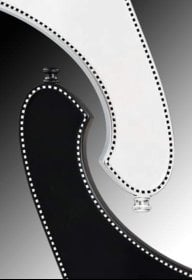
  • Can you fair in the inside curve of the upper and lower horns, so that it is visually one single curve? As drawn there is a discontinuity at the neck. @Gilmourisgod knows what I’m talking about, and even has a nice graphic to help explain it.
  • The curvy swoopy body seems incongruous with the straight-laced, utilitarian headstock. Is that intentional?
 
The curvy swoopy body seems incongruous with the straight-laced, utilitarian headstock. Is that intentional?

I know it's a simple headstock design, but I have used variations of it on all of my guitar builds. I think it is also a striking contrast to the curvy, swooping body shape, and reminds me a bit (in this incarnation) of the arrow shaped headstock on Prince's guitar.

Here it is on two other guitars I made..

20220818_172712.jpg


Yeah, there's a pretty strong implied ellipse in the negative space between upper and lower horns, so strong it looks jarring when you break it. That's one of the things that makes adapting Ric horns to other body shapes so difficult. Believe me, I tried.....
2YpJ4UG.jpg

Yeah, I think that's a good catch. Easy enough to fix. I'm also wondering if the body is a bit too long, as the attachment point is at the 17th or 19th fret, not the 20th (I haven't copied all the fret locations yet).

Opinions on pickup locations, control plate?
 
If you're doing a bolt-on neck and you're okay with 22 frets, I would just copy everything from the stingray body: pup location, neck pocket, etc.
If you're doing a bolt-on and want 24 frets, I'd still keep the pocket and pup location the same and do an extended board, so the neck pocket and pup cavity aren't one giant, connected hole.
 
  • Like
Reactions: Gilmourisgod
If you're doing a bolt-on neck and you're okay with 22 frets, I would just copy everything from the stingray body: pup location, neck pocket, etc.
If you're doing a bolt-on and want 24 frets, I'd still keep the pocket and pup location the same and do an extended board, so the neck pocket and pup cavity aren't one giant, connected hole.

Not a bolt on. It will either be a set neck or more likely a through neck.
 
I'm a Tonewood Agnostic, it still matters, but not nearly as much as pickup placement, electronics, and strings. If you like a Stingray Tone, match the pup locations. The same pickups in the same place are going to sound like a Stingray. I hope we don't come off like back-seat ballbusters on the design, I've tried and failed at original designs, this is HARD. So far I've just tweaked around the edges of classic designs, no real innovation. I tend to paint myself into a corner trying to work within the limitations of CAD, sometimes just breaking out some big french curves and sketching over a paper printout of your design with all the important stuff hardlined is just better...or not. In the end, if you like it, go for it.
 
@Gilmourisgod It's subtle, but I think this pretty much nails what you are describing.. I'm really glad you and @ctmullins caught that!

I think this pretty well captures both the symmetry of the Musicman, and the asymmetry of the Rickenbacker.

upload_2022-8-18_20-37-47.png


As I tell my colleagues at work when we're doing system engineering, catching these kinds of things in the digital world is so much easier and cheaper than catching them in the real world. A few pixels here and there aren't going to hurt my feelings at all.

Also, as I pointed out on my EUB thread, this is a hobby that I share with literally no one in my day to day life, so you guys (and gals) are my sanity checks and sounding boards. If I'm asking questions, it's because I want a second opinion or sanity check and I've nobody else who understands this. So I appreciate all of the comments, especially the critical ones. You make me think from other viewpoints, and introduce ideas that I either wouldn't have caught, or approaches I wouldn't have considered.
 
Last edited:
Not 100% sure I got the scaling right for the tuners as that got screwed up when I copied them from my other drawing, but I matched the post holes so it should be close. This is what the headstock would look like with the 707's That headstock is bigger than it looks! :)

I like the idea of the elephant ears on this one though...

upload_2022-8-18_21-46-25.png
 
  • Like
Reactions: Beej
I’m very much a “function over form” guy when it comes to headstocks and tuners. For me, function - in this case, balance - dictates that the tuners need to be as light as possible. For that reason, I never elect to use the elephant ear tuners, as even the compact Ultralite tuners are larger than is necessary to do the job. I am now firmly in the logical extreme of this thought process, and am building instruments with bridge-side tuners whenever the design allows for it.

I appreciate your compact headstock design! Are you mounting the tuners backwards from normal for a reason? They’ll work either way, it’s just not conventional.

And did you already mention - are you triple-binding that headstock?
 
Yes! the plan is to do a triple binding on the outside edges. I am also planning on doing a veneer of the birds-eye maple on the headstock so that it matches the body! I think that the black/cream/abalone combo looks pretty fantastic. This is going to be kind of my 'Bling' electric bass. (My Spector is black on black).

I'm toying with the idea for the arm bevel, of making that a hard angle, and doing a single abalone stripe at the cut point for the top. so the top will be full thickness down the bevel.

I mounted the tuners that way so that the angled bits would nestle together in the compact headstock. Like some of these things, once the tuners arrive I'll be able to better feel them in meatspace and make sure that this arrangement works.

With the top horn past the 12th fret and 2 big humbuckers, I'm not terribly worried about balance on this bass. I'm guessing this bass with be in the 8ish lb range..
 
Last edited:
I appreciate your compact headstock design! Are you mounting the tuners backwards from normal for a reason? They’ll work either way, it’s just not conventional.
I've always been under the impression that they will work backwards, but that they hold better going forward because of the lash of the round gear meshing with the leadscrew. That said, I just googled it and can't make that determination now. :D Any engineers know? :)

Do you guys know anyone who makes custom control plates? And can get them Chromed? I have a sinking feeling that that is going to become one of the most expensive parts of this project... (potentially even more than the pickups!)
The answer my friend, is nickel-silver plate. It can be had in project sizes, but it's been so long since I used it, all of my reference links are dead. :( The beauty is that you can cut it, file it, sand it, and generally shape it up the way you want, and then all of it will take a uniform high polish, and does not need to be chromed. It's not quite as silver shiny as chrome, but less bluish/greyish shiny than polished aluminum. :thumbsup: