• TalkBass has been independent since 1998. Add your voice.
    Create a free account to reply to discussions, view embedded media, and browse with fewer display ads.
    Join freeLog in
    Want zero display ads or expanded classifieds tools? Compare plans.

5-string vs. tuning down

What's the best way to play below E2?

  • Tune your 4-string to BEAD

    Votes: 25 14.7%
  • Buy a 5-string

    Votes: 134 78.8%
  • Transpose those low notes one octave higher on your 4-string.

    Votes: 7 4.1%
  • Stick with 4 strings, and just don't play anything below E.

    Votes: 4 2.4%

  • Total voters
    170
Foreword - This is a follow-up to my prior thread. (4-string vs. 5-string) Again, I'm a newbie, so this isn't intended to start a fight. It's me trying to figure out the best way to move forward.

As noted in the other thread, I like to play a lot of metal. In fact, my favorite band in the world is Type O Negative, and they tuned their guitars to B-Standard. Therefore, the bass was tuned to BEAD. So if I want to play along, I need to hit the sub-E2 notes.

So the question is this: if I want to play along, would it be better to restring the bass to BEAD tuning? Or just buy a 5-string?

Thanks for any advice you can give me.

-----

My (extremely ignorant) thinking on the matter:

4-string seems a little more comfortable right now. (Probably because that's all I play and that's what I'm used to.) However, with 5 strings, you still get a little more ability to move across the neck (rather than up and down), which seems to be a little easier. (Provided you can keep the string muted, that is....) Again, this may not be an issue in a few months, once I learn how to move around.

In real life--do you ever really play those high notes? Maybe if you're trying to do the Orion solo, but that's probably not realistic for me. (At least not for many years, when I won't be looking for advice from a bunch of randos on the internet.)

The most difficult thing (I think) about tuning BEAD is--most tabs (lessons, etc.) are written for 4-string, so I think that tuning BEAD might be a bad idea for a total noob, like me. So it may not be a good strategy right now, but may be a good idea in the future.
I voted get a 5-string because that's what I did when I played with a group that needed the notes found on a low B-string. I would just tune down my 4-string Jazz before that for a couple of reasons. One is that my maple-neck Jazz sounds really good, and the other is that it is really easy to move around the neck quickly. About the time that I needed to tune my E string down to B for 5-songs a night, I decided it made more sense to just buy an "OK" 5-string to play on those songs. Was not going to spend a lot of money on one because my Jazz sounds so good that I would continue to use if for everything that didn't need to play notes on the B-striing.

The problem with down-tuning for a single song 4 or 5-times a night is that eventually you are going to screw up and forget to tune it back up to E, especially if your group is in a hurry to start the next song. They you have to try to transpose that E string that is not tuned to E to wherever the note you're supposed to play is located on that string. I can tell you from experience, that SUCKS! Do that a couple of times and you'll immediately plunk down some $$ for a "real" 5-string instead of a tuning down the E string of your 4-string.

I didn't want to use a 5-string for all my songs, which is what the logical move was though because I really love the sound andd playability of my '82 Jazz with its maple neck and 70's era pickup spacing (4" center to center). I expected to pay $400 to $500 for a "part-time" 5-string but only ended up paying a little over $200 back in 2009. A friend recommended a Rogue 5-string back when they were made in Korea - they're made in Japan now. He swore by them and I ordered one.

I was really surprised when I received it because the fit and finish was superb, absolutely top notch. Although my Jazz has a narrow neck and the 5-string was much wider and flatter neck, it is still a slim neck and not a thick neck, so it's pretty easy to play. Now days with the made in China ones, you don't dare order it online like I did. You go to the GC, Sweetwater, or wherever they are sold and visually inspect it and then play it to decide if its right for you. Mine is the LX405 Pro and I think the current models are the LX405 ProIII. The Pro was made in Korea; Pro II was, I believe, made in Indonesia; and Pro III is from China. Quality went from best to good to "maybe this is a good one." Point is that there are decent 5-strings out there for a relatively small amount of money that will work just fine as a "sometimes I need a 5-string" bass, and it beats the heck out of drop tuning and re-tuning your bass for each song that begs you to use a 5-string.

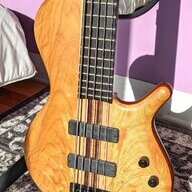
2basses1amp_2.jpg


Now if you're going to get a 5-string to replace your 4-string for all your songs, then you may want to spend good money and get something like this Leland Sklar Signature Dingwall 5-string. :woot::smug:
lee-sklar-ii-metallic-blueberry-sn-5819-e.jpg
 
I have done all the above.

My main bass is a 4 string with a detuner for Drop D.
I have a four string BEAD bass for low stuff.
I have a 5 string for low stuff if I still need the G string.

I mostly just play my main bass, and I have a Drop Pedal if I need to go lower for one song or so.

I fact I used it the other day when I jammed with the band I used to play with and found they now tune to Eb.
 
Really, consider having multiple basses, one each of the types that interest you. There are pros/cons to all configurations of the things you're looking at, and as you wade in your preferences will evolve. Start cheap, yet good enough and see where it takes you.

I started on 5's, but found I like how a J-spaced 4 feels in hand. Now have a few 4's tuned E, E-flat, D, plus a 5-string Ibanez. I might experiment with BEAD at some point too. I enjoy just picking up whichever is set for what I'm doing, and what I'm doing changes over time.
 
With a five-string bass you can play everything a standard-tuned four-string can play, everything a BEAD-tuned four can play, plus things that neither can play. Also songs that need the low B string followed by songs that need the high G string, without having to retune or change basses in between.

Having said that, some people just find four-string basses more comfortable. Of course they're wrong, but many still manage to have successful careers including making hit records, so ..
 
As I said in the previous post, you need to know how often you would need a G string. Chances are, not very often though. Listen to your favorite songs, do they ever have bass solos in them where the bass goes to the G string?
And yeah, of course a 4 is generally more comfortable. It's not as heavy, it's not as big overall, the neck lays more naturally in your hand. But if you go for the 5, go as early as possible.

Not tuning your bass differently because of tabs is not a valid reason imo. You'd want to learn how to play to the actual notes anyways. I'm not saying you should learn to play sheet music, but you need to learn the notes on your neck and then learn what the guitars are doing in your favorite songs. Figure out how the bass fits in with your favorite songs. With metal the bass often just doubles the guitars. So figure out if that's happening. That's how you start developing your own style, by learning how the people who influence you the most do it. Tabs kind of hide that, because you're missing the musical context in a way. You can often just look at chord charts for the guitars, and then play what the guitars play (though often with single notes and not multiple like guitars often do). And then you figure out if there are nuances to the bass playing on the original. Maybe there's a fill, maybe the bass actually isn't copying the guitars the entire time?

Of course I'm very biased by my own experience, but I've spent years playing to tabs, and after about 3 years I felt like I was making no progress at all anymore. So I started playing the same songs I learned with tabs again and relearned all of them with a deeper understanding of music theory. Which in turn also allowed me to very easily figure out new songs by ear, or with very little external help (like looking up what key a particular song was written in). Way more rewarding and fun, and your future self is gonna thank you a ton.
 
There is an appeal with going B E A D and I know a few players that swear by it.

I think for your situation this would likely be a good fit. There are certainly no shortage of 5 or 6 string bassist in metal but it’s extremely common to use a 4 string and drop tune.

I’ve used a 4 string for Drop G, Drop C, and A standard. Worked perfectly and you are correct in assuming you don’t use those high notes. I could have played the overwhelming majority of songs with 2 strings lol.

I strongly prefer playing a 5 string now though but I don’t remember the last time I even touched a 4 string at this point.

Good news is that whatever decision you make allows you to pivot and make the other, it’s a win-win.
 
Horses for courses.

The “ideal” instrument depends entirely on the gig.

The OP Poll does not include a 5th option, which is to replace the E string tuner with a HipShot Detuner, and learn to play with the DADG tuning.

I alternate between a 5 string bass and the 4 equipped with the HipShot Detuner, depending on what kind of low notes I need for a given gig. The 4 with the HipShot can do most gigs, handling most transposes etc. But, some tunes do require notes below low D; and for those gigs, I use the 5. Trivial example of the latter case would be covering Summer of 69 transposed to C, which requires the Low C to sound right.

I personally do NOT use the 5 to simplify fingering, sticking with Simandl fingering patterns, two notes per shift, on whichever configuration; and I tend to choose fingering based on how the part sounds best.

Anyhow, DADG is fun to learn and opens up a surprising realm of possibilities. OTOH the B string goes lower when needed. Again, best choice depends on the material being played. If I had to pick one, I’d pick both.:D
 
yeah, I need the G string. high octave, chords or just for playing Chameleon before 12th fret. some folks don't. do YOU need it? well, it's up to you

this all said, muting the high G is easier than muting the low strings, it's more a question of thicker fretboard and slimmer string spacing
 
If you are playing metal, there is a strong possibility you will need the open B string. When I played seriously in death/thrash metal bands in the early 90s, I tuned my P-bass BEAD. I had no budget for a second bass at that point of my life. The B-string was floppy, but it worked. We played everything with the same positions, just tuned one string lower (e.g. G was now D). Forget the original key. Kind of a pain in the ass for the singer (me), but we sounded brutal (in a good way).

The ideal case is having the budget to buy a five string bass with a good B-string. A set of strings and new nut is considerably cheaper than a new bass. I would try BEAD to see if it works for what you play.
 
The most difficult thing (I think) about tuning BEAD is--most tabs (lessons, etc.) are written for 4-string, so I think that tuning BEAD might be a bad idea for a total noob, like me. So it may not be a good strategy right now, but may be a good idea in the future.
Way easier than you think on a 5 string - just ignore the G string (ha ha) and play the BEAD strings. No need to transpose anything. No retuning. No re-setting up your bass.
 
  • Like
Reactions: Watchootognbout
A set of strings and new nut is considerably cheaper than a new bass. I would try BEAD to see if it works for what you play.

A new nut may not be necessary....if one uses a set of light gauge strings. I recently strung a few 4 bangers BEAD with la Bella low tension flats (118B) and Rotosound Swing Bass light rounds (120B) and no nut filing was required. I love the feel and sound of both of those strings. That said, if a 125 or 130B is the goal, yeah the nut'll have to be filed.
 
  • Like
Reactions: sid sonic
It depends. In some instances using drop D is best. For example, IMHO drop D would be best if your playing heavy music with a guitarist who is using drop D.

My choice is a 6-string Yamaha TRB-6P. It's been my #1 since about 1995.

Back when I only played 4-string, I occasionally used drop tuning to cover low notes. I only did this when I felt it was really important for the song. Most of the time I transposed notes that were out of range up an octave. But sometimes this can really damage a bass line.

An example where I used drop D. In the early 80s I was in a cover band that played I've Had the Time of My Life. The original bass line has an ostinato on the open E string and octave. We transposed the song down a step for our vocalist, so the low note of the octave riff was a D. I thought it really lost something to play the open D string and octave above...so I used drop D.

Heres' the song. Imagine the octave bass ostinato an octave higher:


Sometimes they did not allow time for me to retune, so I had to practice playing a few songs in both drop D and E standard. IMHO, This is an indication that no one thought it mattered but me.

Some players use a Hipshot drop tuner for this. A Hipshot would not have worked on the bass I was playing as the neck is not stiff enough.
Better to play this version.
 
  • Like
Reactions: Wasnex
oh boy here goes more fodder...early 4001 ric's are meant for LOW tension strings...they sing just fine with BEAD tunings on standard strings...wow does that neck thru construction shine...the neck loves the de tuned reduced tension as origionally designed...aka, low tension flats...my only complaint is "why did I buy my ric, 1975 version in 1975 with FRETS!" if I only knew then, and exclusively used, Labella tape wounds as I do now on my fretless jazz, EADG tuning Id say...what a way to ruin a perfectly good instrument with foolish frets !!!...feel the force Luke, whoohoo...ooh, aah, hmm... PS, buy a ric, with frets and use BEAD tuning. you will love it!..now back to finding that player who wants to swap his 4001 fretless Ric with my fretted version 4001...ss