• TalkBass has been independent since 1998. Add your voice.
    Create a free account to reply to discussions, view embedded media, and browse with fewer display ads.
    Join freeLog in
    Want zero display ads or expanded classifieds tools? Compare plans.

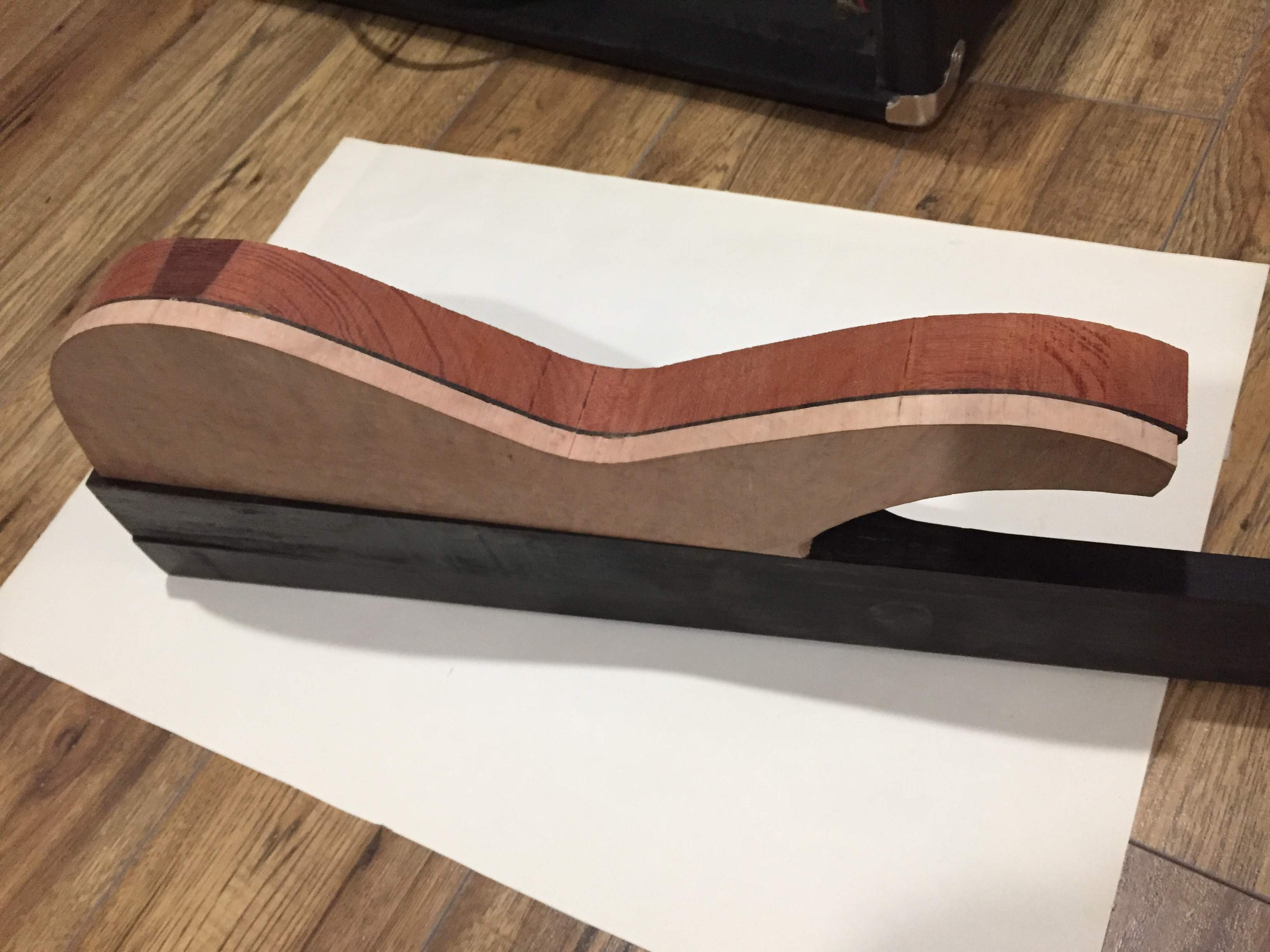
I have one half glued and trimmed further to size. Once the other side has dried and been trimmed its off to the spindle sander to refine the shape before gluing to the neck blank.
IMG_1233.JPG
 
Got the other side trimmed so now on to the spindle sander. The neck blank has the back of the body section readied so now I have to plane off the front before attaching the wings. I build in a slight backward neck angle in all my neck through basses. I find it gives a more natural look and when wearing the bass it doesn't feel like the neck to bent away from you.
IMG_1235.JPG
IMG_1236.JPG
 
Last edited:
I have been trying one of these Saf-T-Planers. Not sure if I like it. Having gone through the process of aligning my table and trying thin cuts I find it jumpy, seems to ride on top of the wood and just not give a very nice surface. Maybe I am doing something wrong but according to the instructions it would seem not. I am working with ebony which is why I have been trying extra thin cuts. The blades seem sharp as it is new but I do notice a lot of heat buildup. Has anyone else tried this rig?
IMG_1238.JPG
 
Last edited:
  • Like
Reactions: erbesoderpayaso
@rudy4444 is a master with this.

I have had some amateur trials and tribulations...

One thing I discovered was that I had been putting a lot of downward pressure on the piece when running it through (mainly because I was apprehensive in its use), that caused the table on my cheap drill press to bend down slightly during the "cut" resulting in upward pressure of the wood onto the planer when released. I hope that's somewhat clear...

Another thing I found is that some woods (e.g. purpleheart) just don't work well with this tool, burns and chatters, whereas others (e.g. walnut) plane like butter.

YMMV, as they say, but I think it's also a matter of practice and technique.
 
  • Like
Reactions: Slidlow
@rudy4444 is a master with this.

I have had some amateur trials and tribulations...

One thing I discovered was that I had been putting a lot of downward pressure on the piece when running it through (mainly because I was apprehensive in its use), that caused the table on my cheap drill press to bend down slightly during the "cut" resulting in upward pressure of the wood onto the planer when released. I hope that's somewhat clear...

Another thing I found is that some woods (e.g. purpleheart) just don't work well with this tool, burns and chatters, whereas others (e.g. walnut) plane like butter.

YMMV, as they say, but I think it's also a matter of practice and technique.
Mucho helpful, thanks. I too may have being flexing the table down as you indicate. I will have to play with it some more.
 
My next step will be routing for the two KTS titanium double acting truss rods. I had a router guide machined some time ago for this style rod so that will be what I will use. just gets double taped to the surface and the router has a guide that engages in the slot. I take my time with multiple thin cuts starting with a square edged bit and a round end bit for the final cuts to depth. I little judicious hand cutting for clearance around the end blocks of the rods and she will be ready for the fingerboard.
IMG_1240.JPG
IMG_1241.JPG
 
I love that piece of ebony, great centerpiece for this instrument.

Yes it was one of two perfectly quartersawn pieces I found at local exotic wood store. Bought them about twelve years ago. One made it into my five string and this one is becoming a six. I doubt I will ever do another with ebony due to its rarity now. My saving grace with these boards is I got about ten bass fingerboards and six guitar fingerboards from the off cuts and I have enough ebony for trim and inlays for my lifetime.
 
  • Like
Reactions: Jisch
IMG_1242.JPG
IMG_1244.JPG
IMG_1245.JPG
I tried the Saf-T-Planer again this time on the Rengas and helpful hints from I-Am-The-Slime. The results were much more satisfactory. Just a light sanding to take out the planer marks and the back of the wings are pretty much ready. There will be more final sanding once glued. Next for these will be the hole for the screw-in output jack and a cavity for the preamp and controls on the upper part of the body.
 
Last edited:
  • Like
Reactions: I-Am-The-Slime
Dang, those are some pretty truss rods!
Just look at those tiny perfect little weld beads!
Amazingly good craftsmanship there.
Kinda geeking out here... but damn!
Too bad the manufacturer quit making them.

Question for you @Slidlow
Do feel it necessary to "wash" the joint when gluing ebony? As in, using acetone or similar, to remove the oils from the surface...for better adhesion?
 
  • Like
Reactions: Slidlow and Beej
Dang, those are some pretty truss rods!
Just look at those tiny perfect little weld beads!
Amazingly good craftsmanship there.
Kinda geeking out here... but damn!
Too bad the manufacturer quit making them.

Question for you @Slidlow
Do feel it necessary to "wash" the joint when gluing ebony? As in, using acetone or similar, to remove the oils from the surface...for better adhesion?
Maybe if enough people pressed them KTS might make again? From my contact with them they had indicated a few end user complaints regarding stiff threads when making adjustments. All titanium has more friction thread to thread so prelubing and insuring no glue gets to the rod is important. I wouldn't mind participating in a campaign to bring them back? They are really cool and the quality is above anything I have ever seen.
Re gluing ebony: I haven't had any issue yet. I leave the mating surfaces sanded to about 80 grit and insure the wood is up to room temp. I haven't found the ebony I have used to be oily but there is risk of a cold glue joint.
 
I haven't found the ebony I have used to be oily
I haven't really either... but the "wood data base" online, states it as such... and recommends the washing procedure I mentioned, which I totally agree with for woods such as Teak for instance. But not so much with the ebony I've come across.
But I suppose the age and drying process used (kiln v air) would have some bearing.
 
  • Like
Reactions: Slidlow
I have been occupied with other projects but did sand out the madrone and the center body section of the neck through. The burl is starting to show nicely and I expect it will be more pronounced when finished. I may consider a thin color wash to enhance the figure before the oil finish. Maybe a light red to tie the top to the color of the rengas. We will see once I get it all together.
IMG_3222.JPG
IMG_3223.JPG
 
I have been really swamped with house renovations so haven't progressed much. Worked a little on the neck blank but nothing worth reporting. It might be April before I can put some serious time in on this.