• TalkBass has been independent since 1998. Add your voice.
    Create a free account to reply to discussions, view embedded media, and browse with fewer display ads.
    Join freeLog in
    Want zero display ads or expanded classifieds tools? Compare plans.

6550 Tubes for Ampeg SVT

This is why "not clipping" is not always consistent with THD, and why some amps may sound richer to some players at lower volumes because of non-linearities within the signal itself.

Global feedback suppresses this, but as soon as the amp clips, the global feedback loop opens which results is abrupt and unpredictable entering and exiting characteristics as the amp begins to overdrive. There needs to be a happy medium between the two extremes.
 
Is there an actual spec for the current the SVT's are biased at? Only measurement I've seen is 28mA. Seem correct?
Also, any other amplifiers use six 6550's?

On the vintage SVTs and the SVT-II the bias setting was 72mV (72mA through the 1 ohm cathode resistors) per trio of power tubes. I would image the modern amps are close to that.

As for other amps running 6x 6550s, off the top of my mind

fender super bassman
fender bassman 300T/sunn 300T
Fender custom shop rumble 300
DCA blackmark 300
Verellen meatsmoke
Mesa bass 400 (could run 6550 or 6L6 I believe)
eden VT300
Trace V6?
Markbass classic 300
The bugera/behringer svt clone
 
Last edited:
Is there an actual spec for the current the SVT's are biased at? Only measurement I've seen is 28mA. Seem correct?
Also, any other amplifiers use six 6550's?

I believe 28mA is the assumed average for the SVT CL.

Here is an analysis I found of the SVT CL bias sense circuit:

upload_2023-3-31_15-53-26.png


You get green when all three tubes in a circuit pull 15mA or more. You get red if one or more tubes pull 30mA or more.

So the tubes are considered in range as long each tube is pulling between 15mA and 29mA.

For vintage SVTs the bias measurement is 72mV. The average current through each of three tubes is 72/3 = 24mA.

With about 690V on the plates, that's just under 50% dissipation for a 35W tubes.

The TE V6 also runs about 690V on the plates. Factory bias is 30mA +/- 2ma. That's a bit under 60%. The TE V8 is biased to 30mA +/- 2mA.

I believe the recommended bias for the Reeves 400 is about 35.5mA. That just under 70%.

If I know the factory bias for an amp, I follow it. If I don't know the factory bias then I set the cathode current = to 70%. But the dissipation is actually based on the plate current. Since a small percentage of the cathode current will go to the screens, the plate dissipation works out to be a bit less than 70%.
 
I recommend starting at 50% of screen + plate power dissipation and see how it sounds. Try 60% and if it sounds better than fine, never exceed 70% (cathode current).

To do it this, you need to know the plate voltage and the cathode (plate + screen) current.
 
Upon reflection. I usually calculate 70% and then set the current a bit below that...so probably in the range of 60-65%.

There are some exceptions. I believe all of my cathode biased amps are running around 90%. Vox AC30, Ashdown LB30 Mk1 and Mk2, Ashdown CTM 30 Little Stubby. These are all running EL84s. I run the Vox at 110V on a variac, or it would run even hotter.

Also my Matchless ThunderChief gets biased between about 70% to 90%. This amp was claimed to be class A, and pretty sure factory bias was over 100%. I have seen photos of this model where the output tubes got so hot the glass melted. Mine runs 540V on the plates and the hottest tube is currently set to 45mA, which is just under 70%.

Factory bias for Orange AD200B is 18-22mA I believe they run about 675V on the plates. 22mA is about 40%.

Factory bias for the Aguilar DB359 is 60mV/2 = 30ma per tube average, which is about 60%

Bassman 300 Pro was originally biased to 100mV, but this was later revised down to 80mV. 80/3 = 27ma, about 50%. The output section in this amp is very, very similar to the SVT output section (same designer).
 
Upon reflection. I usually calculate 70% and then set the current a bit below that...so probably in the range of 60-65%.

There are some exceptions. I believe all of my cathode biased amps are running around 90%. Vox AC30, Ashdown LB30 Mk1 and Mk2, Ashdown CTM 30 Little Stubby. These are all running EL84s. I run the Vox at 110V on a variac, or it would run even hotter.

Also my Matchless ThunderChief gets biased between about 70% to 90%. This amp was claimed to be class A, and pretty sure factory bias was over 100%. I have seen photos of this model where the output tubes got so hot the glass melted. Mine runs 540V on the plates and the hottest tube is currently set to 45mA, which is just under 70%.

Factory bias for Orange AD200B is 18-22mA I believe they run about 675V on the plates. 22mA is about 40%.

Factory bias for the Aguilar DB359 is 60mV/2 = 30ma per tube average, which is about 60%

Bassman 300 Pro was originally biased to 100mV, but this was later revised down to 80mV. 80/3 = 27ma, about 50%. The output section in this amp is very, very similar to the SVT output section (same designer).
Bill became a little more conservative as he got older.
 
Is there an actual spec for the current the SVT's are biased at? Only measurement I've seen is 28mA. Seem correct?
Also, any other amplifiers use six 6550's?
28mA per tube may still be fine for some amplifier that was of some different design than SVT design. Or just even be fine for folks who want to run a svt at "highish side" of biasing current draw than svt standard biasing.
Once you ask a question about what's the correct biasing number for 6550 tubes in general, independent of amplifier design, than the answer must be, it depends.
 
Last edited:
I think its a good bet to start at ~50% power dissipation (at idle mode) such as @agedhorse does recommend.
Yet total bias current draw numbers on its don't tell anything about the amount of biasing.
While about ~25mA of biasing may be fine for a low power amplifier with good portion of class-A but, for a high power AB-class design just same number ~25mA may not have same outcome of biasing in total consideration.
 
Last edited:
Thanks for all of that, wonderful community we have here. I'm guessing most have seen that I picked up a prototype VHT bass amp. I'll have tubes for it in a few weeks and trying to learn all I can about it through other designs. I appreciate any help you all care to provide.;)
 
If I recall correctly then the Vox AC30 does draw some decent bias current (close to class-A) in the expense of quite lowish 30 Watts of output power.

Here are my notes:
AC30 Voltages and Bias
Variac__________110V/1.1A
Heater_________6.25V
Plate___________330V
Screen_________323V
Control_________45/55mV
Cathode________11.09V
Effective Plate___319V
Cathode Resistor_82 ohms (one resistor for all four tubes/4 x 82 = 328 ohms effective)

Target Bias_________90%_______________95%_____________100%
____________33.8ma/135.3ma_____35.7ma/142.8ma____37.6ma/150.4ma

Actual Bias 135.2ma.

LB30 Mk1
Variac 120V/0.92A
Plate = 329V
Cathode = 10.5V to 11.5V
Effective Plate = Average 318V
Total Cathode Resistance = 320 Ohms (per tube)
Calculated Cathode Current range = 32.8-35.9mA
85% dissipation = 32.1mA
90% dissipation = 34mA
95% dissipation = 35.8mA
Seems to be setup pretty similar to the AC30 as far as I can tell.
LB30 Mk2
Variac 120V/0.84A

I didn't document the other readings on this amp yet. However as it's pulling less current through the variac, so the output tubes are probably running a bit cooler.

CTM 30 Little Stubby
Variac 120V/1.04A

Little Stubby is a similar design to LB30, with a quad of cathode biased EL84s. This one has an additional preamp tube and a fan, so I don't think the extra current is a concern. Seems a bit down on power from the LB30s.

I don't think there where really "exceptions to the rules" that much.

I was under the impression that the OT would be set up a bit different for an amp that is intended to be more Class A.

The Matchless was claimed to be Class A and really does seem to sound best biased fairly hot. With JJ KT88s, I thought it sounded best around 90%. With the Shuguangs I have in it now, I thought it sounded better around 70%.

This is claimed to be a 200W amp, but it's the weakest 200W amp in my collection. Seems closer to 100-120W. Definitely an edgy design. It does have a unique and very desirable sound though.


 
  • Like
Reactions: Patrice B
Here are my notes:

I was under the impression that the OT would be set up a bit different for an amp that is intended to be more Class A.
SVT is an class-AB amplifier. You may give that beast some more of bias, it'll remain class AB.

AC-30 is a totally different animal in this regard and with its rather smallish 350V on its plate. Its not valid to compare them "directly" each other by any pure numbers. Thus no way to directly compare them each other by bias current draw numbers per tube.


The Matchless was claimed to be Class A and really does seem to sound best biased fairly hot.
At least VOX AC-30 design is aligned close enough to be called class-A.
For the SVT amplifier I'm pretty pretty well sure that you don't want to bias your SVT that high that it does match the same biasing like VOX AC-30 amplifier.
 
Last edited:
Btw biasing does already change (at some content) once there was load equal to 2.7 Ohm or 5.3 Ohm present to the 4 Ohm tap of output OT, although biasing current draw throughout the amplifier does not change any bit just this moment.
This may sound a little bit strange but, that's the way how it is with tube amplifiers.
 
Last edited:
SVT is an class-AB amplifier. You may give that beast some more of bias, it'll remain class AB.

AC-30 is a totally different animal in this regard and with its rather smallish 350V on its plate. Its not valid to compare them "directly" each other by any pure numbers. Thus no way to directly compare them each other by bias current draw numbers per tube.


At least VOX AC-30 design is aligned close enough to be called class-A.
For the SVT amplifier I'm pretty pretty well sure that you don't want to bias your SVT that high that it does match the same biasing like VOX AC-30 amplifier.

I know you can't compare the raw current numbers. That's why I provided the plate voltage. From the current, plate voltage, and tube specs, you can see how high the dissipation is.

The only fixed bias amp I run over 70% dissipation is the Matchless.

My SVTs sound fine biased to spec, 75mV for the 69 and 72mV for the 87. This is way below 70%.

AFAIK the general rule for an AC30 or similar amp is about 90% dissipation, but some people like to run them much hotter. I have run the AC30 on line voltage (120V), but only for a short time as I don't care to replace tubes frequently. And to be honest, I think it sounds best at 110V anyway, where it biases to about 90%.

No chance I will gig it, so it's fine on the variac. Some suggest installing a 12V bucking transformer or subbing a tube rectifier such as 5V4 or 5R4 that will drop more voltage than GZ34/5AR4 .
 
No chance I will gig it, so it's fine on the variac. Some suggest installing a 12V bucking transformer or subbing a tube rectifier such as 5V4 or 5R4 that will drop more voltage than GZ34/5AR4 .

I hate to derail the topic, but I really want to ask about that term "buck transformer" or "bucking transformer"....

Back in the production days, we would rent huge projectors for several graduation events in our area. I think they were, what, 20K lumens units? Huge rascals that required 30 amps single-phase. The providers sent along a "buck" transformer for each projector. Pretty simple to connect to power, but the buck transformer had to be in use. The projectors came with the transformer mounted in a separate box with L14-30 twist lock connectors (the neutral tab not used), a cable with 2 twist locks and a cable with one twist lock and bare wire to be tied in directly to a double-pole 30 breaker or proper disconnect.

What does the term "buck" or "bucking" mean?

Thanx!
 
I hate to derail the topic, but I really want to ask about that term "buck transformer" or "bucking transformer"....

Back in the production days, we would rent huge projectors for several graduation events in our area. I think they were, what, 20K lumens units? Huge rascals that required 30 amps single-phase. The providers sent along a "buck" transformer for each projector. Pretty simple to connect to power, but the buck transformer had to be in use. The projectors came with the transformer mounted in a separate box with L14-30 twist lock connectors (the neutral tab not used), a cable with 2 twist locks and a cable with one twist lock and bare wire to be tied in directly to a double-pole 30 breaker or proper disconnect.

What does the term "buck" or "bucking" mean?

Thanx!

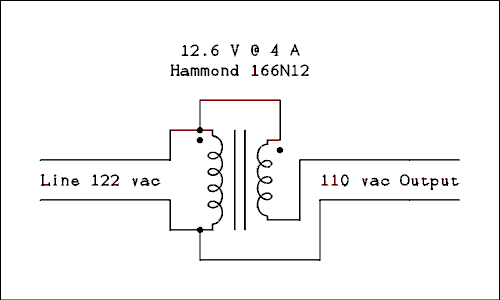
The idea is to use something like a 12V filament transformer to feed the primary of the PT lower voltage.

For example, my AC30 needs about 110V for optimum sound, so you could wire up something like this to feed the PT


upload_2023-4-1_0-22-18.png


XFMR_Buck_Boost.gif
 
Last edited:
I hate to derail the topic, but I really want to ask about that term "buck transformer" or "bucking transformer"....

Back in the production days, we would rent huge projectors for several graduation events in our area. I think they were, what, 20K lumens units? Huge rascals that required 30 amps single-phase. The providers sent along a "buck" transformer for each projector. Pretty simple to connect to power, but the buck transformer had to be in use. The projectors came with the transformer mounted in a separate box with L14-30 twist lock connectors (the neutral tab not used), a cable with 2 twist locks and a cable with one twist lock and bare wire to be tied in directly to a double-pole 30 breaker or proper disconnect.

What does the term "buck" or "bucking" mean?

Thanx!
It may have actually been a 480-240 or 480-208 step down transformer, or 208-240 step up transformer.
 
Reverse the connections and you get a boost:
View attachment 5017658
May it happen that some serial inductance that was added to the voltage supply does have an effect to the total sound of the amplifier?
As far as I can tell some (pure) voltage drift at the line voltage does not have an noticable effect to the sound. At least as long as cork sniffing territory was not touched.

IMO/IME for line voltage adjustments there where autotransformers more commonly used in the past, and probably still will.

Autotransformer - Wikipedia

As there is no galvanic insulation present (and not necessary) these transformers help very effectively to save weight and costs.
 
Last edited:
  • Like
Reactions: agedhorse