• TalkBass has been independent since 1998. Add your voice.
    Create a free account to reply to discussions, view embedded media, and browse with fewer display ads.
    Join freeLog in
    Want zero display ads or expanded classifieds tools? Compare plans.

6550 Tubes for Ampeg SVT

As far as I can tell some (pure) voltage drift at the line voltage does not have an noticable effect to the sound.

I have never tried a bucking transformer, so I can't really comment on what impact it may have other than lowering the voltage.

I have played with feeding different line voltages to several of my tubes amps. I used my variac to adjust the voltage to 120V, 115V, and 110V. Perhaps I am fooling myself, but I feel that there were subtle changes in tone and the way the amps responded dynamically to touch. Any differences noted were subtle at best.

Some of my other British amps seem to like 115V. Some of these amps produce higher PS voltages on 120V/60hz line.

Most of my amps sounded best at 120V, so it's not like I think simply lowering the line voltage always results in better tone and response.

With the AC30 I am mostly concerned about keeping operating voltages and bias within a suitable range for reasonable tube and capacitor life. It's not unusual for this era of amp to bias at 115% dissipation on 120V/60hz. Some people think they sound great running that hot...but I disagree.

I had to replace several capacitors and some tubes in my 76 Matamp GT120. It started having problems after playing the amp to the US for a couple of years. Opened it up and several of the capacitors were swollen/leaking. Checked the operating voltages and several filter capacitors were being pushed over spec. This amp was running fine in Deutschland on the original capacitors.

I selected replacement capacitors with a higher voltage rating and also increased the value of the resistor feeding the preamp supplies to bring the plate voltages of the tubes closer to spec. Had to replace a couple of noisy plate resistors on some of the preamp tubes as well.
 
  • Like
Reactions: Patrice B
I used my variac to adjust the voltage to 120V, 115V, and 110V.
I have got no idea how the "variac" in reality works to adjust voltage.

At least what I can tell to my extent, once I'd notice some deviation in sound due to some voltage drift, then I'd very likely check out lower and upper bandwidth limits and also step/impulse response, or at least beahavior at burst.
 
Last edited:
  • Like
Reactions: Wasnex
At least what I can tell to my extent, once I'd notice some deviation in sound then I'd very likely check out bandwidth and also step/impulse response, or at least beahavior at burst.
:thumbsup:

I don't have the necessary equipment to do that.

I set up all my fixed bias amps to run on 120V, and that is where I typically run them; even if I think they sound subtly better on 115V.

The AC30 is the only amp I consistently adjust the variac down on, it's specifically to cool the tubes off a bit. Sometimes I set the Matamp to 115, but not usually.
 
  • Like
Reactions: Patrice B
I have got no idea how the "variac" in reality works to adjust voltage.

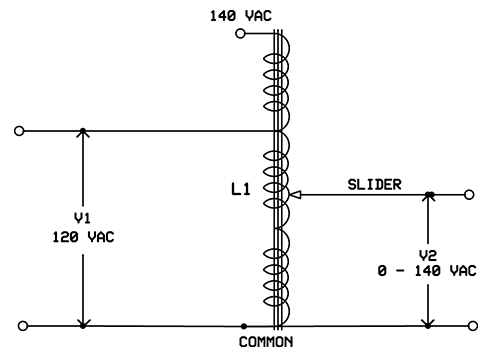
AFAIK it's a form of autotransormer that allow you to set the voltage continuously, rather than incrementally.

NV_0608_Reed_FIG1.jpg
 
AFAIK it's a form of autotransormer that allow you to set the voltage continuously, rather than incrementally.

NV_0608_Reed_FIG1.jpg

I didn't do any math to it, thus its nothing but rather theoretical consideration if serial indictance may have an effect that may sound "subtly better" as you told above.
The consideration is just like the following, current draw at the supply follows roughly the current draw at the amplifier output, thus the draw is anything but of sinusoidal waveform 50/60 Hz.
The inductance that is in series to the voltage supply "might" have kinda of slightly subtile effect to the performance of the amplifier.
Yet I didn't do any math to this topic though.
 
  • Like
Reactions: Wasnex
May it happen that some serial inductance that was added to the voltage supply does have an effect to the total sound of the amplifier?
As far as I can tell some (pure) voltage drift at the line voltage does not have an noticable effect to the sound. At least as long as cork sniffing territory was not touched.

IMO/IME for line voltage adjustments there where autotransformers more commonly used in the past, and probably still will.

Autotransformer - Wikipedia

As there is no galvanic insulation present (and not necessary) these transformers help very effectively to save weight and costs.

I have got no idea how the "variac" in reality works to adjust voltage.

At least what I can tell to my extent, once I'd notice some deviation in sound due to some voltage drift, then I'd very likely check out lower and upper bandwidth limits and also step/impulse response, or at least beahavior at burst.
A typical buck-boost transformer is in fact an autotransformer, the tapped winding is common to the input and output therefore is not isolated.
 
How much does heat matter to power tubes? I'm guessing when biased properly they should run at a safe temperature, but when is a fan needed? Some spec sheets I've looked at show a max temp of 250* C, if a fan is used, is there a point when if it's cooled off to much there's operational issues?
 
  • Like
Reactions: Patrice B
250 degrees C is the maximum envelope temperature. Fan cooling is used to keep the envelope temperature down where convection cooling is inadequate. This is especially true for operating in high ambient conditions, or in tight/restricted spaces.
 
wait how are these winged C’s so reasonably priced? When I checked a few years ago the factory had shut down and prices were crazy.

My thoughts exactly. They shut down more than 10 years ago and prices have skyrocketed. I'm frankly amazed that anyone still have matched quads in stock.

The last years of production also had serious issues, presumably due to poorly maintained equipment. I'm not sure if this affected all their different types of tubes but their last years of KT88s would just blow up in your face within seconds due to a problem with the vacuum (even when I purchased them as a tested/burned-in/matched "Premium" quad from a highly regarded tube re-brander). I would be VERY wary about anyone selling Winged C tubes are "reasonable" prices these days. At least unless it's from a dealer I trust 100%.

Before things went downhill they were the last of the REALLY good tube manufacturers from the golden age of tube production IMO (although for some reason I think they never managed to design a 12AX7 that worked properly...).
 
Last edited:
My thoughts exactly. They shut down more than 10 years ago and prices have skyrocketed. I'm frankly amazed that anyone still have matched quads in stock.

The last years of production also had serious issues, presumably due to poorly maintained equipment. I'm not sure if this affected all their different types of tubes but their last years of KT88s would just blow up in your face within seconds due to a problem with the vacuum. I would be VERY wary about anyone selling Winged C tubes are "reasonable" prices these days. At least unless it's from a dealer I trust 100%.

Before things went downhill they were the last of the REALLY good tube manufacturers from the golden age of tube production IMO (although for some reason I think they never managed to design a 12AX7 that worked properly...).

I can't vouch for the quality of the tubes, but I am sure I am not the only TB member with a very favorable impression of TC Tubes. I trust them more than most other tube vendors, which is not necessarily saying a lot.

FYI, The Winged C KT88s are a fairly recent addition to TC Tubes' offerings. Before Covid they sold primarily current production New Sensor tubes, with a few NOS/ANOS mixed in from time to time. I believe these tubes (and all the other output tubes they currently sell) popped up as their new stock dwindled, just before prices went through the roof. AFAIK TC has not raised the price since the tubes were listed.

AFAIK, tubes from the last year or two of Winged-C production were very problematic. I believe they shut down in 2012. The tubes TC is offering appear to be from earlier when Winged-C was still considered among the best available.

Note the description from the product page:
upload_2023-4-2_13-45-18.png

So these do not appear to be from the last years of production.

It's possible these are seconds. If you don't know, big companies can buy tubes that have been tested/QC'ed to different quality levels. When they receive a big batch of tubes, the company does their own testing and return tubes that don't meet their standards for credit.

Not all rejects are considered bad tubes. Often functioning rejects are sold to other tube vendors, who test, grade, and sell them as A-stock. So it's possible these are not the top quality tubes sold by premiere sellers, but they still may be of the same quality sold by various tube vendors back in the day.

If you have concerns, call TC Tubes and ask for additional details, and also ask if the tubes carry any sort of warranty.

At $90 a pop, I would choose current production JJ 6550 at $60 each. Back when Winged-C was still pumping out good tubes, Winged-C and JJ were generally considered the best.

TC also offers some VA 6550A for $49. These should be Shuguang 6550A, which had a decent reputation. Unfortunately Shuguang has also stopped production.
 
Last edited:
What about the clear top Svetlana 6550b they list from the 90’s? What’s the story on those? SVT capable?

I have a 73 SVT with GE 6550’s. I am thinking about using it this summer on the 6 or so gigs we have scheduled. I was practicing through it yesterday and noticed it wasn’t sounding clean. I looked around back and noticed the 2nd and 5th tube were red plating. Checked the bias with a volt meter, and it was way out…. Like .224. I turned it down and it has settled at .072 for both sides. Not sure how long those tubes were running red, but they aren’t now. It is quieter now after making the adjustments. That said, I’m thinking I might need to look for a quality sextet. I did order some a year ago (Fender GT branded 6550we), but I understand those aren’t the greatest and I just picked them up right as the war was starting.
 
Last edited:
Checked the bias with a volt meter,
I highly suggest to use a high quality voltmeter that provides a suitable measuring range for ~70..80mV measurements
Many folks probably do the mistake just to measure smallish voltage numbers at quite too large measuring range.
For example if the measuring range was 5V at 4 digits of reading, just in the form of
0.072 V
then there is a good chance to receive a highish measurement inaccuracy.

Even for high quality meters the measured variable shall at least reach ~5% of range just to keep measurement errors small as possible

and it was way out…. Like .224.
hard to believe it was even possible to set bias that high.
Yet it might have something to do with cheap (crappy) voltmeters that suck on sufficient accuracy at mV measurements.
 
Last edited:
Checked the bias with a volt meter, and it was way out…. Like .224.
Once your voltmeter does not provide a 500mV range or something similar such as 200mV then you may try hard to get measurement results of sufficient accuracy.
Btw although the schematic reads 0.072V, this does not mean that someone shall measure this voltage at a voltage range such as 5V range on the meter.
 
  • Like
Reactions: Patrice B
It could have been user error or maybe I am remembering it wrong as I immediately started cranking it down and got it to the .072 range. I was shocked and was scrambling when I saw the number. I used 2V and then flipped to 200mv I believe. Got both sides really close and when putting the probes in 1 and 2, it was .06 or so after running it for 15 min. The adjustments are so sensitive it is a little tough to get it where you want. Anyway, I’m not an amp tech obviously but it seems much happier and running quieter now. I just hope the two tubes that were red plating aren’t on their way out.

Unfortunately, I won’t get a chance to play through it again until Wednesday or Thursday. I did a quick test last night and no red plating and it was running quiet. Plugging a bass in, it sounded good. I only had about 30 sec with it though, so we will see later this week.
 
Last edited:
  • Like
Reactions: Patrice B
It could have been user error or maybe I am remembering it wrong as I immediately started cranking it down and got it to the .072 range. I was shocked and was scrambling when I saw the number. I used 2V and then flipped to 200mv I believe. Got both sides really close and when putting the probes in 1 and 2, it was .06 or so after running it for 15 min. The adjustments are so sensitive it is a little tough to get it where you want. Anyway, I’m not an amp tech obviously but it seems much happier and running quieter now. I just hope the two tubes that were red plating aren’t on their way out.

Unfortunately, I won’t get a chance to play through it again until Wednesday or Thursday. I did a quick test last night and no red plating and it was running quiet. Plugging a bass in, it sounded good. I only had about 30 sec with it though, so we will see later this week.
Once you call them by numbers starting form left to the right (back viewing), which ones did glow red?

I can't tell exactly anymore cause its way to long time ago. It was about in the late 70's, a couple of months ago when I purchased my SVT as brand new, two or three tubes started to glow red. The reason was a schematic fail (as far as I can recall). I had to ship the amp to the service-center of the shop where I purchased the amp.
The thing I try to tell is, there might be an issue with your amp that you can't fix by biasing.

Yeah, good old USA quality made in the 70's, my 1978 SVT didn't even keep up ~6 months of occasional use without suffering the first issue. And I have to tell several issues followed behind.
Sometimes it is as is, no luck, s_h_i_t happens.
Yet I still keep my SVT till today, and probably will !!!
 
Last edited:
The middle one of each set of three. Not sure if that’s random or those two are linked together


The tubes are linked in circuits of three. From left to right let's call them 1,2,3 and A,B,C

1,2,3 work together and are connected to one side of the output transformer. A,B,C work together and are tied to the other side of the output transformer. This is called push pull.

The cathodes of all three tubes in each circuit are tied together and connected to ground through a 1 ohm bias sense resistor. So one bias sense resistor sums the current of 1,2,3 and the other bias sense resistor sums the current of A,B,C.

The bias adjustment ensures the total current pulled by 1,2,3 = the total current pulled by A,B,C. It does not ensure 1,2,3 all pull the same current and it does not ensure A,B,C all pull the same current.

The bias setup involves adjusting for 72mV across each 1 ohm bias sense resistor. Sine the resistor is 1 ohm, the math to figure the current is easy: 1mV indicates 1mA of current and 72mV indicates 72mA of current. If each tube was perfectly matched the current would be 72/3 = 24mA per tube.

If one tube stops working, you can probably still adjust for 72mV...but then each of the functioning tubes is pulling 72/2 = 36 mA.

Since you indicate that tube 2 and tube B were read plating, it's likely that tube 2 is running hotter than tubes 1,2. Also tube B is running hotter than tubes A,C.

You may be able to sort the tubes into a different order to get a better current match. To do this you need some way to measure the current of all three tubes in each trio.

Ideally all six tubes match, but since the SVT has two bias circuits, it's not critical. However, it is preferred for the three tubes in each trio to match as closely as possible. In other words 1,2,3 need to match, and A,B,C need to match. Also ideally trio 1,2,3 has similar plate current and transconductance characteristics to A,B,C. The idea is if a matched sextet is not available, you can buy two matched trios that are reasonably similar.
 
250 degrees C is the maximum envelope temperature. Fan cooling is used to keep the envelope temperature down where convection cooling is inadequate. This is especially true for operating in high ambient conditions, or in tight/restricted spaces.


Something I've always wondered, does cooling down the glass envelope cool down the heater filament also? If not, what is the purpose?