• TalkBass has been independent since 1998. Add your voice.
    Create a free account to reply to discussions, view embedded media, and browse with fewer display ads.
    Join freeLog in
    Want zero display ads or expanded classifieds tools? Compare plans.

71 Fender P Bridge

tjaila

Guest
Jul 24, 2011
63
12
Belgium
hello you all,

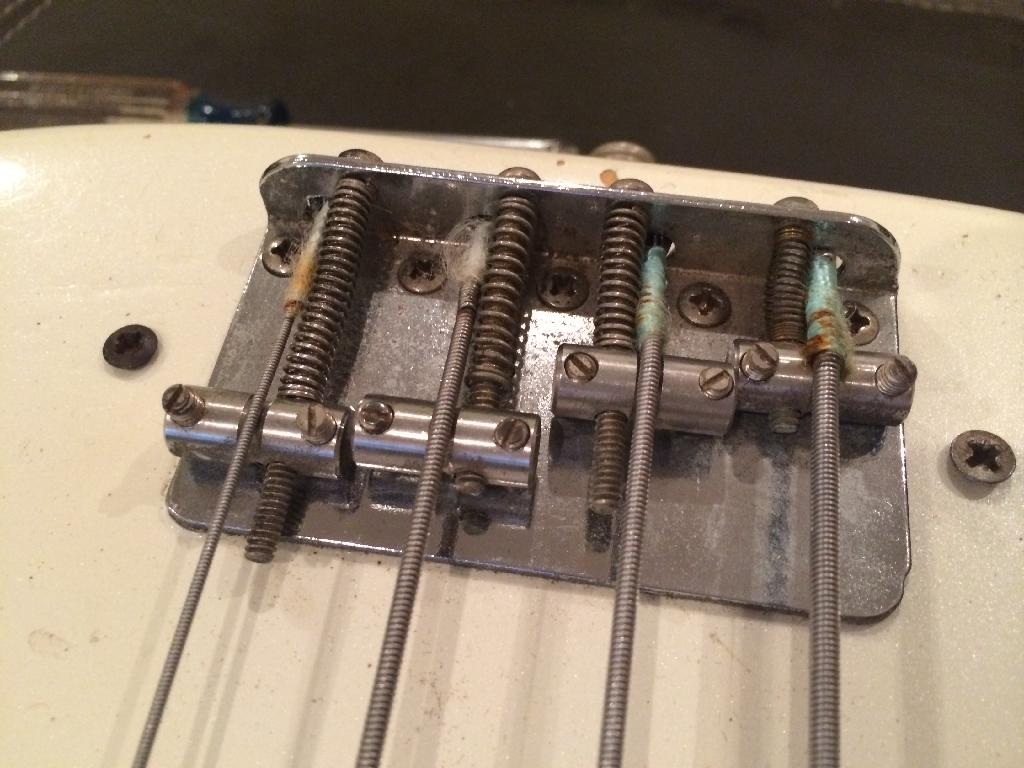
i'm looking to bring the bridge back to "normal" as you can see in the pictures below: mine has been messed with

ofcourse, i want to keep it as close to factory as possible
so, what needs to be done here ?
are the "screws" supposed to be of the same length ?
how would be best to fix this ?

IMG_20141118_095610.jpg


P_10.jpg


thanks in advance
 
The single-grooved barrel was introduced in late 1969, along with the longer 'G' intonation screw (a short-lived idea that disappeared by 1973/74 when all screws returned to an equal length).

Your 1971 bridge looks to be correct and original, with the exception of the short 'E' intonation screw. All bridges I have seen use equal length screw for E, A and D.

Here is a photo of an original 1971 P bridge.

1971 P-bridge.jpg
 
Last edited:
The single-grooved barrel was introduced in late 1969, along with the longer 'G' intonation screw (a short-lived ideal that disappeared by 1973/74 when all screws returned to an equal length).

With regard to the long 'G' screw, this was not as much an "idea" as it was a necessity. Fender had some early 70's bodies that had the bridge mounting holes drilled in the wrong place. I have a '73 like this. The bridge was actually too low (close to the bottom edge) and there was no way to "intonate" the bass without this longer screw.
It must have been cheaper to get a few longer screws than throw away the mis-drilled bodies.
I would have loved to have been in the meeting where this was discovered/reported/addressed. Pretty clever way to deal with a little "oops" actually.
 
  • Like
Reactions: RockinRonnie
Your 1971 bridge looks to be correct and original, with the exception of the short 'E' intonation screw. All bridges I have seen use equal length screw for E, A and D.
I think you are right about the E string intonation screw - it should be the same length as the A and D string screws. It's either a replacement or the original was cut (why?).
 
My '75 had 4 equal length screws but the E string would be uncomfortably close to the screw after intonating it so I cut the screw shorter so it wouldn't bug me. Perhaps I wasn't the only one with the complaint? This was in 1975 mind you... I replaced it with the Badass bridge and lost the original.:rollno:
 
were it mine i'd ditch the single groove saddles entirely for a set of threaded-rod '50s-'60s style saddles; see how the G is getting forced away from the rest by the string pull, allowing them all to slide around and get out of alignment?
 
The saddles can "slide around and get out of alignment" 'cause there're no alignment slots/grooves. Better designed bridge plates have those or some other method of guiding the saddles and keeping the string spacing as desired. What happens trying to use 18mm or 17.5 mm string spacing with those cut-off threaded rod saddles?
There are a lot of years between '71 and '14- and many improvements have been made since.
Saw a nice yellow truck with original wooden spoke wheels today in WPB, Fl,
alright for an antique, but impractical in 2014.
There are numerous reasons why some things are not the same...
 
Saw a nice yellow truck with original wooden spoke wheels today in WPB, Fl,
alright for an antique, but impractical in 2014.
There are numerous reasons why some things are not the same...
But if you are trying to restore the yellow truck to original condition, perhaps the wooden wheels are essential.

Now why you would want to restore a '71 Fender to an unimproved condition is a good question. :laugh:
 
  • Like
Reactions: JustForSport
The saddles can "slide around and get out of alignment" 'cause there're no alignment slots/grooves. Better designed bridge plates have those or some other method of guiding the saddles and keeping the string spacing as desired. What happens trying to use 18mm or 17.5 mm string spacing with those cut-off threaded rod saddles?
yeah, that's where you have problems; the threaded-rod saddles prove their worth with wider string spacings, like 20mm (to line up with jazz pickups), so that the string pull wants to bring the 4 saddles together, holding them against each other to prevent drift and improve sustain.

thing is, i'm not sure when you'd ever want to go narrower than 19 or even 20mm on a fender-type bass.
 

Latest posts