
Pretty sure this has been debunked- unless there is an acoustic component to the sound - tone wood influence is negligible. I think there is a video on YouTube using 2x4s and concrete bodies keeping all else identical. Hollow bodies - different story.

Enjoy the benefits of a premium membership!
Upgrade Account
-
TalkBass has been independent since 1998. Add your voice.
Create a free account to reply to discussions, view embedded media, and browse with fewer display ads.
Join free Log in
Want zero display ads or expanded classifieds tools? Compare plans.
You are using an out of date browser. It may not display this or other websites correctly.
You should upgrade or use an alternative browser.
You should upgrade or use an alternative browser.
A different take on the tone wood debate.
- Thread starter TonyP-
- Start date
More options
Who Replied?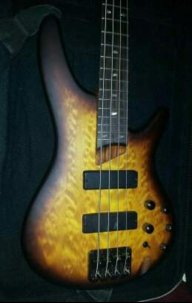
Interesting; But what if you go out and cut your wood from the same tree on the same day, same amount of curing time (if any), stored in the the same controlled environment, install the same strings, electronics, set-up the same(?) and logically they're suppose to sound, feel and play the same? uh..forget the logic part. Just a thought Out loud while passing by.
i would think different parts of a tree woyld have different densities however subtle that might be..might make a difference.


There is/was a guy who did exactly that, and made a YouTube video to test (hear) the results. But I cannot remember his name at the moment - if I can find a link to that video I will add it here. He took the neck, pickups & electronics, and bridge off a Strat, mounted all of that to different planks of wood, and played the same chords/riffs through the same amp with the same settings. In effect, the only thing that changed each time was the body wood.I've always been of the opinion that to truly decide the tone wood debate, all variables except the wood would have to be identical. The pickups would need to be the same...electronics, strings (rounds vs flats, stainless vs some other material, heavy vs light gauge) , body style (mass might have an effect), amp, player.
Build several bodies (jazz style, for example) out of walnut, alder, swamp ash, maple, cocobolo, whatever, and then assemble each using the same neck, bridge, strings, pups, electronics, amp and have the same guy test each to see how they sound different.
Or, I could just be an idiot...
I have a guitar body I bought to use as a test for paint. It is made out of MDF. My son says it would probably sound as good as anything else, but I think if it would, everyone would be building guitars out of MDF and not more expensive woods.
BnB
I could hear a difference between each one. Did I hear a difference because I wanted to? Maybe. Were the differences subtle? Yes, but I could still hear them.
First off, the "debate" is really not one, IMO. Generally, if you want to settle a debate you ask an expert. The real experts on the whole thing are those who build instruments. If you find a decent luthier who doesn't think the type / species / individual piece of wood used in an instrument affects the tone I will be very surprised. The reason it's a "debate" is armchair philosophers / self-titled "experts" and the nature of the internet. "I did x and didn't hear a difference, so it makes no difference", etc. The video linked to earlier is a great example of this. They're taking a 90% complete instrument and then poorly coupling some different pieces of wood to it. Of course there'll be minimal difference, the fretboard, neck and wood the bridge is attached to will have the most effect on the tone of the instrument.
But to the real point here: Yes, a "hot" pickup will tend to override more of the character of the instrument due to the compression and reduced dynamic response inherent in the pickup design, but not all that much, it will still sound different in a different instrument. A pickup can only "pick up" the difference in movement between it and the string. That movement is affected very little by the pickup design, mainly the response to the movement (although magnet strength and field shape will have an effect on string damping and possibly creating harmonic nodes if the pull is high enough). An extreme example is a guitar with truly hot humbucker pickup played through distortion pedals into a high-gain amp will start to have a very on-off response, almost keyboard-like. At that point it doesn't really matter what material the guitar is made from. All dynamics and subtelties of frequency response of the instrument itself are practically irrelevant. This is one reason I prefer a good Strat with vintage wound pickups to a Les Paul with hot humbuckers. The Strat will show it's character more readily and has better response to dynamic playing. It's less forgiving, but can sound oh so sweet in the right hands (Clapton, Gilmour, Knopfler, etc).
But to the real point here: Yes, a "hot" pickup will tend to override more of the character of the instrument due to the compression and reduced dynamic response inherent in the pickup design, but not all that much, it will still sound different in a different instrument. A pickup can only "pick up" the difference in movement between it and the string. That movement is affected very little by the pickup design, mainly the response to the movement (although magnet strength and field shape will have an effect on string damping and possibly creating harmonic nodes if the pull is high enough). An extreme example is a guitar with truly hot humbucker pickup played through distortion pedals into a high-gain amp will start to have a very on-off response, almost keyboard-like. At that point it doesn't really matter what material the guitar is made from. All dynamics and subtelties of frequency response of the instrument itself are practically irrelevant. This is one reason I prefer a good Strat with vintage wound pickups to a Les Paul with hot humbuckers. The Strat will show it's character more readily and has better response to dynamic playing. It's less forgiving, but can sound oh so sweet in the right hands (Clapton, Gilmour, Knopfler, etc).

The reason wood matters is simple. In physics, when string vibration is studied it's assumed at the most basic level that the anchors at each end (bridge and nut) are of infinite mass so do not absorb any energy from the string. In the real world the mass is not infinite and the wood and hardware (add tuners and tailpieces to the equation) absorb energy and at different frequencies the absorption will be different due to resonances.
That's why many people (like myself) advise playing any electric string instrument first unplugged to hear the actual acoustic tone. The pickups merely act as filters to this tone, they cannot add anything. The most extreme example I can think of is Gibson basses with "mudbuckers". They can sound quite twangy unplugged but the pickup slows the attack and removes high end, yielding the classic muddy, burpy Gibson sound.
Anyone who has played carbon fiber basses like Steinbergers, Status, Zon, Modulus, etc. will have noticed that there is an increase in sustain and a more even tonal character up and down the neck due to the stiffness of the neck (and in some cases body) material. It can be heard even unamplified. The instrument doesn't absorb as much energy from the strings, simple as that.
Now, if you rephrase the argument, pickups become very important in voicing the instrument because of the filtering affect. I have a 53 P-bass that has a mudbucker added near the fingerboard and when that pickup is soloed, it makes the bass sound very much like a Gibson, muffled with a slow attack. So with any single bass, swapping pickups can make a huge difference in the sound but the vibration of the strings is still limited by the energy absorption of the body, neck and hardware.
That's why many people (like myself) advise playing any electric string instrument first unplugged to hear the actual acoustic tone. The pickups merely act as filters to this tone, they cannot add anything. The most extreme example I can think of is Gibson basses with "mudbuckers". They can sound quite twangy unplugged but the pickup slows the attack and removes high end, yielding the classic muddy, burpy Gibson sound.
Anyone who has played carbon fiber basses like Steinbergers, Status, Zon, Modulus, etc. will have noticed that there is an increase in sustain and a more even tonal character up and down the neck due to the stiffness of the neck (and in some cases body) material. It can be heard even unamplified. The instrument doesn't absorb as much energy from the strings, simple as that.
Now, if you rephrase the argument, pickups become very important in voicing the instrument because of the filtering affect. I have a 53 P-bass that has a mudbucker added near the fingerboard and when that pickup is soloed, it makes the bass sound very much like a Gibson, muffled with a slow attack. So with any single bass, swapping pickups can make a huge difference in the sound but the vibration of the strings is still limited by the energy absorption of the body, neck and hardware.

Maybe we could make a sticky out of this answer?In order of importance to tone, IMHO, it goes hands, strings, pickups/electronics, anything the string touches (frets, nut, bridge saddle etc), and then wood somewhere after all that. Wood is organic and unpredictable so it just makes sense to me that its effect on tone is also unpredictable.
I've also never made an instrument so my opinion is based on zero evidence and isn't worth getting upset over or even taking seriously.
EDIT: To address the OP, TonyP's point is sensible and intriguing.

I don't attribute it to anything other than my ears, but if you gave me 10 ash/maple jazzes and and 10 alder/rose, my experience of 30+ years of experience would force me to presuppose that I'd like a whole more of the ash/maples than I would the alder/rose.
And, yes, I'd even do it blindfolded if it bothers you that much.
And, yes, I'd even do it blindfolded if it bothers you that much.
A different take on the tone wood debate.
First off – I want to say that I am in the camp that different wood species makes a tonal difference in instruments.
A good example are the MFDs pickups found in G&Ls, Dimarzio Model Js and for alnico
However -
I feel wood choices make less of difference with stronger pickups that have there own personality. A trait I think you find more with ceramic pickups as compared to alnico, I'm speaking in general terms.Stingray pickups (they are Alnico but have the output).
My thoughts are you going to get more nuances of the different woods with a under wound Alnico pickups.
What are your thoughts on this?
At one point I owned an Alembic Series 1 and an Alembic Series II at the same time.
THe S1 had a flame maple top. The SII had a coco-bolo top. Everything else was the same and the only other difference was the Series electronics, (Master volume and variable Q vs no MV and no variable Q).
With the electronics basically set to flat for both, there was very clearly a difference between the two basses. The maple topped bass was noticeably brighter to my ears, while the the coco-bolo topped bass was a bit darker sounding.
I agree, and this is exactly what I do.That's why many people (like myself) advise playing any electric string instrument first unplugged to hear the actual acoustic tone. The pickups merely act as filters to this tone, they cannot add anything.

So, to be clear, you are essentially asking whether pickup strength affects the degree of influence that the mechanical construction of the bass contributes to the individual instrument tone? And / or speculating that more powerful pickups over-ride that factor?A different take on the tone wood debate.
First off – I want to say that I am in the camp that different wood species makes a tonal difference in instruments.
A good example are the MFDs pickups found in G&Ls, Dimarzio Model Js and for alnico
However -
I feel wood choices make less of difference with stronger pickups that have there own personality. A trait I think you find more with ceramic pickups as compared to alnico, I'm speaking in general terms.Stingray pickups (they are Alnico but have the output).
My thoughts are you going to get more nuances of the different woods with a under wound Alnico pickups.
What are your thoughts on this?
Probably, the best example to look at would be the Alembic Series I/II instruments. Quite aside from their eye candy construction, Alembic has an ultra powerful pickup drivetrain; and the neck through construction is specifically used, in their case, to minimize variation in tone between instruments. The engineering design intent was to use the woods for eye candy and NOT for tone. On this topic, you might have an interesting discussion with Ron Wickersham.
Yet, for all that effort, no two Alembic basses sound or play quite the same. And part of, or perhaps the main problem for us players is that it is generally not possible to separate the player interaction with the instrument from the sound the audience or recording board hears, even though they are two separate aspects.
My dear wife will tell me the basses all sound the same. And, indeed, it is quite difficult, perhaps not possible, to differentiate two different basses of similar configuration on a recording. Which is one very good reason to remain focused on playing skills and knowledge.
Still, there is a very definite hookup that occurs between the player and the instrument while playing that quite definitely includes the mechanical aspects of the individual instrument construction, and strongly affects the act of expression. In short, we perceive a whole world of somewhat subtle aspects of the instrument that are not primarily apparent in the audible product. I suppose that's why we keep going around in circles with this conversation.
Anyhow, you've got a vibrating string that carries an astoundingly complex array of overtones; which themselves are subject to the specific damping characteristics at the string ends. The pickup converts the final summation of that complexity. The only way to take wood out of the equation entirely is not to use it. Instead, you can use a graphite composite or aluminum; and instruments with those kinds of construction can be produced with impressive instrument to instrument uniformity. Is that what we really want as players? The market has generally said, no.
Going back to Alembic, my experience is that their philosophy works to a degree, and that supports your hypothesis. But, ultimately as a player, the mechanical construction of each wooden instrument will matter.
And, we will probably keep debating it.
It hasn't been debunked. However if it were that easy we'd be playing 2x4s.Pretty sure this has been debunked- unless there is an acoustic component to the sound - tone wood influence is negligible. I think there is a video on YouTube using 2x4s and concrete bodies keeping all else identical. Hollow bodies - different story.
The video shows that the non wood portions play a significant impact. That nearly any mounting surface will do.But why when we have the choice between ten P basses at a shop and we aren't talking about color choices, why do some of us pick the one that sounds and feels distinctly different than the others. The electrical components don't give us rigidity or resonance.
All substances have tone.
This is dead horse beating isn't it?
All we know is if someone says they can't hear it they just said they can't hear it. They have no special powers to tell anyone what they hear.

- Aug 25, 2004
- 940
- 1,342
- Disclosures
- Builder: Martin Keith Guitars
So, to be clear, you are essentially asking whether pickup strength affects the degree of influence that the mechanical construction of the bass contributes to the individual instrument tone? And / or speculating that more powerful pickups over-ride that factor?
Probably, the best example to look at would be the Alembic Series I/II instruments. Quite aside from their eye candy construction, Alembic has an ultra powerful pickup drivetrain; and the neck through construction is specifically used, in their case, to minimize variation in tone between instruments. The engineering design intent was to use the woods for eye candy and NOT for tone. On this topic, you might have an interesting discussion with Ron Wickersham.
Yet, for all that effort, no two Alembic basses sound or play quite the same. And part of, or perhaps the main problem for us players is that it is generally not possible to separate the player interaction with the instrument from the sound the audience or recording board hears, even though they are two separate aspects.
My dear wife will tell me the basses all sound the same. And, indeed, it is quite difficult, perhaps not possible, to differentiate two different basses of similar configuration on a recording. Which is one very good reason to remain focused on playing skills and knowledge.
Still, there is a very definite hookup that occurs between the player and the instrument while playing that quite definitely includes the mechanical aspects of the individual instrument construction, and strongly affects the act of expression. In short, we perceive a whole world of somewhat subtle aspects of the instrument that are not primarily apparent in the audible product. I suppose that's why we keep going around in circles with this conversation.
Anyhow, you've got a vibrating string that carries an astoundingly complex array of overtones; which themselves are subject to the specific damping characteristics at the string ends. The pickup converts the final summation of that complexity. The only way to take wood out of the equation entirely is not to use it. Instead, you can use a graphite composite or aluminum; and instruments with those kinds of construction can be produced with impressive instrument to instrument uniformity. Is that what we really want as players? The market has generally said, no.
Going back to Alembic, my experience is that their philosophy works to a degree, and that supports your hypothesis. But, ultimately as a player, the mechanical construction of each wooden instrument will matter.
And, we will probably keep debating it.
In fact, Alembic puts a brass block underneath the bridge, explicitly to decouple/isolate the bridge from the body.
They intend it to be an inertial mass that reflects energy back into the string rather than absorbing it.
Ron Wickersham has been clear about its intended purpose - read the BP article from the early 2000s and he talks about it.
This, to me, further supports the case that wood matters. If you have to design a system to minimize the impact of the wood,
and if the material underneath the bridge makes a meaningful difference, then both observations point to the same conclusion - the material is an important determinant of sound.
Alembic also describes the tonal effects of the different neck laminates on their website.
Most of the arguments suggesting wood doesn't matter could be equally applied to any other mechanical/physical component of the bass.
Sure, if you roll your tone to zero or boost the active bass control to 10, then you might not hear the differences between a bent-plate Fender bridge and a Badass.
But that doesn't mean they sound the same.
Ditto for the YouTube "science", which is never really well-structured IMO. Pressing a neck/bridge structure into some blobs of wood will not prove anything,
especially once you add in the compression YouTube uses to process audio.
To OP's question - certain pickups can have a nonlinear response that is distinctive enough to mask or filter out some of the effects of construction.
EMGs, for example, have a particular tone that I hear coming through no matter what I put them on.
Gibson "Mudbuckers" are another example.
Remember, as always, that these simply represent a "filtered" reproduction of the instrument.
If you look at frequency response analyses for common bass pickup types (J, MM, etc.) you'll see that they have substantial peaks and dips, and are far from "flat".
In my repair work, I fix a lot of broken Gibson headpieces. Often, in bad cases, I have to laminate the back of the headpiece with ebony to strengthen the cracked area.
Doing so makes the headpiece WAY more rigid, since it has "skins" of hardwood on both front and back.
It is very common for those clients to report that their guitars sound better, clearer, sustain longer, etc. after such a repair.
This is because the headpiece becomes less of an energy sink. I don't solicit these observations - people just tell me afterward that it's better.
Another clear example of the effect of construction.
Cheers,
Martin
+1In fact, Alembic puts a brass block underneath the bridge, explicitly to decouple/isolate the bridge from the body.
They intend it to be an inertial mass that reflects energy back into the string rather than absorbing it.
Ron Wickersham has been clear about its intended purpose - read the BP article from the early 2000s and he talks about it.
This, to me, further supports the case that wood matters. If you have to design a system to minimize the impact of the wood,
and if the material underneath the bridge makes a meaningful difference, then both observations point to the same conclusion - the material is an important determinant of sound.
Alembic also describes the tonal effects of the different neck laminates on their website.
Most of the arguments suggesting wood doesn't matter could be equally applied to any other mechanical/physical component of the bass.
Sure, if you roll your tone to zero or boost the active bass control to 10, then you might not hear the differences between a bent-plate Fender bridge and a Badass.
But that doesn't mean they sound the same.
Ditto for the YouTube "science", which is never really well-structured IMO. Pressing a neck/bridge structure into some blobs of wood will not prove anything,
especially once you add in the compression YouTube uses to process audio.
To OP's question - certain pickups can have a nonlinear response that is distinctive enough to mask or filter out some of the effects of construction.
EMGs, for example, have a particular tone that I hear coming through no matter what I put them on.
Gibson "Mudbuckers" are another example.
Remember, as always, that these simply represent a "filtered" reproduction of the instrument.
If you look at frequency response analyses for common bass pickup types (J, MM, etc.) you'll see that they have substantial peaks and dips, and are far from "flat".
In my repair work, I fix a lot of broken Gibson headpieces. Often, in bad cases, I have to laminate the back of the headpiece with ebony to strengthen the cracked area.
Doing so makes the headpiece WAY more rigid, since it has "skins" of hardwood on both front and back.
It is very common for those clients to report that their guitars sound better, clearer, sustain longer, etc. after such a repair.
This is because the headpiece becomes less of an energy sink. I don't solicit these observations - people just tell me afterward that it's better.
Another clear example of the effect of construction.
Cheers,
Martin
But, my main point was that there are two aspects surrounding what we regard as "Tone;" those being what the audience / recording board hears vs what the player perceives while playing. The two are related but not the same. Ergo, the constant tone wood debate; my answer to which is, yes.
Further to your point, agreed that neck construction, in Alembic's case for example ebony laminates vs Purple Heart, undoubtedly produces a difference the player perceives. Whether or not the audience or recording console discriminates is much less certain. Perhaps unlikely. That's ok. The two can coexist as part of the same animal; or elephant, so to speak.
Last edited:
agreed that neck construction, in Alembic's case for example ebony laminates vs Purple Heart, undoubtedly produces a difference the player perceives. Whether or not the audience or recording console discriminates is much less certain
In the final mix, OK maybe it's not that audible but if you solo a recorded bass track you can easily hear differences between different basses. At mixing time, many tricks can be played. I was once asked by some friends to play DB on a CD but the producer nixed the idea. Instead he simply mixed a J-bass on some of the tracks to emulate the tonality of a DB. It would probably fool most people.
What you hear is subjective. I did another session where I brought a Steinberger and a P. The engineer didn't like the tone of the Steinberger and asked me to plug in the P. He declared it was so much more solid and had more low end. In fact, my Steinberger has far more low end than my P but also more upper harmonics for that "piano string" sound, but it lacks the low mid bump of a P which is what the engineer was hearing as more lows.
I believe you missed my point. Which was that similarly configured basses will track and sound essentially the same. Sure, any two different instruments can sound distinctive, depending on a lot of factors. But, if you constrain everything as much as possible between two similar instruments, they will be difficult, if not impossible to discriminate on the track / FOH; even though the player will most likely still perceive a difference in the playing interaction.In the final mix, OK maybe it's not that audible but if you solo a recorded bass track you can easily hear differences between different basses. At mixing time, many tricks can be played. I was once asked by some friends to play DB on a CD but the producer nixed the idea. Instead he simply mixed a J-bass on some of the tracks to emulate the tonality of a DB. It would probably fool most people.
What you hear is subjective. I did another session where I brought a Steinberger and a P. The engineer didn't like the tone of the Steinberger and asked me to plug in the P. He declared it was so much more solid and had more low end. In fact, my Steinberger has far more low end than my P but also more upper harmonics for that "piano string" sound, but it lacks the low mid bump of a P which is what the engineer was hearing as more lows.


So then, NOT identical?
Which is to say, the _only_ variable was the body and fingerboard wood.
I would say yes to the extent that there are resonances that can absorb frequencies and cause the string to dampen but the type of wood used is minimal especially on the body compared to say the neck. There would be so much substantial inertia compared to the string - ie the energy taken from the string to cause the wood to vibrate.In fact, Alembic puts a brass block underneath the bridge, explicitly to decouple/isolate the bridge from the body.
They intend it to be an inertial mass that reflects energy back into the string rather than absorbing it.
Ron Wickersham has been clear about its intended purpose - read the BP article from the early 2000s and he talks about it.
This, to me, further supports the case that wood matters. If you have to design a system to minimize the impact of the wood,
and if the material underneath the bridge makes a meaningful difference, then both observations point to the same conclusion - the material is an important determinant of sound.
Alembic also describes the tonal effects of the different neck laminates on their website.
Most of the arguments suggesting wood doesn't matter could be equally applied to any other mechanical/physical component of the bass.
Sure, if you roll your tone to zero or boost the active bass control to 10, then you might not hear the differences between a bent-plate Fender bridge and a Badass.
But that doesn't mean they sound the same.
Ditto for the YouTube "science", which is never really well-structured IMO. Pressing a neck/bridge structure into some blobs of wood will not prove anything,
especially once you add in the compression YouTube uses to process audio.
To OP's question - certain pickups can have a nonlinear response that is distinctive enough to mask or filter out some of the effects of construction.
EMGs, for example, have a particular tone that I hear coming through no matter what I put them on.
Gibson "Mudbuckers" are another example.
Remember, as always, that these simply represent a "filtered" reproduction of the instrument.
If you look at frequency response analyses for common bass pickup types (J, MM, etc.) you'll see that they have substantial peaks and dips, and are far from "flat".
In my repair work, I fix a lot of broken Gibson headpieces. Often, in bad cases, I have to laminate the back of the headpiece with ebony to strengthen the cracked area.
Doing so makes the headpiece WAY more rigid, since it has "skins" of hardwood on both front and back.
It is very common for those clients to report that their guitars sound better, clearer, sustain longer, etc. after such a repair.
This is because the headpiece becomes less of an energy sink. I don't solicit these observations - people just tell me afterward that it's better.
Another clear example of the effect of construction.
Cheers,
Martin
The fact that there is no resonant chamber would put its natural resonance at a fairly high frequency also further lessening the effect.
in the case of the neck and dead spots etc. it's less a resonance thing but more that the tension is directly affected as the string vibrates.
end if the day - this may affect tone but the type of wood is likely less important than the type of construction- ie laminated vs not laminated. Carbon fiber reinforced vs not. Quarter sawn vs not will likely bring bigger tonal influence than rock maple vs curly maple vs wenge for instance.
This guy has a great attitude, and gives you a chance to really hear (or not hear) a difference between tone woods.
These are a great watch!For what it's worth, I am a firm believer that wood creates a noticeable difference in tone. I had two basses by the same builder, both had the same pickups, and both had the same neck woods and hardware. One bass had a 2 piece alder body, and the other had a two piece alder body with a maple top on it. I wanted to like the alder bodied bass better, as I liked the way it looked better, but it just didn't sound the same and I knew I would never pick it up and play it. My .02 of course!
A "proper" tonewood test would be comparing necks, not bodies. Easier to hear the differences. That said, this one's quite relevant to the topic:
Listen to the clean tone on the neck pickup vs the bridge, the bridge is "hotter".
FWIW, I prefer the Alder in all tests
Listen to the clean tone on the neck pickup vs the bridge, the bridge is "hotter".
FWIW, I prefer the Alder in all tests
Last edited:
Latest posts
-

-
 I'm back with a '51-ish P from parts (mostly), and a WB finish question
- Latest: Bruce Johnson
-

-

-
