
• TalkBass has been independent since 1998. Add your voice.
    Create a free account to reply to discussions, view embedded media, and browse with fewer display ads.
    Join freeLog in
    Want zero display ads or expanded classifieds tools? Compare plans.

A different take on the tone wood debate.

A different take on the tone wood debate.

First off – I want to say that I am in the camp that different wood species makes a tonal difference in instruments.

A good example are the MFDs pickups found in G&Ls, Dimarzio Model Js and for alnico
However -

I feel wood choices make less of difference with stronger pickups that have there own personality. A trait I think you find more with ceramic pickups as compared to alnico, I’m speaking in general terms.Stingray pickups (they are Alnico but have the output).

My thoughts are you going to get more nuances of the different woods with a under wound Alnico pickups.

What are your thoughts on this?

My thought is, I don’t care what it’s made out of, either it’s a good sounding instrument with a useful voice or not.

That said, there may be some truth to what you say, that there may be a ratio of the impact of the type of wood against the strength of the pickup.
 
A different take on the tone wood debate.

First off – I want to say that I am in the camp that different wood species makes a tonal difference in instruments.

A good example are the MFDs pickups found in G&Ls, Dimarzio Model Js and for alnico
However -

I feel wood choices make less of difference with stronger pickups that have there own personality. A trait I think you find more with ceramic pickups as compared to alnico, I’m speaking in general terms.Stingray pickups (they are Alnico but have the output).

My thoughts are you going to get more nuances of the different woods with a under wound Alnico pickups.

What are your thoughts on this?
The final question will always be the same: how much? Can we quantify all these variables? Can we even define them accurately? I don't think so. Furthermore, what you hear will not necessarily be what I hear.
 
  • Like
Reactions: 2tonic and TonyP-
A different take on the tone wood debate.

First off – I want to say that I am in the camp that different wood species makes a tonal difference in instruments.

I don't think anybody says it doesn't....but, wood - like anything else - isn't a static concept....mass and density for duplicate instruments will be different, response characteristics for duplicate pickups will vary, etc.. and sometimes there are lemons.....the best anyone can do when talking tonewoods, pickups, etc is to talk generalities... . Just because x-amount of basses made of certain woods all have similar attributes doesn't mean they all will

Guitars and basses, like people, are individual case by case subjects
 
Just because x-amount of basses made of certain woods all have similar attributes doesn't mean they all will

Guitars and basses, like people, are individual case by case subjects
I don’t disagree with that at all...
 
I built acoustic guitars for a number of years, have expressed my opinion here, been told I was a dead-wrong idiot, and so I leave these threads - which frankly ought to be banned - to those who wish to traffic in misinformation.
My late father built over 40 Spanish classical guitars plus a few violins. As one of his woodworking hobbies.

To him, tone was the response of the instrument to certain frequencies mostly in response to the top thickness contour and bracing and the top material. His last instruments had wood'teflon honeycomb sandwich and were awesome.

Sadly, i own none of the really good instruments which he placed with really good classical players. He spent an hour with Chet Atkins but didnt sell him one.
 
Well, after 1/16" of finish, holes cut & drilled, metal rod down the middle, fret board glued on, several pounds of pressure from strings, pressed against your stomach absorbing all the vibration, ALL resonance is removed. Resonance is the main factor in sound difference. Imagine holding the wind chime tube in your hand then striking it.
 
  • Like
Reactions: Loring and Vinny_G
Opinions:
The materials used to build a bass (tonewoods, plywoods, carbon fiber, plastic, etc) all affect the sound, to one degree or another.

Is this effect quantifiable, or repeatable? Doubtful in the case of wood. It's an organic material with internal faults and voids, no two pieces are identical.

Energy transfer is the name of this game. Different species and pieces of wood transmit and absorb energy to varying levels, at varying frequencies. Generalizations regarding the properties of particular species (rigidity, tensile and shear strength, etc.) are possible, and can be used to broadly aim for a desired result, but it's a crapshoot whether you wind up with a lemon or a lark.
Luthiers use the known general properties of woods, and combinations thereof, balanced against the aesthetics of the instruments appearance.

Sustain, fullness, dead spots, liveliness, responsive feel, ergonomic warmth are affected by materials and finish processes, but cannot be known until construction is complete.

I agree with you @TonyP- that the pickups are a disproportionately large part of the equation. Their construction can counteract, or compliment, the properties of the other assembled materials.

The differences in the amount of energy absorbed or transmitted, at different frequencies, is infinitesimally small compared to the energy amounts conducted via the magnetic stimulation of the pickups coils, so it only stands to reason the PUs have the most effect.

One only needs to loosen the bridge screws 1 turn each, or better yet, slip a piece of rubber, cardboard, or heavy paper under the bridge and retorque, to appreciate the differences due to varying properties of wood species chosen for a build.


When it comes to Steinbergers, or Status Graphite basses, all bets are off!! :D
 
Well, after 1/16" of finish, holes cut & drilled, metal rod down the middle, fret board glued on, several pounds of pressure from strings, pressed against your stomach absorbing all the vibration, ALL resonance is removed.


If that were true, nobody would ever talk about dead spots - dead spots are due to the neck having a prominent and unfortunate resonance, stealing energy from the vibrating string to shake the neck and body.
 
Every physical component of a bass will have an effect on the sound.
Some more than others, of course.
All of them affect the string response subtractively - meaning, they all remove energy from the string at particular frequencies.

When people discuss "resonance", what does that mean? If a piece of wood clearly and vigorously resonates at a particular frequency, then it will
rob energy from the string most effectively at that frequency. That is not a good thing when it comes to evenness of response. This point is often overlooked or misstated.

Among professional instrument makers, it is understood and accepted that the tone of the instrument (including solidbodies) is directly and meaningfully affected by the wood or material used to make it.
Bear in mind that those of us that do this for a living have sample sizes in the hundreds or thousands of instruments, many/most of which are otherwise very similar.
For example, at my old job we built several hundred nearly identical solidbody guitars with poplar bodies and wenge fingerboards. Same pickups, same strings, same everything.
When we did the occasional one with an ebony fretboard, the difference was evident. Though this isn't the "double-blind" study that people seem to get hung up on,
it is nonetheless a meaningful observation.

The common example of dead spots is a nice example of how the physical, vibrational modes of a solidbody bass can clearly and negatively affect tone.
Stiffening a neck (with carbon fiber, for example, or by using wenge or a similar stiffer wood) can move or eliminate dead spots.
This is well understood and well documented. Many (most?) players don't realize the extent to which the neck is in motion while playing.
Sometimes, dead spots can even be eliminated by simply pressing the headpiece firmly against a wall to restrict its movement.

Similarly, basses with lightweight swamp ash bodies typically do not sustain as long as heavy Northern ash or other dense bodies.
This is obvious and basic - the lighter wood absorbs energy more readily from the string.

If a bass were made with a concrete body, we would expect it to sound different than one with a balsa body. Such an expectation would be reasonable.
Although the variation between species of wood is smaller than the difference between balsa and concrete, it is nonetheless sufficient to expect differences there also.
And, those differences are in fact real, for those that have sufficient exposure to understand them.
Loose frets, poorly coupled bridges, overly heavy tuners, excessive finish thickness....these all have their own impacts, and one can learn to recognize them too.

A common rebuttal is that "yes, wood matters - but since every piece is different, we can't make any general conclusions about HOW".
Again, sample size is the key here. Sure, there will be outliers within a species - but once you make enough similar basses, you can safely start to predict the average,
sufficiently to make informed decisions about which woods will combine best to yield a specific result.

I made a bass last year with a composite fingerboard (Richlite), and the effect was clear as day.
Similarly, I made two basses with swamp ash (not a usual material for me) and they were very similar in response, despite having different pickups and electronics.

I remain surprised that people find this so difficult to believe.
Ultimately, it boils down to this: the pickups read only the strings.
The manner in which the strings vibrate is very much affected by the structure that supports them.
The materials used to build that structure are an important and meaningful part of the strings' vibrational behavior.

Cheers,
Martin
 
I'm in the camp of respectful indifference...

I think if I had to pick somewhere on the bass that tonewood matters most, I'd probably say the neck/fretboard. I prefer maple fretboards for feel, not necessarily tone. There are so many variables involved in the tonewood debate that I am content to say "A good piece of lumber, shaped into a bass, is a good piece of lumber" and leave it at that. Some basses have bum tone and no explanation as to why, then others are simply amazing.
 
  • Like
Reactions: Loring and DJ Bebop
A different take on the tone wood debate.

First off – I want to say that I am in the camp that different wood species makes a tonal difference in instruments.

A good example are the MFDs pickups found in G&Ls, Dimarzio Model Js and for alnico
However -

I feel wood choices make less of difference with stronger pickups that have there own personality. A trait I think you find more with ceramic pickups as compared to alnico, I’m speaking in general terms.Stingray pickups (they are Alnico but have the output).

My thoughts are you going to get more nuances of the different woods with a under wound Alnico pickups.

What are your thoughts on this?

The theory makes sense on the surface, but may not scientifically.

Here's a scenario; you have a bass with very low output pickups. When you play the bass, do you pluck the strings extremely hard to achieve volume, or do you just crank up the gain / preamp of the amp? Suppose you take that same bass and change to high output pickups. Do you leave the gain set the same as with low output pups and just very lightly pluck the strings so it's not loud and overdriven, or do you just turn the gain down?

My thought is that the type of wood used to make the bass will have more effect on string vibration the harder the strings are plucked. So if the output of the PUPS affect the way you pluck strings, is it the low output pup allowing the effect of the wood come through, or is it the way we are playing the bass?

I have no answers, just questions.....
 
  • Like
Reactions: TonyP-
I've always been of the opinion that to truly decide the tone wood debate, all variables except the wood would have to be identical. The pickups would need to be the same...electronics, strings (rounds vs flats, stainless vs some other material, heavy vs light gauge) , body style (mass might have an effect), amp, player.

Build several bodies (jazz style, for example) out of walnut, alder, swamp ash, maple, cocobolo, whatever, and then assemble each using the same neck, bridge, strings, pups, electronics, amp and have the same guy test each to see how they sound different.

Or, I could just be an idiot...

I have a guitar body I bought to use as a test for paint. It is made out of MDF. My son says it would probably sound as good as anything else, but I think if it would, everyone would be building guitars out of MDF and not more expensive woods.

BnB
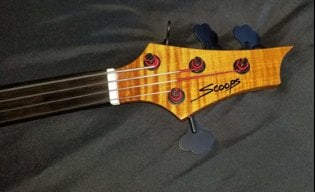
I have my son's Hondo P bass that has a plywood body and, it sounds awesome :)
 
  • Like
Reactions: Vinny_G
A different take on the tone wood debate.

First off – I want to say that I am in the camp that different wood species makes a tonal difference in instruments.

A good example are the MFDs pickups found in G&Ls, Dimarzio Model Js and for alnico
However -

I feel wood choices make less of difference with stronger pickups that have there own personality. A trait I think you find more with ceramic pickups as compared to alnico, I’m speaking in general terms.Stingray pickups (they are Alnico but have the output).

My thoughts are you going to get more nuances of the different woods with a under wound Alnico pickups.

What are your thoughts on this?

I am in the resonant frequency camp

Your electric bass is a tone generating system made of many things
Pickups, signal chain, strings, fingers/attack and amplifier/speaker being the main components
For example, if we think signal chain, your tone pot has more effect on your tone than the actual wood

The whole tonewood discussion is good and meaningful for acoustic instruments, not electrics.

Does the type of wood matter, sure it does because it is part of the resonant frequency equation.
But not to the point of the sales hype we hear
 
  • Like
Reactions: TonyP- and Loring