
I took a DiMarzio Model J neck pickup out of my Jazz Bass and put it into our bass player's Squier Bronco bass. The Bronco still sounds like a Bronco, not like a Jazz Bass. I'm of the opinion that changing a pickup is a less important contributor to the instrument's sound than other factors like wood, body thickness, scale length, etc.

Enjoy the benefits of a premium membership!
Upgrade Account
-
TalkBass has been independent since 1998. Add your voice.
Create a free account to reply to discussions, view embedded media, and browse with fewer display ads.
Join free Log in
Want zero display ads or expanded classifieds tools? Compare plans.
You are using an out of date browser. It may not display this or other websites correctly.
You should upgrade or use an alternative browser.
You should upgrade or use an alternative browser.
A different take on the tone wood debate.
- Thread starter TonyP-
- Start date
More options
Who Replied?

What are your thoughts on this?
I built acoustic guitars for a number of years, have expressed my opinion here, been told I was a dead-wrong idiot, and so I leave these threads - which frankly ought to be banned - to those who wish to traffic in misinformation.


@TonyP- I believe I recall disagreeing with you a few times, but I am 100% with you on this one.

buldog5151bass
Kibble, milkbones, and P Basses. And redheads.
Interesting; But what if you go out and cut your wood from the same tree on the same day, same amount of curing time (if any), stored in the the same controlled environment, install the same strings, electronics, set-up the same(?) and logically they're suppose to sound, feel and play the same? uh..forget the logic part. Just a thought Out loud while passing by.
Not all wood, even from the same tree, is identical. I know ash, for example, can differ over 30% at the same moisture content. Wood lower on the tree tends to be lighter.

- Aug 21, 2003
- 11,619
- 18,701
- Disclosures
- A-Designs Mike Lull GK Tsunami Cables GHS Strings RMI Basswitch Nordstrand Pickups Darkglass
Agreed,@TonyP- I believe I recall disagreeing with you a few times, but I am 100% with you on this one.
And Yes think I believe the word was arrogant was used once
 in your end.
 No harm, no foul...
There are vids in YouTube wherein woods are compared in a "sciencey" way. One guy took the same neck, bridge and pickups (one module) and with a mallet hammered the subject into various woods. The sound was observed and recorded with a device I don't know the name of.
The differences were small with the typical tobewoods tested. Very small.
The differences were small with the typical tobewoods tested. Very small.

As far as I'm aware, no one has yet passed a double blind test on tone wood. That's my takeaway.
Part of the problem with the wood debate is how different woods are presented in discussion. Wood simply cannot add anything to the tone of an instrument, though it's often presented that way. But what it can and does do is dampen different frequencies. So if someone tells you that a certain wood has a strong midrange, what they are really saying is that other frequencies are dampened. The other part that's misunderstood is that characteristics associated with different woods are generalizations. They cannot be assigned to every piece of wood from that species.
So while I'm absolutely convinced that wood plays a role in an instrument's sound, and the neck wood more than the body wood, I'm also the first to admit differences are generally very subtle. To compare it to say, tomato sauce, the difference between woods is like the difference between how much basil is in different recipes. It can be the difference between good and really good.
So while I'm absolutely convinced that wood plays a role in an instrument's sound, and the neck wood more than the body wood, I'm also the first to admit differences are generally very subtle. To compare it to say, tomato sauce, the difference between woods is like the difference between how much basil is in different recipes. It can be the difference between good and really good.

About the wood question:
Twice, by happenstance, I owned a pair of basses identical except for the body and fingerboard wood. Had the same strings on them, as well. They were a pair of Sadowsky Metro MV-5s, and a pair of Xotic xj-1ts. The difference in tone was obvious, between the ash/maple and alder/rosewood.
And right now, I have a pair of Sandberg VM-5s. Both have ash bodies; one has a pau ferro board and the other a rosewood board. (Again, the same strings on both.) It's more subtle, but there's a difference in tone.
The one with the pau ferro board is in the livestream video, linked in my sig.
Twice, by happenstance, I owned a pair of basses identical except for the body and fingerboard wood. Had the same strings on them, as well. They were a pair of Sadowsky Metro MV-5s, and a pair of Xotic xj-1ts. The difference in tone was obvious, between the ash/maple and alder/rosewood.
And right now, I have a pair of Sandberg VM-5s. Both have ash bodies; one has a pau ferro board and the other a rosewood board. (Again, the same strings on both.) It's more subtle, but there's a difference in tone.
The one with the pau ferro board is in the livestream video, linked in my sig.
The impact of the tone wood on the tone is as big as that of the metal type of pickguard screws.
The best tone of any kind to me is Allan Holdsworth's guitar tone in his prime. His main guitar had no wood molecules whatsoever.
The best tone of any kind to me is Allan Holdsworth's guitar tone in his prime. His main guitar had no wood molecules whatsoever.
Is it possible that the tone wood question came up to help hone someone's argument skills?
I mean, there could be plans in the near future to discuss Politics and religion with thanksgiving just around the corner?
I mean, there could be plans in the near future to discuss Politics and religion with thanksgiving just around the corner?
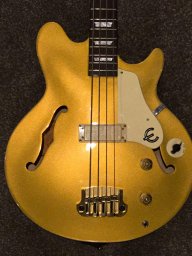
I think tone wood makes a huge difference in acoustic guitars and mandolins. Maybe to some extent in hollow body basses. Less so in solid body basses. Not saying it doesn't, I just think it's way more pronounced in acoustic instruments. Probably the density is more of a factor in solid bodies, rather than species, as far as sustain goes.

I have always felt that the hardness of the fingerboard wood has a noticeable effect on the amount of high frequency sustain, whereas the hardness of the body wood has a definite effect on how heavy the bass is when you wear it, and how easy it is to dent.  Otherwise, there are so many variables, the best bet it to just play each bass and see if you like it.
Otherwise, there are so many variables, the best bet it to just play each bass and see if you like it.
Was it this one?There are vids in YouTube wherein woods are compared in a "sciencey" way. One guy took the same neck, bridge and pickups (one module) and with a mallet hammered the subject into various woods. The sound was observed and recorded with a device I don't know the name of.
The differences were small with the typical tobewoods tested. Very small.

I'm a Physicist (studies Acoustics of musical instruments in college) and a bass player, so take my response as being affected by that.
The output of a magnetic pickup comes from the relative motion of the string versus the pickup - if the string moves, the pickup produces an output. If the body moves (the pickup is screwed to the body), the pickup produces an output. If both move, then it matters if they're moving together (lower output) or in opposite directions (more output).
It's obvious that everything on an electric bass moves. When you put a Snark tuner (it's an accelerometer, it senses physical vibrations of a solid body) on your headstock, the reason it works at all is that the headstock is vibrating. So the wood that the bass is made out of does vibrate, and it matters to some degree what it's made out of. The only question is to what degree.
On to the original question...
An underwound pickup has more bandwidth than a hot one one with a lot of turns. This gives it more bandwidth when loaded by the cable capacitance. Does that mean that the wood has more effect? Well, having studied the vibrations of different parts of musical instruments, what you find is that the vibrations of the bigger parts of things (like the body of your bass) are concentrated in a limited bandwidth - mostly low mid and below in the case of a bass guitar. I think you'll find that even the high output/more colored pickup has sufficient bandwidth to capture all (or almost all) of what's going on in the body vibration department.
Yes, the underwound pickup will sound different, but I think the differences in sound between that and an overwound one are more electrical than revealing more acoustical stuff - whatever role the body wood plays is there with both pickups.
I was totally gonna get all sciencey and junk. But this guy stole my thunder ..... n stuff.
Builders don't do them not because it would sound bad, but because it would not sell. Nobody would buy them, because our perception of things is biased from the start. Cheap wood equal cheap tone in the subconscious mind of people. This is the real problem of this kind of debate.I have a guitar body I bought to use as a test for paint. It is made out of MDF. My son says it would probably sound as good as anything else, but I think if it would, everyone would be building guitars out of MDF and not more expensive woods.
Yes, the same everything is not achievable, anyway, even with synthetic materials. As long as it is done by a human being, there will always be variations.Interesting; But what if you go out and cut your wood from the same tree on the same day, same amount of curing time (if any), stored in the the same controlled environment, install the same strings, electronics, set-up the same(?) and logically they're suppose to sound, feel and play the same? uh..forget the logic part. Just a thought Out loud while passing by.

Although not basses, Fender's new Acoustasonic Telecasters are great examples of the tone wood vs electronics debate. At $2K- $3.5K depending upon tone wood, they are at the leading edge of the guitar world. It's a good thing that: a) I am left handed, and b) I only play bass. For the rest of you, pony up and Fender on!
- Oct 18, 2012
- 6,683
- 5,538
- Disclosures
- Endorsing Artist: Fender, Spector, Ampeg, Curt Mangan, Nordstrand Pickups, Korg , Conquest Sound
In order of importance to tone, IMHO, it goes hands, strings, pickups/electronics, anything the string touches (frets, nut, bridge saddle etc), and then wood somewhere after all that. Wood is organic and unpredictable so it just makes sense to me that its effect on tone is also unpredictable.
I've also never made an instrument so my opinion is based on zero evidence and isn't worth getting upset over or even taking seriously.
EDIT: To address the OP, TonyP's point is sensible and intriguing.
I agree with most of this except hands being first. You hands definitely impact note clarity and definition, but in my opinion strings and pickups have more to do with tone.


