
Enjoy the benefits of a premium membership!
Upgrade Account
-
TalkBass has been independent since 1998. Add your voice.
Create a free account to reply to discussions, view embedded media, and browse with fewer display ads.
Join free Log in
Want zero display ads or expanded classifieds tools? Compare plans.
You are using an out of date browser. It may not display this or other websites correctly.
You should upgrade or use an alternative browser.
You should upgrade or use an alternative browser.
Double Bass A little bit of help please ..
- Thread starter Andy Mopley
- Start date
More options
Who Replied?
Looking at it for the first time, and without bass in hand--I'd consider playing it on the A and D strings, with a low thumb on the E, 1 on the B, 3 on the C#, especially if it's a very fast tempo (I don't know the part, so I'm not sure of the tempo). Whether I actually would do that if it's NOT a fast tempo just depends on how comfortable it is, how much faith I have in my ability to do it in tune etc after a little bit of messing with it. If that didn't work, then in the pick your poison scenario I'd go with the string crossings: 1 on the E (on A string), 4 on the B (D string) for the first measure, 2 on the E on A string, 1 on the C# on G string, and so on. At 12, 4 on the E on A string so as to use 2 and 1 for the C# and C on G string. G# with 2 on D string, then shift up to the D# with 2 and the B on the D string with 4. The last two measures I'd do entirely on the G and D strings, 1 on the F#, 4 on the E, pivot for 1 on the G#, 4 on the E and B.
The busier shifting, to me, is just too liable for intonation, clarity and cleanliness issues. Doing it that way, you'd be combining a string change and a shift in order to get to each note in the measures with C#'s--while doing it across the strings with minimal shifting makes the right hand more challenging overall, it makes it so that the left can essentially be placed on autopilot while you focus your energy on the right hand as opposed to trying to do difficult things in both hands at the same time.
The busier shifting, to me, is just too liable for intonation, clarity and cleanliness issues. Doing it that way, you'd be combining a string change and a shift in order to get to each note in the measures with C#'s--while doing it across the strings with minimal shifting makes the right hand more challenging overall, it makes it so that the left can essentially be placed on autopilot while you focus your energy on the right hand as opposed to trying to do difficult things in both hands at the same time.

Isn't that what we do?.... do difficult things in both hands at the same time.
Isn't that what we do?
This is true, but I assume those who spend any time around here are aware that playing bass is difficult, and know that I meant difficult to mean more so than the already very challenging task we grapple with on a daily basis.
Because of the staccato notation, I'd probably go with the string-crossing approach, since you want to have some space between notes and you can avoid possible intonation issues with an awkward shift. Just my $0.02.

We did this earlier this season and I believe I opted to play the first four measures on the A and D string ( 1 on E, 4 on B, and 4 on C#). I like it this way because I can use the same finger on the E and the shift isn't as far as on the G and D strings. I'd rather shift than do big string crossings. There's more of a chance of excess string noise with having to get over an extra string. I can also spend more time on each note if I'm not having to immediately leave the note to get the bow over that extra string.
For #12 the first measure is still on the A and D string, second measure is on the D and G strings ( 1 on G#, 2 on D#, and 4 on B), 3rd and 4th measures still on the D and G strings (1 of F #, 4 on E, 1 on G#, 4 on E, and 4 on B).
I hope this helps.
For #12 the first measure is still on the A and D string, second measure is on the D and G strings ( 1 on G#, 2 on D#, and 4 on B), 3rd and 4th measures still on the D and G strings (1 of F #, 4 on E, 1 on G#, 4 on E, and 4 on B).
I hope this helps.

Depends on the passage, of course, but I believe I find myself in this camp most often as well. Depends on each player and their comfort zone/strengths, I suppose.I generally prefer to cross strings than to shift if I have a choice... just my 2 cents without a bass in hand sitting at a computer at work.
I definitely agree with Cory in that, if you were to play it shifting, it should be done higher on the instrument so that the distance is smaller and, in this case, you have the neck heel as a more solid reference point for the E.
Thanks all, much appreciated! Cory, seeing you played it, what about @14, as attached, D and G string?We did this earlier this season and I believe I opted to play the first four measures on the A and D string ( 1 on E, 4 on B, and 4 on C#). I like it this way because I can use the same finger on the E and the shift isn't as far as on the G and D strings. I'd rather shift than do big string crossings. There's more of a chance of excess string noise with having to get over an extra string. I can also spend more time on each note if I'm not having to immediately leave the note to get the bow over that extra string.
For #12 the first measure is still on the A and D string, second measure is on the D and G strings ( 1 on G#, 2 on D#, and 4 on B), 3rd and 4th measures still on the D and G strings (1 of F #, 4 on E, 1 on G#, 4 on E, and 4 on B).
I hope this helps.
Attachments
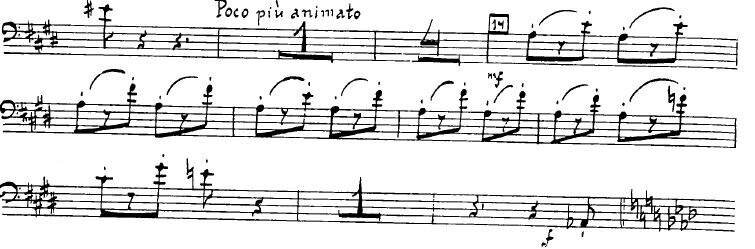
I'm pretty sure I did that on the D and G string with the same fingerings as before. When the pattern changes I do 2 on F nat., 4 on C sharp, 1 on G sharp, and 2 on E. I like this because it's easy to keep the same sound quality as before and it keeps the bow stroke consistent.
I'm pretty sure I did that on the D and G string with the same fingerings as before. When the pattern changes I do 2 on F nat., 4 on C sharp, 1 on G sharp, and 2 on E. I like this because it's easy to keep the same sound quality as before and it keeps the bow stroke consistent.
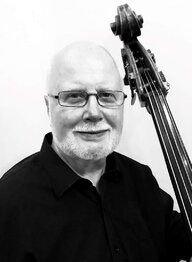
Thanks Cory...this is you, right?
Rochester Philharmonic Orchestra Blog: Meet Cory Palmer, new principal bass
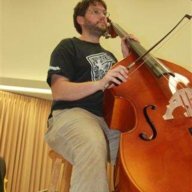
Using 1 2 3 4 fingering helps me reduce shifting or at least reduce pivoting to a 1/2 tone. Purely of academic interest is playing the Es with second finger, pivoting to 4 for Bs and crossing to 1 for C sharp. The thumb stays in the one place. This would be almost 1 2 3 4 fingering. Staying at the balance point of the bow makes string crossing relatively easy to control. Just testing !!
Thanks Cory...this is you, right?
Rochester Philharmonic Orchestra Blog: Meet Cory Palmer, new principal bass
That is indeed.
I was looking for something to typeset using lilypond. Here's what the first of these two excerpts looks like using that language. Here's the source code to create this:
% ----------------------------------- Begin file Cind.ly ------------------------------------ %
\version "2.18.2"
\new Staff {
\clef bass
\key e \major
\relative c
\compressFullBarRests
\time 6/8
{
e8\staccato\mp^"unis. circo." [(r8 b\staccato )] e8\staccato [(r8 b\staccato )]
e8\staccato [(r8 cis'\staccato )] e8\staccato [(r8 cis'\staccato )]
e8\staccato [(r8 b\staccato )] e8\staccato [(r8 cis'\staccato )]
e8\staccato [(r8 cis'\staccato )] e8 r4
% Newline to make this consistent with shared excerpt
\break
% -------------------------------------------------------------------- %
% Multiple measure rest
% -------------------------------------------------------------------- %
% Multiple measure rests needs a capital R instead of a lowercase r,
% and it also needs the the compressFullBarRests command. In a
% different time signature, you need to tell it how everything scales
% as well
R1*6/8*4
e8\mf \staccato [(r8 cis'\staccato )] e8\staccato [(r8 c'\staccato )]
gis \staccato [(r8 dis'\staccato )] b\staccato r4
r4 fis8\mf e'4\tenuto gis8
e'4.\tenuto gis8 r4
}
}
% ----------------------------------- End of file Cind.ly ------------------------------------ %
% ----------------------------------- Begin file Cind.ly ------------------------------------ %
\version "2.18.2"
\new Staff {
\clef bass
\key e \major
\relative c
\compressFullBarRests
\time 6/8
{
e8\staccato\mp^"unis. circo." [(r8 b\staccato )] e8\staccato [(r8 b\staccato )]
e8\staccato [(r8 cis'\staccato )] e8\staccato [(r8 cis'\staccato )]
e8\staccato [(r8 b\staccato )] e8\staccato [(r8 cis'\staccato )]
e8\staccato [(r8 cis'\staccato )] e8 r4
% Newline to make this consistent with shared excerpt
\break
% -------------------------------------------------------------------- %
% Multiple measure rest
% -------------------------------------------------------------------- %
% Multiple measure rests needs a capital R instead of a lowercase r,
% and it also needs the the compressFullBarRests command. In a
% different time signature, you need to tell it how everything scales
% as well
R1*6/8*4
e8\mf \staccato [(r8 cis'\staccato )] e8\staccato [(r8 c'\staccato )]
gis \staccato [(r8 dis'\staccato )] b\staccato r4
r4 fis8\mf e'4\tenuto gis8
e'4.\tenuto gis8 r4
}
}
% ----------------------------------- End of file Cind.ly ------------------------------------ %


