• TalkBass has been independent since 1998. Add your voice.
    Create a free account to reply to discussions, view embedded media, and browse with fewer display ads.
    Join freeLog in
    Want zero display ads or expanded classifieds tools? Compare plans.

A question for the STRICT 1-2-4 fingering advocates

I have a very flexible view about the left/fretting hand technique. I don't abide by any "dogma" rules, but...

I wrote for myself a simple (just for the sake of the left hand/fretting technique on the electric bass) exercise, loosely based on Giant Steps' harmonic content/chord progression.
I followed one rule with very few exceptions
- the chord notes on Beat 1 and Beat 3, and on Beat 2 and Beat 4 - one half step above or below the chord note.

Please note, it has NOTHING TO DO WITH THE BEAUTIFUL GIANT STEPS BASS-LINES PLAYED BY SUPERB MUSICIANS. It's only about the technique of the fretting hand.

First time (A), the line is kind of "jumpy", the second time (B) is more linear with a lot of chromaticism.
My question for the 1-2-4 fingering supporters:

How would you play the exercise by using only 1, 2, and 4 fretting fingers at the 286 BPM tempo?

Also.

What if that exercise was played on the fretless bass or on the Double bass?
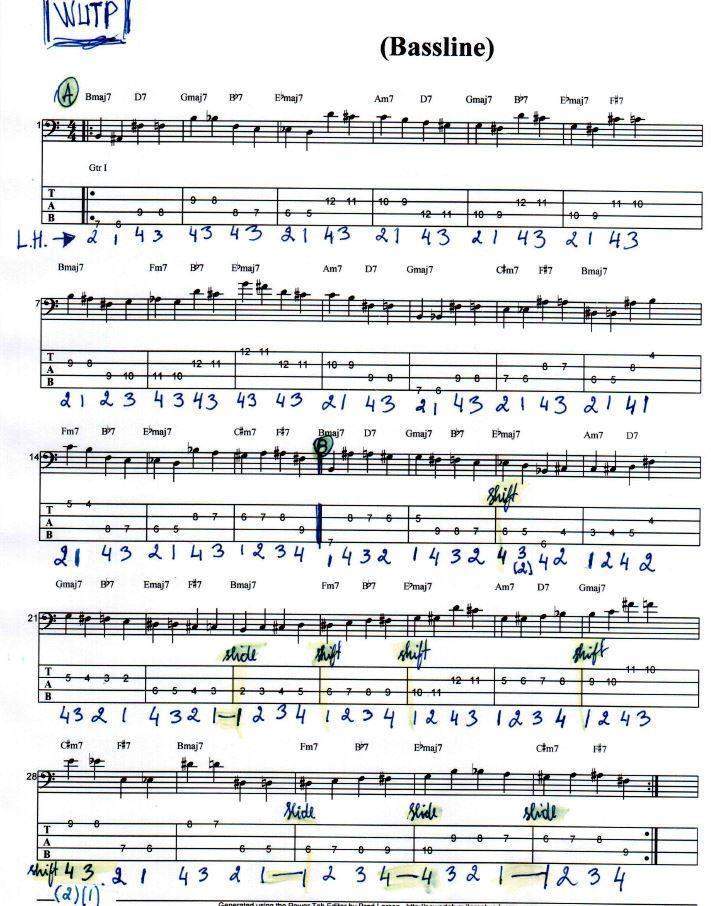


GiantStepsBassEx.jpg


Just in case, I decided to use "Giant Steps" because there are a lot of Youtube videos of that song with the "Bass-Removed" backup tracks, that provide me with some beautiful background while playing that exercise.


Giant Steps 160bpm-Bass Removed-Backing Track


OR (more challenging)

Bass Removed-Giant Steps 286bpm-Backing Track

 
Last edited:
  • Like
Reactions: OldDirtyBassist
If i get a chance later tonight i will try to play this on DB and see how i would finger it. I can't play much of anything at 286 BPM though, so i dont know if it is really going to prove anything for you, lol. I can at least say that i wont be playing in the middle of the neck like the tab is suggesting. I'll be playing it all closer to the nut, shifting up only as needed. In my experience, you have to use open strings very frequently to make 1-2-4 fingering work.
 
  • Like
Reactions: Whousedtoplay
No, you are absolutely correct.
And the first advocate of 1-2-4 fingering on the electric bass is one of my favorite bass players, a very versatile Double bass/Electric bass Musician, a superb bass teacher, and a person who's done so much for the bass community - Ed Friedland.
Plus, almost all electric bass players that started as the Double bass players.

Huh--I've been around plenty of doublers, and I don't recall hearing of or seeing that before. It might be necessary for bassists with very small hands, but otherwise I really don't see the point.
 
  • Like
Reactions: Whousedtoplay
Well, if you wrote this exercise simply to prove 1-2-4 fingering wrong, then what is the point of this? Traditionally, 1-2-4 fingering is primarily used on the double bass, some players have brought it over to electric out of habit, or only use it in the lower register of the electric bass, utilizing all 4 fingers as they move up the neck. All double bass players use all 4 fingers in the higher registers of the neck, but 1-2-4 fingering in lower registers due to ungodly large space intervals. There are huge physical differences between the double bass and electric bass, i'm not sure you realize that.

Regardless, this could be played with 1-2-4 fingering like i said earlier, just with the use of open strings and played closer to the nut. Or you could play it using all 4 fingers in the middle of the neck. But who gives a poopie?
 
  • Like
Reactions: Whousedtoplay
I have a very flexible view about the left/fretting hand technique. I don't abide by any "dogma" rules, but...
The problem here is that nobody advocated a strict 124 fingering. You claimed that you would not teach a beginner to play 124 In first position. That's why I said
"Ed Friedland would disagree with you. So do I."


*Just to verify about the "same fret, same finger" fingering.
When I'm using that "same fret, same finger" method (I use it quite often), my 4th finger (in this case) frets A on the E string and stays on that 5th fret. I don't lift my finger to fret D on the A string. I just, kind of, move the pressure point/center from the E string onto the A string in my 4th finger.
I would call it - "Barre" on the Bass guitar.
But almost all famous bass teachers are against it
.*
Ed Friedland isn't.


*What's more, I would not teach any new beginner bass-players to use 1 2 and 4 fingers while playing the following three notes on the E string: F(1st fret), G (3rd fret), and Ab(4th fret)?*
Ed Friedland would disagree with you. So do I.
 
  • Like
Reactions: Whousedtoplay
I think it's largely a personal preference. Hand size plays into it a lot. If you have Jaco sized hands, than 1FPF will make more sense.
Personally I don't have the biggest hands, and I find 1FPF in first position to cause unnecessary strain. I used to use 1FPF, and after a few years of playing in a band that was on the more technical side of things I started to feel the effects. Once I began moving forward with the mentality of taking the path of least resistance I adopted a 1-2-4 approach, and it was a decision that saved my hand/wrist from a lot of pain.

What you're teaching your student should have nothing to do with what feels more natural for your hand. Pay attention to their hands, and don't teach them a technique that will strain them, and potentially cause them damage down the road.
 
Also, if I need to play F (1st fret) and G (3rd fret) on E string, followed by Bb (1st fret) and C (3rd fret) on A string,
without hesitation, I would use 1st and 4th left hand fingers.
What kind of fingering technique is it?

Using 1st finger for F and 4th finger for G? That's just simply normal/standard fingering technique. 9 out 10 pro players (including Jaco Pastorius--see above) would play it that way. :)
 
Last edited:
  • Like
Reactions: Whousedtoplay
Wow, a good thing - I'm not TEACHING ANYBODY!

Just a question.
Are you saying that
A.) using/spreading 1st (Index) and 2nd (Middle) left hand fingers between F (1st fret) and G (3rd fret) would strain them LESS
than
B.) using/spreading (less) 1st (Index) and 3rd (Ring) left hand fingers between F (1st fret) and G (3rd fret) ?

Let's say, in my case, those strict 1-2-4 rules would have caused some damage to my hand.

Also, if I need to play F (1st fret) and G (3rd fret) on E string, followed by Bb (1st fret) and C (3rd fret) on A string,
without hesitation, I would use 1st and 4th left hand fingers.
What kind of fingering technique is it?


I'm not saying either A nor B. I'm saying that I would spread 1st finger on F, and 4th finger on G. 1-2-4 spread across 3 frets respectfully.
Of course that's only dealing with the lower position on the instrument. Once I reach 1st finger on the 5th fret I begin to transition into 1FPF, and once I reach about the 7th fret with my index I'm playing 1PFP exclusively beyond that point.

For your scenario of playing F G Bb C I would use the same approach of 1-4-1-4. I would consider that a 1-2-4 technique. 1FPF would be 1-3-1-3 for the same notes.
 
  • Like
Reactions: Imaginary Pony
"If a melodic gesture ends on a stable beat, shift on the mobile beat or vice-versa. This is to help avoid gaps in the phrasing due to the shift.
In 4/4 time beats 1 and 3 are the stronger stable beats, so you should always try to avoid shifting over notes that are played at either place.
Likewise if a melodic gesture ends on a mobile beat you should shift on the stable beat.
You do not want your melodic phrasing to be punctuated with gaps due to large shifts."
http://www.notreble.com/buzz/2009/10/15/lesson-fingering-strategies-for-the-upright-bass/

Does this rule apply to electric bass?

Apologies for the slight derail, but can someone tell me what is meant by the terms "stable beat" and "mobile beat"? I've never heard those terms and couldn't find the answer with the Google machine....
 
  • Like
Reactions: Whousedtoplay
Could you please take with your cellphone your left hand position while you are playing that simple pattern?

You're right, it is not easy to hold a good hand position while snapping a photo. I should have cut you a little more slack, apologies. :)

Here is how I would play F-G-Ab using 1-2-4 fingering. The biggest difference from your technique is you will notice I don't try to keep my index finger on the F; it moves up to the 2nd fret.

se3a7n.jpg


You can also watch the Jaco Pastorius video I posted if my photo isn't clear---his technique was a lot better than mine! ;)
 
  • Like
Reactions: Whousedtoplay
I don't get this religious war between one finger per fret and 1,2,4 fingering. Use what is comfortable. My only problem with the one finger per fret crowd is that some seem to think that any hand can stretch to accommodate this technique. If you can do OFPF, bravo; if you can't, learn to shift smoothly. I've seen awful and awesome player using both techniques.
 
  • Like
Reactions: Whousedtoplay