• TalkBass has been independent since 1998. Add your voice.
    Create a free account to reply to discussions, view embedded media, and browse with fewer display ads.
    Join freeLog in
    Want zero display ads or expanded classifieds tools? Compare plans.

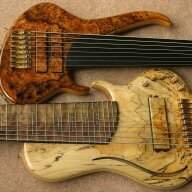
ACG 9 STRING!!

Hard to imagine Martin producing anything that the word shabby could be applied to.

My thanks to Mark for his patience and his support through out this build it is and was very much appreciated.
Alan

Alan, you make a very good point about Martin, which could both be misconstrued by some (despite the use of smilies) and get me into trouble. For the avoidance of doubt by anyone:
  • I know Mark and we have shared jokes about his ACG 9 string and my SEI 9 string that is still being built
  • Both Martin and Alan make world class basses, none of which could remotely be called shabby
  • My original posting was trying to emphasise just how beautiful Mark's ACG 9 string bass is.
Thanks for helping make this clear to all.
 
Alan, you make a very good point about Martin, which could both be misconstrued by some (despite the use of smilies) and get me into trouble. For the avoidance of doubt by anyone:
  • I know Mark and we have shared jokes about his ACG 9 string and my SEI 9 string that is still being built
  • Both Martin and Alan make world class basses, none of which could remotely be called shabby
  • My original posting was trying to emphasise just how beautiful Mark's ACG 9 string bass is.
Thanks for helping make this clear to all.


Sorry. I was not having a go at you just mentioning that I hold Martin in the highest esteem for his work and being a really nice guy and I am absolutely sure you think the same.
 
Sorry. I was not having a go at you just mentioning that I hold Martin in the highest esteem for his work and being a really nice guy and I am absolutely sure you think the same.

+1 re Martin, which is why I always go to him for my basses. Seriously, thanks for post and no offence taken of any sort whatsoever.

Anyway, lets get back to just how beautiful your latest creation is...
 
I just took a good look at the builders website, and I was blown away! I love the wood combinations on all his bass in his gallery.

Didn't mean to derail your thread, but I had to come back and post.
I really want one now.... does he ship to the states? :help:

-ScottM
 
Mark

Congratulations! The bass looks absolutely gorgeous and no doubt will provide you with much enjoyment...it is simply fantastic and I'm so pleased for you!

Only thing though is with you & Alan putting the bar so high, I'm concerned my Sei 9 might look a bit shabby in comparison...:hmm::(:help::D

Cheers mate :D

I'm sure the Sei 9 will be able to show it's face and won't be sitting embarrassed in a corner :D :D I love my Sei bass and it's one of my lifetime ambitions fulfilled.

The idea of getting a 9 came really by playing the 7 so much.

None (and I mean absolutely none!) of this would not have been possible without the total support of my wife, Jennifer. Long story short, she encouraged me to go for the 9 string if that is what I wanted to do. It was more than just sanctioning some selling & funding, but giving me strength to believe in myself. Her support means that my music means something to both of us, regardless of whether anyone likes the end result of the instrument or my subsequent compositions.

My thanks to Mark for his patience and his support through out this build it is and was very much appreciated.
Alan

I should thank you for fielding my (sometimes) strange questions!

The whole process of the 9 has been a lot of fun. I enjoyed the research that I did for the spec and Alan distilled it, enhanced it and produced an instrument which plays and sounds as good as it looks.

I've played the bass for quite a while today and I really couldn't be happier with it. :bassist: :bassist:

.....and just in case anyone thinks that 9's (or ERB's in general) are only for jazz/fusion soloing, I played along with one of my favourite albums tonight...


.... "New Jersey" by Bon Jovi.
 
I just took a good look at the builders website, and I was blown away! I love the wood combinations on all his bass in his gallery.

Didn't mean to derail your thread, but I had to come back and post.
I really want one now.... does he ship to the states? :help:

-ScottM

I've said it before and I'll say it again. If you can even think about affording a new custom bass right now, you need to talk to Alan. His quality for the price was pretty near unmatched even before the US$ became stronger relative to the Pound. I'm sure that Alan will start raising his prices if I say this too much, but it's true. ACG is one of the stunning bang for the buck high end basses out there right now.

And just to be clear, I am not talking about these basses as just being 'bargain' basses. It is my honest opinion that Alan makes basses that are right up there in the highest tier alongside my very favorite luthiers.

That is why I have a second ACG on order, and I am confident that it will not be my last. :cool:

Tom.
 
sorry if you said it already in the thread... how is it tuned? and i'm not an anti ERB kinda guy but i do have to ask, what do you use all those strings for? i play a 5. think i could go to a 6 and use it. but beyond that i don't know that i could do much with it. what do you use it for? again, i'm not an anti ERB guy. just curious.

btw, AMAZING looking bass.
 
I just took a good look at the builders website, and I was blown away! I love the wood combinations on all his bass in his gallery.

Didn't mean to derail your thread, but I had to come back and post.
I really want one now.... does he ship to the states? :help:

-ScottM

No worries about de-railing :D

As Tom has said ACG have customers from the USA, so no worries for you there.

The mix of wood combinations, bespoke pickups/electronics and Alan's skill in creating wonderful instruments from them, makes ACG a real contender for anyone looking for a custom build.


What is the tuning?

It's tuned F# B E A D G C F Bb.

i'm not an anti ERB kinda guy but i do have to ask, what do you use all those strings for? i play a 5. think i could go to a 6 and use it. but beyond that i don't know that i could do much with it. what do you use it for? again, i'm not an anti ERB guy. just curious.

btw, AMAZING looking bass.

I went from a 4 to a fretless 6 (in 1998) to a fretted 7 (2002) and then the 9.

When I first got the 6, I was the bassist/lead vocalist in a band. Apart from that, I could also trade solos with the guitarist, so I used the range and it was great fun. Same with the 7, I saw Bill Dickens using one, was amazed by it, bought a Conklin GT7 via eBay from a guy in the States and carried on using it in the same way.

So I've been playing 6 strings and upwards for a while now and the jump from a 7 to a 9 isn't that big. Buying a 9 without going up in stages would be incredibly difficult (not impossible but it would take a better player than me :D).

I don't see myself doing the pianistic/Chapman stick style of playing which I've seen some players do so excellently on bass websites and YouTube. I'm not really into loopers either. The guys who use them are great, but it's just not the thing for me.

I see the 9 as a challenge not only to play but also to compose for. I have a small studio at home, so the 9 will be used for some multi-track instrumental stuff as well as the entire background for songs that I have already. It won't be used exclusively though, I'll still use 4 string basses, fretless and guitars (on which I use a whammy bar to make up for lack of technique :D).

The 9 is definitely not a one-trick pony or some sort of sideshow. It's an instrument which will be used as all others are; for the enjoyment of playing and creating music.


Mark

I have just caught up on this thread and saw you now have it! What a beast:hyper: I just love the wood combinations and cannot wait to hear what she sounds like.

Will you be making any soundclips?

Regards

Matthew

Hi Matthew. It's a beast alright, but one that's tamed with a bit of practice. As a 7-stringer yourself, you can probably appreciate that it's not that big a jump from a 7 to a 9.

I'll be making some soundclips in the near future. I have an Open University essay to do this week, so I have to make sure I have the work done before I turn my attention to the 9 :D
 
Please note: This review has been written for the sheer enjoyment of writing. I am not connected with AC Guitars in any way, only as a customer The review has not been requested by AC Guitars nor was prior warning given to AC Guitars before posting.

This is a review of the ACG 9 string bass which I took delivery of in January this year. This bass may have a larger than normal body and neck, but at the heart of it is a solid sounding, traditional electric bass guitar. AC Guitars have been making a name for themselves over the last few years. The vision of one man, Alan Cringean, ACG instruments are instantly recognisable with their original silhouettes, high build quality and stunning woods.


ACG9front.jpg


ACG9back.jpg


Construction and hardware

This ACG 9 string has the “Recurve Singlecut” shape and uses a set-neck, a glued joint, instead of the more usual thru-neck or bolt-on. This set-neck design is well executed and shaped with no ungainly mounds or troughs in the join between neck and body. The neck and body sandwich a “transition block” of wenge which, as well as being used when the neck and body are glued, gives a clean and handsome look to the finished joint.


ACG9transition.jpg


The neck itself is a 7 piece laminate of maple and wenge. The back of the headstock has a wenge backplate to mirror the wenge of the neck whilst the front of the headstock mirrors the wood used on the body of the bass, which is a smart touch. The headstock carries 9 Hipshot Ultralite tuners which have been angled slightly towards the body. This both makes tuning physically easier and reduces the size of the headstock to help with the balance of the whole instrument.


ACG9Hstock.jpg


The neck carries an acrylicised, book-matched, spalted maple fingerboard (!) which is completely flat (i.e. no radius). Supplied by Gallery Hardwoods in the USA, the “stabilized figured woods have been impregnated with monomers and acrylics to produce a dimensionally stable wood*” As well as allowing woods which were previously considered too fragile to be used as fingerboards the “stabilized woods minimize or totally eliminate: shrinking, cracking, expanding, warping*”. ACG have embraced this new innovation and are one of the only (if not the only) luthiers in the UK to offer acrylicised fingerboards to their customers.


ACG9upperbody.jpg


The ACG 9 has a 35” scale, has 17mm string spacing at the Hipshot bridge and a wide fingerboard which grows from 79.7mm (3.14”) at the nut to 126.4mm (4.98”) at the 24th fret. The neck is very shallow at 20.2mm (0.8”) and is very slighter narrower at the body joint. The frets themselves are fat and not too high measuring 2.58mm tall (0.1”) and 1.55mm high (0.06”). The entire bass is 118cm (46 ½”) long and 38cm (15”) at its widest point. Surprisingly, the big ACG 9 string weighs just 5.4kg (just under 12lbs) and fits in an off-the-shelf Hiscox case.

The neck joint and body cutaway gives access to all of the 24 frets. The range of the ACG 9 is 5 octaves plus a major third (4 frets)!!

The body is swamp ash and the piece has been specially selected for its light weight. A black veneer is sandwiched between this and the mahogany top. The top not only has stunning figuring but the colour varies from light, orangey hues to dark brown. The black hardware compliments the colouring of the whole bass.

The whole instrument is finished in an acid catalysed lacquer with the “sheen level” adjusted to make a satin, smooth finish on the back of the neck and a high gloss everywhere else. On many basses, a thick gloss finish coats the whole instrument necessitating 0000 wire wool (or similar) to be used on the back of the neck to make it smoother and easier to get around on. This clever control of the “sheen level” makes the bass great to play straight away. The quality of the finish is really impressive with no bubbles, runs or other defects.


ACG9body.jpg


Electronics and controls

The ACG -01 preamp is only available on ACG basses (the 02 version, with reduced functionality can be purchased from ACG direct) and is a filter-based system. This does take some getting used to but, as with all things in life, the work you put in pays dividends. Sounds range from dark, thick and soupy to harsh, thin and trebly. Not only can separate sounds be set on each custom wound ACG pickup, they can then be blended together as well. If that wasn’t enough to shape your tone, each pickup has coil switching controlled by the relative toggle switch below the bridge.

The controls are on 4 stacked knobs and the first of these takes care of volume and pickup blend. The next two stacks are low pass filter stacks, one for each pickup. The further the bottom of the stack is rotated clockwise, the more high frequencies are let through the filter. Importantly, the bottom end of the sound is not affected as it would be on a regular eq-based preamp. The top controls the “overshoot peak” essentially enhancing the frequencies passing through the filter. The fourth stack is a high-pass filter which affects the whole sound. This time, the lower ring controls the amount of low frequencies passing through and the top enhances those frequencies.

It all sounds complicated, but in essence the stacks are volume/blend, tone shaping for neck pickup, tone shaping for bridge pickup and a stack to add treble to the whole thing.

The 9 string also has a third toggle switch to select either the bridge pickup or the piezo pickup in the bridge. Instead of blending in a flat piezo signal to the magnetic pickups, either the bridge or piezo signal runs through one channel of the ACG EQ-01 preamp. This means that the piezo signal can be shaped as well, creating a totally new range of sounds. The pre goes down to 20Hz, so even affects the low F# string.

This ACG bass also has a low-battery indicator, so the 9V battery can be changed before it’s completely exhausted. This avoids the huge embarrassment caused when your bass cuts out mid-gig.


Playability and sound

All of the previous would count for nought if the bass was a swine to play. As mentioned before, the fingerboard is very wide but because it’s flat, and so does not have a radius or a ‘curve’ to it, this makes getting around surprisingly easy. The fingerboard feels very smooth and hard, but even smoother than a traditional varnished maple fingerboard. This at first feels a little strange, but after a minute or so this is forgotten and you find that the fingerboard is ultra-fast.

The 9 strings come from S.I.T. in the USA, are tuned in fourths from F# B E A D G C F and Bb and measure .165, .135, .105, .80, .60, .35, .30, .19 and .12. The lowest 5 strings are taper-core so exposing the core at the bridge and over the bridge saddle. It’s important to note that the 9 strings are based around a ‘conventional’ 4 string set of .35, 60, 80 and 105 with a .135 making the low B of a ‘conventional’ 5 string set. This essentially makes the instrument a 5 string bass with extra strings added and makes the adjustment to playing this “Extended Range Bass” as painless as possible.

Straight from the workshop, the action was really low. This hasn’t been adjusted at all ever since and measures 1.6mm (4/64”) on the lowest string and 0.4mm (1/64”) on the highest string. At the 12th fret the action is 2mm (5/64”) and 0.6mm (1 ½ / 64”). There is a tiny bit of relief of 1.6mm (1/16”) in this neck. This low string height added to the glassy-smooth fingerboard combine to make the ACG 9 an incredibly easy instrument to play. The wide neck takes some getting used to but this is by no means an impossible mountain to climb.

Frets end have been carefully bevelled and there are no protruding fret ends to catch flying fingers or thumbs. The crowns of the frets have been nicely shaped and polished to a high shine. Being really picky, the only criticism of the setup is that the strings are too low in the nut slots. There are some repairers and luthiers who would dictate that half of the string diameter should be exposed in the slot and that the sound could be muted because of this. Overall though, the setup is really low and buzz free which is all us bassists could ask for.

The balance is also spot on. The neck strap button lives above the 10 fret giving a fulcrum which the headstock and tuners cannot outweigh. The bass is heavy, but not overly so. Wearing the bass with a thick, padded strap means this bass can be worn for extended periods during practice, rehearsal and gigs.

Even with the preamp set totally flat, the sound of the ACG 9 is full and round and from there it is possible to dial in, literally, any sound you can think of. Even that low F# is audible and usable, even through a 40 watt 12” practice amp. The bass continues to sing all the way up the entire range with no dreaded ‘dead spots’.

It has to be said though, that the preamp does need some getting used to as you start to understand how each control affects the sound. However, after a short time it gets easier to dial in sounds quickly and easily. As of now, I have one sound that seems to work for everything I need so I add bass or treble from that favoured setting. The pre even affects the low F# string so the entire range of the bass can be shaped. With this and the huge range of the bass, the ACG 9 becomes a very powerful tool indeed. The highest tribute I can pay to the ACG pre it is to say that, when finances allow, I will have one fitted into my Sei bass and sell the 3 band Schack circuitry that lives in there at the moment.


ACG9closeback.jpg


Conclusion

These “Extended Range” basses are definitely a niche market, so it is to ACG’s great credit that they even took the order for such an instrument. This is no publicity stunt though, but a serious instrument which shows ACG’s attributes of original design, high build quality and stunning woods. The acrylicised fingerboard is a revelation both in looks and playability and the ACG 01 preamp is a refreshing approach, addressing the limitations of the more conventional banded eq setup.

All through both the consultation process on the specification and the build itself, communication between myself and ACG has truly been a two-way process. Ideas have been aired and used or left by the wayside according to what would serve the bass best. The instrument leads the way and Alan Cringean doesn’t impose his preconceptions or preferences during the build.

I couldn’t be more pleased with this ACG 9 string. It sounds great, plays great, looks great and is wonderfully made. I have no qualms in recommending ACG for anyone looking for a new bass regardless of the number of strings required.


Further information on all ACG basses can be found at www.acguitars.co.uk

A full explanation of the ACG filter-based preamp can be found directly at [Invalid or Expired Link Removed]


* Taken at 19/5/09 21:55 BST from Link Removed
 
This is a great looking bass ,and it was nice that posted the start and finish.
I played a 9 string made by bee basses i thought that it would cause a lot of problems getting around on it , but it was not that bad, i played some tap stuff and chordal stuff on it , so i know that you are having fun "ENJOY".
 
Yes, Alan is one of two European builders using my Acrylized boards. Alan has excellent taste and insight in wood selections that consistently produce stunning and unique aesthetics and I'm proud to be associated with him. While Alan uses a wide spectrum of board choices the other builder has used only acrylized ebony in volume...Jens Ritter.

Alan must have 30/40 acrylized boards in stock with another 30/40 on order when I return to the shop in July.
 

Latest posts