
You can't go wrong with Jensen. They are probably the best in the industry.
for clean clear and colorless sound yes, but that’s the exact opposite of the Motown DI.

TalkBass has been independent since 1998. Add your voice.
Create a free account to reply to discussions, view embedded media, and browse with fewer display ads.
Join free Log in
Want zero display ads or expanded classifieds tools? Compare plans.
You can't go wrong with Jensen. They are probably the best in the industry.

In my opinion, I don't think there is any magic in a crappy transformer. There are better ways to add distortion in a controlled manner.for clean clear and colorless sound yes, but that’s the exact opposite of the Motown DI.
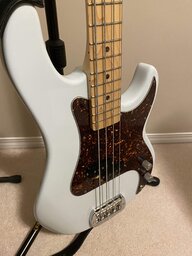
I was tempted to get it for my P-Bass as it would make me feel ever so slightly closer to the legendary James Jamerson... if only I had "the hook" of a finger.


In my opinion, I don't think there is any magic in a crappy transformer. There are better ways to add distortion in a controlled manner.
26931518[/URL], member: 120092"]Generally, if your DI is deleting that much signal, I'd say it's a pretty lousy DI.
Don’t we all!!!
Actually I don’t think you need this DI at all for that. I think it’s most important to have a string mute that works well for your bass to get his thumpy sound.
To be honest I decided to get the Motown DI when I saw an old IG post from Stephen Campbell (from the Marcus King Band) praising this DI for its rich sound when Recording the wonderful Carolina Confessions album with producer Dave Cobb. I can certainly live without it. The Noble DI puts much more of a smile on my face.
The last DI I have any interest in getting is the Useful Arts BF-S Pro. I’ve been told by a few sources that the weird impedance does wonders for bass unlike anything else… (GaS)
If my understanding is correct, only the XLR out is affected by the transformer? One of the draws of the Noble DI for me is that both the balanced out and the 1/4" are effected by its electronics and tubes which is really nice if you plan on using it both in front of an amp at home, and as a DI at a venue.

A transformer DI steps the signal down in voltage and in impedance. That means the signal will survive a very long cable run without changing frequency response, and work into a mic input - your raw bass signal won’t do that. You aren’t actually losing signal, you’re trading off voltage, and gaining in current as a result. Plug it into an input it isn’t designed to work with, and you might get the wrong impression.
It’s not a “lousy” DI, it’s doing its job very well.
All that said, If you’re looking for the magic of the Motown sound, it ain’t in the transformer - it’s well before that in the signal chain.

Have you actually run power through one of these?The attenuator is only used if running a speaker level through it. It can take up to 100w, so it pairs up with a B-15 rather well.
I use mine live and in the studio. On the last batch of recordings, I was perfectly happy with the straight tone from the DI.
Here's the Wiki version of the story.Just shows what I know. Thanks for the info and correcting me.
I'm not sure how I feel about them calling the "Motown" DI now.
Couple years later and the link 404'd for me. I've seen this elsewhere as well with other Wolfbox links. Wonder if someone is trying to scrub info about this?Everything you need to know about the motown di box is here:
Link Removed
BTW the original transformers were Triad Magnetics A-11/12J. Read article for further interesting info!
Hmmmm... maybe in the fingers?A transformer DI steps the signal down in voltage and in impedance. That means the signal will survive a very long cable run without changing frequency response, and work into a mic input - your raw bass signal won’t do that. You aren’t actually losing signal, you’re trading off voltage, and gaining in current as a result. Plug it into an input it isn’t designed to work with, and you might get the wrong impression.
It’s not a “lousy” DI, it’s doing its job very well.
All that said, If you’re looking for the magic of the Motown sound, it ain’t in the transformer - it’s well before that in the signal chain.
The thru jack is exactly in parallel with the input jack. The only thing it will have is some loading applied to the pickup, compared to the bass being plugged straight into the amp.Judging by wiring in this photo, I don't think the Thru would be affected by the transformer as they are wired in parallel (I think that is the correct word). Would be super cool if they were. However, I may be completely wrong.
Have you actually run power through one of these?
I built a clone from the original design. The "attenuator" is a standard two watt, 100K pot with series resistors either side of it. Not a 100 watt L pad, or anything like that.
If you ran your amp out to the D.I. in, then came out of the parallel 1/4" jack to your cab, it might be OK.
It certainly won't provide a proper load for your amp (especially tubes) by itself.
I was never under the impression that they were designed to take power, so am interested in your experience.
It's probably just a T pad, which should be able to attenuate enough to keep the transformer core from saturating.Have you actually run power through one of these?
I built a clone from the original design. The "attenuator" is a standard two watt, 100K pot with series resistors either side of it. Not a 100 watt L pad, or anything like that.
If you ran your amp out to the D.I. in, then came out of the parallel 1/4" jack to your cab, it might be OK.
It certainly won't provide a proper load for your amp (especially tubes) by itself.
I was never under the impression that they were designed to take power, so am interested in your experience.

A transformer DI steps the signal down in voltage and in impedance. That means the signal will survive a very long cable run without changing frequency response, and work into a mic input - your raw bass signal won’t do that. You aren’t actually losing signal, you’re trading off voltage, and gaining in current as a result. Plug it into an input it isn’t designed to work with, and you might get the wrong impression.
It’s not a “lousy” DI, it’s doing its job very well.
All that said, If you’re looking for the magic of the Motown sound, it ain’t in the transformer - it’s well before that in the signal chain.
You may claim it was Jamerson, but Babbitt got a pretty good sound there, too. So which is it, really?
The "magic" was always the preamps they used and the electronics going all the way through to the tape machine. Everything at Motown was heavily modified at one time.