• TalkBass has been independent since 1998. Add your voice.
    Create a free account to reply to discussions, view embedded media, and browse with fewer display ads.
    Join freeLog in
    Want zero display ads or expanded classifieds tools? Compare plans.

Acoustic bass fetish club Part 2

LOVE Mendocino! Been going up that way since college days MANY years ago. Stayed at the Mendocino Hotel, Heritage House, MacKerricher Park etc. Skunk Train rides... the whole tourist-y enchilada. But sadly, have not made it up there in awhile.

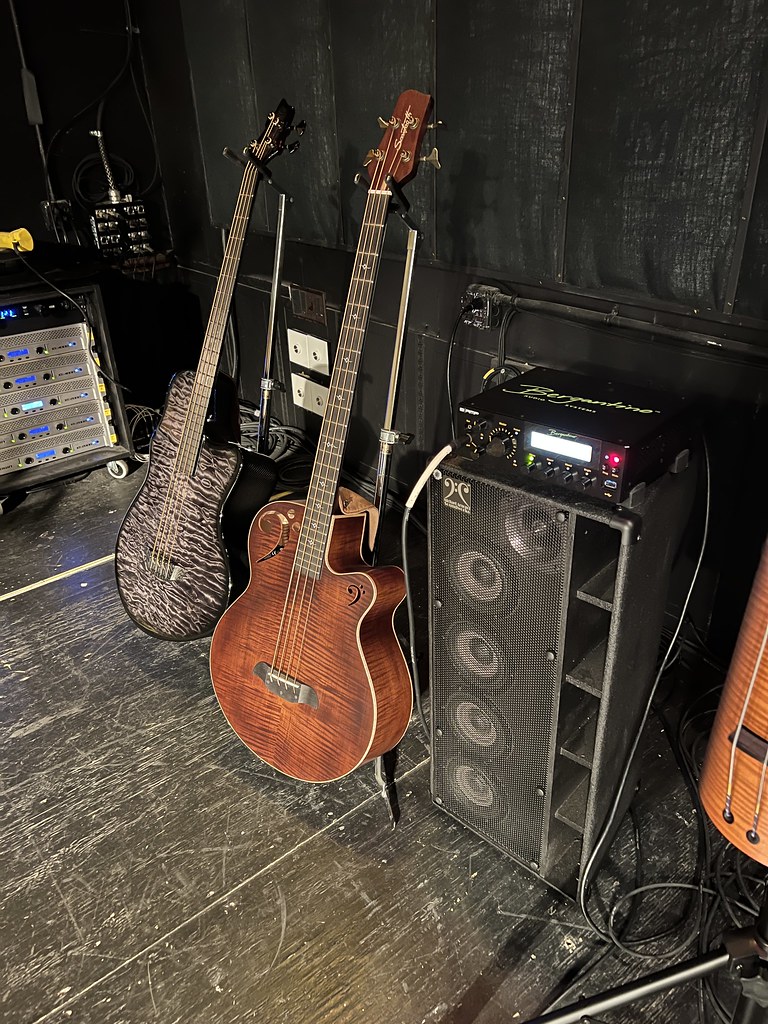
I'm not giving up. In fact, I'm starting to bond with this one. I just need to find the right strings and maybe an FRFR that I can use for acoustic-ish gigs. Recommendations that won't break the Bose bank? Would something like this fit the bill? Headrush FRFR-112 2000-Watt 1x12" Active Guitar Speaker Cabinet 2010s - Black | Reverb

Also wondering if anyone has experience with LR Baggs pres in front of their amps and how they do with feedback issues. The Para DI and Venue DI look nice.
The 12" Headrush will handle band volume better than the little 8" version that I use for folkie gigs.

The only downside IMO, is that it's a little tubby on the low end. Not a problem if you use the EQ on your bass or a preamp to roll off that bass/midbass bump. A preamp with a high-pass filter would be even better than one with EQ only.

I use my FDeck HPF preamp v3 to good use when I need to tame amps or house PA systems that have too much booty for ABG. Francis is a long-time Talkbass member, so if you buy from him, your money goes to one of the Chosen...
 
  • Like
Reactions: dwellers
Anyone have experience with a small vertical 2x8 cab like the TC, Trace-Elliot or Peavey cabs? Think they do better with AEB than a single larger driver like a single 12?
I often use my Trace Elliot Elf stack with both my Alien acoustic and solid body’s. I haven’t noticed much of a difference from when I use a large stack other than the old school giant having better eq capabilities to cut down on feedback issues
 
  • Like
Reactions: dwellers
Judging by the way he said that case was a third of the cost of the bass, he bought the cheapest Rockbass which comes with the cheaper bags. I have the top of the line Alien and the bag that comes with it is much nicer

At $1700 - $2600 for the Alien 4, depending on where you purchase, I would hope so!

My Ortega cost $630 ... My Fender cost $530 shipped. They have nice cases. Very nice.
 
  • Like
Reactions: dwellers
Anyone have experience with a small vertical 2x8 cab like the TC, Trace-Elliot or Peavey cabs? Think they do better with AEB than a single larger driver like a single 12?

@dwellers.... I've been designing and building speakers since 1982. Larger diameter drivers move more air down low. That's the only real advantage.

If you're looking for more loudness, mutiple drivers will do it (two 10" drivers have more cone surface area than a single 12") ...
But it won’t sound better, unless pushed extremely loud. Two 10s move more air.

I don't believe in buying any kind of combo units. Buying raw drivers for waaaay less, building your own cabinet, and using an external amplifier with DSP is the best solution.

In example: A Fearless DIY cabinet, with an inexpensive Berringher NX-3000D smokes any Trace Elliot combo. Easily.
 
Anyone have experience with a small vertical 2x8 cab like the TC, Trace-Elliot or Peavey cabs? Think they do better with AEB than a single larger driver like a single 12?

Yes, I do tend to prefer cabs with smaller, vertically arrayed drivers, as opposed to larger single driver cabs, for ABG or double bass. The Trace ELF 208's are very nice, and I like to use two of them stacked. I also really love the Michael Arnopol Soundworks cabs for ABG and double bass. Here is my MAS-45 Tower, which I really love.

52775169376_7307cdc309_b.jpg
 
David Luke at RevSound has been terrific to work with. He makes great sounding, reasonably priced bass cabs (I have a 212T which is a rock beast!). I think I will order a 208V from him instead of an off-the-shelf Trace (Peavey). The Trickfish stuff is nice (I have their newer 500 watt head) but their 208 is close to $1000. Thanks for all the comments and suggestions. Happy to be part of this community!

To be continued...
 
Yes, I do tend to prefer cabs with smaller, vertically arrayed drivers, as opposed to larger single driver cabs, for ABG or double bass. The Trace ELF 208's are very nice, and I like to use two of them stacked. I also really love the Michael Arnopol Soundworks cabs for ABG and double bass. Here is my MAS-45 Tower, which I really love.

52775169376_7307cdc309_b.jpg

That R Sarzo is simply sex on that floor ...
 
  • Like
Reactions: tombowlus and B-Mac
20170815_221724.jpg
Sorry, not here. Did it go to a Martin certified tech? If so, should be excellent. Which Martin do you have?

Yeah. Elderly Instruments in Lansing, MI. At one time, they were the largest Martin dealer and they had a bunch of custom models of Martins that were sold exclusively through their shop. Top notch repair department all around.

The bass is a 00C-16GTAE Bass. It has a small, thin body but a full 34.15" scale length. It is really comfortable to play, doesn't have excessive feedback issues and it sounds terrific.
 
Last edited:
View attachment 5102408

Yeah. Elderly Instruments in Lansing, MI. At one time, they were the largest Martin dealer and they had a bunch of custom models of Martins that were sold exclusively through their shop. Top notch repair department all around.

The bass is a 00C-16GTAE Bass. It has a small, thin body but a full 34.15" scale length. It is really comfortable to play, doesn't have excessive feedback issues and it sounds terrific.

Those have amazing acoustic volume.
(Within ABG world):)
Volume is dependent on design not just size. Martin wouldn’t know anything about design being such a new startup.:)

Boy do they sound balanced and have a perfect tone. When my salesman called me in he had one in a case next to his desk. I didn’t need it as the Dave Maize was enough at the time. I would have snatched it up otherwise.
 
Last edited:
  • Like
Reactions: bass-shy
View attachment 5102408

Yeah. Elderly Instruments in Lansing, MI. At one time, they were the largest Martin dealer and they had a bunch of custom models of Martins that were sold exclusively through their shop. Top notch repair department all around.

The bass is a 00C-16GTAE Bass. It has a small, thin body but a full 34.15" scale length. It is really comfortable to play, doesn't have excessive feedback issues and it sounds terrific.
It's great you went to Elderly...first rate place. That 000 bass is nice. Not as loud unplugged, but a great one amped. I like my Martin a lot...B-1E, my first bass.
bass comparison.jpg
 
Hi everyone! Has anyone experimented with the resonant frequency of an acoustic bass' body by adjusting the dimensions of the sound hole?

I have a five-string, purely acoustic Thunderchief which has quickly become my favourite instrument. Without electronics, it is not very useful live, but it has been wonderful for practice and teaching, where it saves on setup time. I also really enjoy its acoustic tone and am impressed by its acoustic projection.

I have noticed that the body has a resonant frequency of around 75Hz and the notes around D2 and Eb2 are consequently a little louder and fuller than that rest. I have noticed this particularly when trying to record with the bass or the few times that I've tried to use it live with a condenser mic in acoustic settings ( with IEMs, a Cajon and subsequent lower stage volume). I believe that this is known as Helmholtz resonance. Reducing the area of the sound hole by placing my hand or a flat object over part of it lowers this resonance and also seems to make it less pronounced so that the notes are more even across the instrument's range. This reduces the bass' overall projection and the fullness of the higher notes, but it also makes the lower notes sound a little fuller. As with most things this is a tradeoff. It seems that the Helmholtz resonance of most acoustic six-string guitars is near the fundamental of the lowest notes of the instrument, which I suspect lends itself to a more even note-to-note volume and tone. Would I be correct in thinking that an acoustic instrument's body is effectively a high-Q high-pass filter, or am I over-simplifying things? Of course, it wouldn't just be the Helmholtz resonance that affects the tone and frequency response. Would the vibration modes of the soundboard have a greater affect on the upper frequency response of the instrument, while the lower frequency response is dominated by the air resonance?

When I can afford it (musical equipment is not cheap for South Africans), I would like to install a K&K pickup and would also like to make a wooden sound hole cover to avoid feedback. This made me consider making a sound hole cover with an adjustable port/opening (similar to the top sound hole of this classical guitar: Projector Model – Classical) so that I could fiddle with the body's resonance. I would use this feature primarily for recording, where evenness in tone is more critical than projection and it would hopefully allow me to rely less on notch filters. This wouldn't do any damage to the bass, would be removable when not needed/wanted and would be a fun project.

Has anyone ever tried anything similar or done any experimentation with adjusting the resonance of an acoustic instrument? Do you notice a similar resonance with your acoustics? I would be interested to hear!
 
I know some have experimented with making a tube to insert in the sound hole.
You can experiment cheaply with card stock/ file folders, whatever taped into a cylinder that fits the hole. Try different lengths/ depths. Like tuning a speaker.
A stiffer , more attractive and permanent one could be made by bending wood veneer to shape if you like the effect.
 
Has anyone ever tried anything similar or done any experimentation with adjusting the resonance of an acoustic instrument? Do you notice a similar resonance with your acoustics? I would be interested to hear!


Check out Carleen Hutchen's work (published in the Catgut Society) for further research on the topic for stringed instruments and "mode matching' in general. Chuck Traeger has work with this on DB, and im sure there probably some guitar luthiers doing similar experimentation. "Mode matching" might help 'adjust' to a point but you're ultimately bound by the size/shape of a finished instrument.

You might find more info in the Luthiers forum too.

wow those are some beautiful guitars Florian Vorreiter Lutherie


you might want to experiment with adding weight to the headstock to see how much (if any) the resonance moves. ultimately you'd want to match the Body resonance B0 to the Air resonance A0, which might be impossible.

Soundhole "porting" and weight to/from neck (headstock) in combination with various string types/gauges may be your only options.
 
Last edited:
The Hampshire Guitar Orchestra (hago) is a large British classical guitar ensemble.

Don't be confused by references to bass guitar vs contrabass. In their world, a "bass" guitar is more like a baritone, and a "Contrabass" is the equivalent of what we play, with either 4 or 6 strings...

They have an excellent article on making a tube out of page protectors, and then using it to tune the low end of a contrabass guitar for use in Classical guitar ensembles. They even have sound samples:

Invalid Link Removed

Invalid Link Removed

It's a simple, easily reversible mod, and only requires page protectors, scissors, and some scotch tape!
 
Last edited: