• TalkBass has been independent since 1998. Add your voice.
    Create a free account to reply to discussions, view embedded media, and browse with fewer display ads.
    Join freeLog in
    Want zero display ads or expanded classifieds tools? Compare plans.

active or passive?

not to start another active/passive religion war, but I was wondering, checking a beautiful Fender Jazz bass custom shop equipped with an 18v onboard preamp, if the rich and robust sound, the impressive amount of harmonics, with no dead note, is something due to the presence of a preamp or not.
I have a very good Fender Custom Shop jazz bass, passive, and it sounds good but not so good as its active sibling.
It's not a volume thing, I know, it's more like an openness around the freqs
By the way the active jazz bass I was checking sounds a little more dull when I disengage the preamp.
So the question is: a preamp (onboard or outboard) could "steps out" some freqs that in passive mode are barely audible? or it's a matter of woods and building and pre is something related only to the volume?
Ciao
 
  • Like
Reactions: EatS1stBassist
An onboard preamp can cut and boost frequencies and boost the overall output. The same thing can be accomplished by plugging a passive bass into an external preamp. A passive bass can't boost anything. It can only cut. But the important thing to remember is that neither passive nor active wiring can add anything to the sound that's not already there. They can only manipulate what is there - so pickups and strings also have a lot to do with it.

If active sounds better than passive to you, then I think your ears just prefer to hear some boosting.
 
Thanks for the reply. Maybe my 57 years old ears are more comfortably with some boost, and this could be true, but I was referring to another thing. It seems to me that the active jazz bass I've checked, it's nothing extraordinaire referring to my passive, being, IMHO, in the same league of my Jazz CS. I was (and am) wondering if a good preamp can reveals hidden sonic treasures. Actually I'm trying to follow the road of the typical mid '70 session man that with the growing of better recording techniques was forced to upgrade its '62 jazz bass.

An onboard preamp can cut and boost frequencies and boost the overall output. The same thing can be accomplished by plugging a passive bass into an external preamp. A passive bass can't boost anything. It can only cut. But the important thing to remember is that neither passive nor active wiring can add anything to the sound that's not already there. They can only manipulate what is there - so pickups and strings also have a lot to do with it.

If active sounds better than passive to you, then I think your ears just prefer to hear some boosting.
 
I was (and am) wondering if a good preamp can reveals hidden sonic treasures.

Absolutely. Boutique basses such as Alembic and Wal owe a great deal of their reputation to the unique preamps (and pickups) found in their instruments. My earlier point was that if it’s there, a preamp can raise whatever that “it” is to the point where you’re aware of it. Think of it as you would a lens.

So yes, it can reveal hidden sonic qualities.
 
sorry if I was misunderstanding something about your post.
Well I'm starting to think that maybe also my Jazz bass has some hidden sonic treasures to reveal.

Absolutely. Boutique basses such as Alembic and Wal owe a great deal of their reputation to the unique preamps (and pickups) found in their instruments. My earlier point was that if it’s there, a preamp can raise whatever that “it” is to the point where you’re aware of it. Think of it as you would a lens.

So yes, it can reveal hidden sonic qualities.
 
  • Like
Reactions: 40Hz
Just to clarify that there is a difference in an onboard preamp active electronics and true active electronics.....True Active is low impedance (Low Z) active pickups (like Alembic, USA Peavey Cirrus, early EMG, etc) whereas the rest are basically passive pickups through an onboard three or four band EQ......In most cases, an 18v system means True Active

As far as the sound: you could try an outboard active d.i. on your passive bass, like a Sans Amp
 
  • Like
Reactions: jd56hawk
Just to clarify that there is a difference in an onboard preamp active electronics and true active electronics.....True Active is low impedance (Low Z) active pickups (like Alembic, USA Peavey Cirrus, early EMG, etc) whereas the rest are basically passive pickups through an onboard three or four band EQ......In most cases, an 18v system means True Active
Not really. An "active" pickup is really a passive pickup that has a preamp (actually a buffer) housed in the pickup shell. Regardless of whether the preamp is in the pickup shell or in the body of the bass, the impedance of an active system is lower than a passive pickup alone. Voltage is irrelevant in this regard.
 
Passive basses have the pickups loaded by the volume control, tone control, the cable that you attach to your bass, and the amplifier or whatever is on the other end of that cable. The issue with this is all the uncertainty about what's hooked up to what, as the bass is high enough impedance that things can change quickly is you change other parts of the system - the cable, for example.

Active basses take that loading internal, and send a low impedance signal out of the bass. This takes the loading out of the equation, and often other things are done in the bass, like active eq. You can choose to do different kinds of eq than is possible with a passive bass - sometimes this is done to good effect, but (my opinion) often it's not. My biggest beef with active basses is that so few of them are done well with respect to a decent circuit - most of them have treble controls that go far to bright for my taste, and very few are as quiet (hiss wise) as a good passive bass into a good preamp. Yes, there are exceptions, but none compelling enough for me to decide to rewire my basses active. I design pro audio gear for a living, so maybe I'm a bit particular, but I also know that these circuits can be done far better, and it really wouldn't cost much more to do things right.

On my basses, I go a slightly different route. I wire things for lower impedance (usually by using humbucking pickups in parallel), then loading them with on board capacitance (as the impedance is lower with parallel pickups, this makes it sound more "normal"). This deals with the loading issues pretty well, and also makes the volume control on the bass act more like just a volume control (typical passive basses have a volume control that changes tome a bit). Anyway, what I get out of all this is basses that have many (not all) of the advantages of an active bass, but I don't need a battery on the instrument. The lowered impedance also helps keep the thing quiet.
 
  • Like
Reactions: speyer
sorry if I was misunderstanding something about your post.
Well I'm starting to think that maybe also my Jazz bass has some hidden sonic treasures to reveal.

No apologies needed. It’s not you. I have an unfortunate tendency to be overly wordy. Sometimes it’s hard to follow me. As my long suffering SO will be the first to tell you. ;)

One way to find out, however, is to drop a preamp in your passive bass. I’ve used Audere preamps in the past and I think they’re really nice besided being affordable. You’ll see them in the classifieds here every so often too. Doesn’t hurt to try. And you can always pull and sell it if it doesn’t work for you.
 
I have owned and enjoyed both active and passive basses. I currently have three basses and one being built. All are active except one. A nice option many onboard preamps have is an active/passive switch. The John East preamps I prefer have two pots per control...one active and one passive. Depending on if you are in active or passive mode, it engages the right pot. I can pull the passive tone control up and disable the preamp and it's a fully passive bass, with passive volume and balance and all the associated pros and cons. I can go active and have an active volume and balance control with none of the passive drawbacks.

So there are differences other than just "active" or "passive". It's HOW the active preamp works. John's preamps are awesome!
 
not to start another active/passive religion war, but I was wondering, checking a beautiful Fender Jazz bass custom shop equipped with an 18v onboard preamp, if the rich and robust sound, the impressive amount of harmonics, with no dead note, is something due to the presence of a preamp or not.
I have a very good Fender Custom Shop jazz bass, passive, and it sounds good but not so good as its active sibling.
It's not a volume thing, I know, it's more like an openness around the freqs
By the way the active jazz bass I was checking sounds a little more dull when I disengage the preamp.
So the question is: a preamp (onboard or outboard) could "steps out" some freqs that in passive mode are barely audible? or it's a matter of woods and building and pre is something related only to the volume?
Ciao

To answer your question about the onboard preamp - yes. What you are hearing is the active buffer. It definitely makes a difference and can make the bass sound brighter. The difference between my Sadowsky in passive mode and active is only a few dB - they are extremely well setup so I can switch between the two modes without much of a dropout.

I have used passive basses into external pres as well for years on most records I play on. I simply boost the bass and treble on the pre a little, but it’s not the same sound as the active. So personally, I like both. It just really matters what sound you are going for. A lot of guys now are “warming up” active basses by using flats or rolling off the treble knob on their 3 band EQs or running through a tub preamp - etc.

If you use pedals you also want to take into account how the bass interacts with them. This usually is not a problem, but it’s worth checking out because if you switch between active and passive basses, the gain staging will be different.

I love recording passive basses, but a really well made active bass does a great job too. I guess it really boils down to what you are trying to do. To answer the second part of your question about the outboard preamp - you can definitely use one to hype up a passive bass. Most guys I know either hype up a Passive bass a little with preamp EQ or warm up an active with that preamp EQ or flats. It sounds similar, but both techniques result in different sounds.
 
Last edited:
  • Like
Reactions: mellow yellow
Not really. An "active" pickup is really a passive pickup that has a preamp (actually a buffer) housed in the pickup shell. Regardless of whether the preamp is in the pickup shell or in the body of the bass, the impedance of an active system is lower than a passive pickup alone. Voltage is irrelevant in this regard.

I only mentioned Voltage as being relevent - mentioning the 18v system in many Low Z True Active systems, like the Cirrus - as an observational landmark because, usually, theres two 9v batteries and its a giveaway -- one for the pickups, one for the onboard three/four band pre.....early EMGs only had a single 9v because no other onboard 3-band or 4-band pre came with it.....It blew me away to find out that my '83 Electra X640N is Low Z/True Active......man, theres a lot of bass there for what was intended as a low budget bass when it came out (including Series/Parallel option and Alembic-like Q-Filter/Parametric )
 
Last edited:
I only mentioned Voltage as being relevent - mentioning the 18v system in many Low Z True Active systems, like the Cirrus - as an observational landmark because, usually, theres two 9v batteries and its a giveaway -- one for the pickups, one for the onboard three/four band pre.)
An 18V system is not 9 for the preamp and 9 for the pickups - that's a dual 9V system. An 18V system provides 18V to the preamp, Cirrus included. For that matter, two 9V batteries could supply a 9V system, an 18V system or two 9V systems, depending on how it's wired. The term "Low Z True Active" suggests that there is something "untrue" about other active systems.
 
  • Like
Reactions: Acoop
Passive basses have the pickups loaded by the volume control, tone control, the cable that you attach to your bass, and the amplifier or whatever is on the other end of that cable. The issue with this is all the uncertainty about what's hooked up to what, as the bass is high enough impedance that things can change quickly is you change other parts of the system - the cable, for example.
I have two passive basses that both use an onboard Creation Labs Redeemer circuit. If I understand correctly, that device is meant to mitigate the issue you describe here.

Like someone said above, onboard preamps on active basses and preamps in DIs or amplifier heads do more or less the same thing. If you can use the preamp tone controls on those devices to get the sound you want, an onboard preamp on the bass itself might be redundant.

Unless you like the idea of the preamp always being with the bass.

Unless you like the specific tone shaping characteristics of a certain bass preamp, like a Stingray.

Lots of room for personal preference here.
 
not to start another active/passive religion war, but I was wondering, checking a beautiful Fender Jazz bass custom shop equipped with an 18v onboard preamp, if the rich and robust sound, the impressive amount of harmonics, with no dead note, is something due to the presence of a preamp or not.
I have a very good Fender Custom Shop jazz bass, passive, and it sounds good but not so good as its active sibling.
It's not a volume thing, I know, it's more like an openness around the freqs
By the way the active jazz bass I was checking sounds a little more dull when I disengage the preamp.
So the question is: a preamp (onboard or outboard) could "steps out" some freqs that in passive mode are barely audible? or it's a matter of woods and building and pre is something related only to the volume?
Ciao
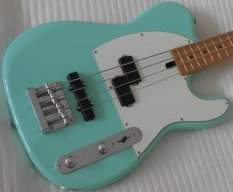
I play mostly passive basses although in the past I’ve owned many active four and five strings all sounded beautiful. once I had a Schechter beautiful bass but lacking so I just added a battery to the already on board active system and man I just couldn’t believe how sweet it sounded after that so I know what you mean it’s not a power thing or this or that and there have been some single 9 V systems I didn’t care for but all in all when I doubled that battery to 18 V something happened and it was good!;)
 
  • Like
Reactions: mellow yellow
HOW the active preamp works. John's preamps are awesome!

I think Johnny makes great preamps, no argument there. I seem to remember disconnecting the battery on mine, and got no tone at all. I'm not doubting there is a preamp bypass. I am thinking they may not be truly passive when disengaged. Just my observation.