• TalkBass has been independent since 1998. Add your voice.
    Create a free account to reply to discussions, view embedded media, and browse with fewer display ads.
    Join freeLog in
    Want zero display ads or expanded classifieds tools? Compare plans.

active or passive?

The older I've gotten, the more I've seen the onboard preamp as more of a convenience than an actual part of the instrument. I will admit that many preamps have some great EQ shaping, sometimes with a frequency shift knob as well, but you can accomplish the same thing in theory with an external pedal.

Now if you don't have/like pedalboards, don't have room for one in the studio, or the convenience is worth it then the onboard preamp is a great solution. But just the same as an OD pedal is a tool when cranking your tube power amp into breakup territory isn't an option, the onboard preamp is a tool to get a desired effect.

The heart and soul of your bass is what it is, you'll get out what you put into it. That being said, a bad preamp can most assuredly ruin an otherwise good bass. This is why I've gravitated towards passive stuff with my basses.
 
The older I've gotten, the more I've seen the onboard preamp as more of a convenience than an actual part of the instrument. I will admit that many preamps have some great EQ shaping, sometimes with a frequency shift knob as well, but you can accomplish the same thing in theory with an external pedal.

Now if you don't have/like pedalboards, don't have room for one in the studio, or the convenience is worth it then the onboard preamp is a great solution. But just the same as an OD pedal is a tool when cranking your tube power amp into breakup territory isn't an option, the onboard preamp is a tool to get a desired effect.

The heart and soul of your bass is what it is, you'll get out what you put into it. That being said, a bad preamp can most assuredly ruin an otherwise good bass. This is why I've gravitated towards passive stuff with my basses.
The amp with eq is s..t. Eq has no matter on it.
 
The amp with eq is s..t. Eq has no matter on it.

Not following you, man...EQ on amplifiers in general is bad so EQ doesn't matter? If that's what you're saying, there are EQ pedals, outboard preamps, rack graphic EQs, or amps that you know...have GOOD EQ (like GK, Ampeg, Aguilar, Markbass...). That's the point of my post, plenty of options, so why add another point of failure?
 
The heart and soul of your bass is what it is, you'll get out what you put into it

Well this is true, BUT the electronics (active or passive) is the media between my bass and my ears. When I had a little but well armed rec studio, the difference between an SM57 in a stock Behringer preamp or an U87 in a Millennia Media was really audible. the source (voice) was the same, the results totally different one from another. Obviously the U87 with the marvelous Millennia HV3B captured subtle nuances that with the sm57 connected to the cheap Behringer don't exist at all. If I think to my bass as the voice of a singer, so as its acoustic sound that has to be captured by a pickup (a mic) I can think to obtain different sounds according to the electronics used. BTW an Sm57 with a good old germanium preamp is a very good choice for a male singer à la Daltrey, so to say


The older I've gotten, the more I've seen the onboard preamp as more of a convenience than an actual part of the instrument. I will admit that many preamps have some great EQ shaping, sometimes with a frequency shift knob as well, but you can accomplish the same thing in theory with an external pedal.

Now if you don't have/like pedalboards, don't have room for one in the studio, or the convenience is worth it then the onboard preamp is a great solution. But just the same as an OD pedal is a tool when cranking your tube power amp into breakup territory isn't an option, the onboard preamp is a tool to get a desired effect.

The heart and soul of your bass is what it is, you'll get out what you put into it. That being said, a bad preamp can most assuredly ruin an otherwise good bass. This is why I've gravitated towards passive stuff with my basses.
 
The heart and soul of your bass is what it is, you'll get out what you put into it

Well this is true, BUT the electronics (active or passive) is the media between my bass and my ears. When I had a little but well armed rec studio, the difference between an SM57 in a stock Behringer preamp or an U87 in a Millennia Media was really audible. the source (voice) was the same, the results totally different one from another. Obviously the U87 with the marvelous Millennia HV3B captured subtle nuances that with the sm57 connected to the cheap Behringer don't exist at all. If I think to my bass as the voice of a singer, so as its acoustic sound that has to be captured by a pickup (a mic) I can think to obtain different sounds according to the electronics used. BTW an Sm57 with a good old germanium preamp is a very good choice for a male singer à la Daltrey, so to say

You're overextending what I was talking about, the subject is onboard preamps in basses, so when I'm referring to the "heart and soul of the bass" I'm talking about everything sans the onboard pre. If you take out the pickup, you no longer have an electric bass since there is nothing to pick up the string vibrations. This is why I'm considering this a core component, you cannot have an electric bass without one....so now onto the 2nd part...

Yeah it's a balancing act, but to refer you to the OP's original question, what I'm addressing is whether or not the onboard preamp is doing something that numerous external options are capable of or are already doing. In this case, the answer is no, pedals, rackmount EQs, and the amp's EQ section are all doing this already. Now does that mean that onboard pre's have nothing to offer sonically? Not at all. As I said, this depends on the EQ manipulation capable within your signal chain.

If you are plugging straight into a DI at a studio or live gig, that onboard pre DEFINITELY has a function independently since you have no other options. Hell, even if you just like the convenience of it then by all means go for it, it's a totally valid reason. The only other thing I probably forgot would be shaping the tone before it goes to something like an OD or fuzz pedal, but you can just put an EQ pedal in the signal chain before that to get the same result. Don't want another pedal crowding the place up? Fine, again, another totally valid reason to have an onboard pre.

Though your example with the mics only supported my point that a bad preamp can ruin an otherwise good signal. So to my original statement, why add another point of failure or overcomplicate things? YMMV
 
you have to excuse me because my English is scholastic, (I live in Italy) and maybe I'm lacking' or misunderstanding something but the question was (I'm the OP)

(quote)
So the question is: a preamp (onboard or outboard) could "steps out" some freqs that in passive mode are barely audible? or it's a matter of woods and building and pre is something related only to the volume?
Ciao


Someone in the replies started to speak about onboard vs outboard, but the subject is active or passive? I was wondering if an instrument with some acoustic character could benefit from the use of a pre (on or out board) to rise up some "hidden treasures" that with a passive setup could not to exist.
About your statement regarding the pickups as a core componente that is true, but I want to imagine a luthier that build a bass choosing a right pickup for the kind of sound that instrument have and for the sound that that bass have to have. Right doesn't means the better. According to its sonic characteristics one can choose a single coils, an humbucker, an overwound and so on.
Maybe I'm wrong but I would imagine a scenario like this.
thanks for your reply
ciao


You're overextending what I was talking about, the subject is onboard preamps in basses, so when I'm referring to the "heart and soul of the bass" I'm talking about everything sans the onboard pre. If you take out the pickup, you no longer have an electric bass since there is nothing to pick up the string vibrations. This is why I'm considering this a core component, you cannot have an electric bass without one....so now onto the 2nd part...

Yeah it's a balancing act, but to refer you to the OP's original question, what I'm addressing is whether or not the onboard preamp is doing something that numerous external options are capable of or are already doing. In this case, the answer is no, pedals, rackmount EQs, and the amp's EQ section are all doing this already. Now does that mean that onboard pre's have nothing to offer sonically? Not at all. As I said, this depends on the EQ manipulation capable within your signal chain.

If you are plugging straight into a DI at a studio or live gig, that onboard pre DEFINITELY has a function independently since you have no other options. Hell, even if you just like the convenience of it then by all means go for it, it's a totally valid reason. The only other thing I probably forgot would be shaping the tone before it goes to something like an OD or fuzz pedal, but you can just put an EQ pedal in the signal chain before that to get the same result. Don't want another pedal crowding the place up? Fine, again, another totally valid reason to have an onboard pre.

Though your example with the mics only supported my point that a bad preamp can ruin an otherwise good signal. So to my original statement, why add another point of failure or overcomplicate things? YMMV
 
You're overextending what I was talking about, the subject is onboard preamps in basses, so when I'm referring to the "heart and soul of the bass" I'm talking about everything sans the onboard pre. If you take out the pickup, you no longer have an electric bass since there is nothing to pick up the string vibrations. This is why I'm considering this a core component, you cannot have an electric bass without one....so now onto the 2nd part...

Yeah it's a balancing act, but to refer you to the OP's original question, what I'm addressing is whether or not the onboard preamp is doing something that numerous external options are capable of or are already doing. In this case, the answer is no, pedals, rackmount EQs, and the amp's EQ section are all doing this already. Now does that mean that onboard pre's have nothing to offer sonically? Not at all. As I said, this depends on the EQ manipulation capable within your signal chain.

If you are plugging straight into a DI at a studio or live gig, that onboard pre DEFINITELY has a function independently since you have no other options. Hell, even if you just like the convenience of it then by all means go for it, it's a totally valid reason. The only other thing I probably forgot would be shaping the tone before it goes to something like an OD or fuzz pedal, but you can just put an EQ pedal in the signal chain before that to get the same result. Don't want another pedal crowding the place up? Fine, again, another totally valid reason to have an onboard pre.

Though your example with the mics only supported my point that a bad preamp can ruin an otherwise good signal. So to my original statement, why add another point of failure or overcomplicate things? YMMV

I think you are missing what he is asking.

Active basses change the character of the sound due to the buffer. The bass sounds more forward and brighter as a result.

There are other ways to achieve that, but it does not mean they will sound the same.

This is why Synth players value certain filters in certain synths more than others. Most filters do the same thing in concept, but they add a different flavor to the sound.

I just recorded for 3 hours with both my passive Fender and active Sadowsky. They both have flats but each impart their own sonic character. For the more immediate and up front sound, I used the Sadowsky. For the more relaxed tune, I used the Fender through a lightly boosted tube preamp with a bass and treble EQ.
 
you have to excuse me because my English is scholastic, (I live in Italy) and maybe I'm lacking' or misunderstanding something but the question was (I'm the OP)

(quote)
So the question is: a preamp (onboard or outboard) could "steps out" some freqs that in passive mode are barely audible? or it's a matter of woods and building and pre is something related only to the volume?
Ciao


Someone in the replies started to speak about onboard vs outboard, but the subject is active or passive? I was wondering if an instrument with some acoustic character could benefit from the use of a pre (on or out board) to rise up some "hidden treasures" that with a passive setup could not to exist.
About your statement regarding the pickups as a core componente that is true, but I want to imagine a luthier that build a bass choosing a right pickup for the kind of sound that instrument have and for the sound that that bass have to have. Right doesn't means the better. According to its sonic characteristics one can choose a single coils, an humbucker, an overwound and so on.
Maybe I'm wrong but I would imagine a scenario like this.
thanks for your reply
ciao

"(I'm the OP)"

Sorry on that one, you can hand me the "Dumbass of the thread award" for not noticing that lol. I had somebody else reply to me first so I was mistakenly thinking I was still talking to that other person. Sorry about that :(

So maybe the terminologies are getting mixed up. An "Active" bass is one with some kind of onboard buffer or preamp, a "Passive" bass only has the basic electronics and no built-in preamp...it can only cut frequencies instead of boosting them, it does this with passive attenuation using potentiometers which require no batteries or external power to do their functions.

Concerning the pickups, we are completely in agreement as pickups are what I believe to be the bulk of your end product in conjunction with strings. When I say "pickups" I'm also including horizontal placement, height, and any other "setup" adjustments made to them. There is some character added by all the components, but my experience has been that. As for the preamps, you could wire your pickups straight to the output jack on a bass and you are literally getting the same signal a preamp would...so going out to an external pre would net you the same results. So I wouldn't say there is any special mojo to having it onboard, but you EQ is definitely important and useful. Sometimes different basses just need that extra push to really shine, and there's nothing wrong with that :thumbsup:
 
  • Like
Reactions: mellow yellow
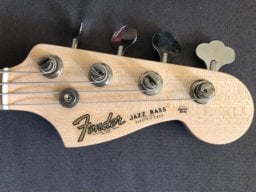
not to start another active/passive religion war, but I was wondering, checking a beautiful Fender Jazz bass custom shop equipped with an 18v onboard preamp, if the rich and robust sound, the impressive amount of harmonics, with no dead note, is something due to the presence of a preamp or not.
I have a very good Fender Custom Shop jazz bass, passive, and it sounds good but not so good as its active sibling.
It's not a volume thing, I know, it's more like an openness around the freqs
By the way the active jazz bass I was checking sounds a little more dull when I disengage the preamp.
So the question is: a preamp (onboard or outboard) could "steps out" some freqs that in passive mode are barely audible? or it's a matter of woods and building and pre is something related only to the volume?
Ciao

Tough to say.
You could have found an exceptional Jazz custom or maybe you have a middling quality Custom shop. Or maybe your ear just prefers the sound of active.

I have both and like both. I do like the flexibility of an onboard preamp on my Carlo, but my LDB parts jazz sounds plenty good passive and they both share time at my gigs.
 
Active basses change the character of the sound due to the buffer. The bass sounds more forward and brighter as a result.

Unless you have a long cable run from your output jack to the next unit in your chain (meaning you would get noticeable signal attenuation), the buffer is not going to net you something audible that external options cannot...be it a boost to gain, treble content, or whatever your external options allow you to manipulate. Many external pedals (such as Boss effects pedals) contain signal buffers already, so with a reasonable length cable coming from a passive bass you are again getting the same result.

And like I said...convenience, not having space (as in a small studio recording or a DI only option at a gig), or liking the specific EQ points of a certain onboard pre are all totally valid reasons to avoid the external options. The effect of the signal attenuation is even more negligible when we factor in how the bass sits in a live mix, on a recorded song, or even from different parts of a room. However if the onboard pre nets you what want the way you want it, then it's the option for you. This is the core principle of "YMMV" :cool:
 
Not really. An "active" pickup is really a passive pickup that has a preamp (actually a buffer) housed in the pickup shell. Regardless of whether the preamp is in the pickup shell or in the body of the bass, the impedance of an active system is lower than a passive pickup alone. Voltage is irrelevant in this regard.
Active pickups and passive pickups were actually wound differently as well. But actual active pickups are mainly a thing of the past. I think that’s why there is some confusion. These days “active bass” generally refers to a bass with passive pickups and active eq wether they have an active/passive switch or not.
 
Unless you have a long cable run from your output jack to the next unit in your chain (meaning you would get noticeable signal attenuation), the buffer is not going to net you something audible that external options cannot...be it a boost to gain, treble content, or whatever your external options allow you to manipulate. Many external pedals (such as Boss effects pedals) contain signal buffers already, so with a reasonable length cable coming from a passive bass you are again getting the same result.

And like I said...convenience, not having space (as in a small studio recording or a DI only option at a gig), or liking the specific EQ points of a certain onboard pre are all totally valid reasons to avoid the external options. The effect of the signal attenuation is even more negligible when we factor in how the bass sits in a live mix, on a recorded song, or even from different parts of a room. However if the onboard pre nets you what want the way you want it, then it's the option for you. This is the core principle of "YMMV" :cool:

After years of making records and owning a multitude of instruments, I don’t agree with this at all.

Especially the boss pedal buffer - not the same thing. I toured with a Tu-2 for years and ended up using it in the studio for a long time after. It’s not even close to the same buffer as having an active bass preamp.

I can run my Sadowsky in passive mode mode through my preamp with EQ set the same as for my passive Fender. It’s still not the same as running it in active even with all the EQ set flat.

The OP is coming from a recording background so I think he will appreciate the difference.
 
YMMV = Your Mileage May Vary...Google it if you need help with the context

Especially the boss pedal buffer - not the same thing. I toured with a Tu-2 for years and ended up using it in the studio for a long time after. It’s not even close to the same buffer as having an active bass preamp.

I didn't quote a specific pedal because the TU-2 might have been wired for being as unobtrusive with the signal as possible...being a tuner and all. However something like a distortion pedal or other effect may incorporate this to mitigate signal attenuation. I'm not an EE for Boss Electronics so I can't speak on every single schematic for all their pedals, but I'm going to wager the TU-2 isn't going to be wired to handle the signal the same as others.

Unless the circuit design is exactly the same or within certain tolerances, anything is going to handle the signal differently if they are not the same wiring/PCB design. An Aguilar preamp and a Bartolini pre are both going to have buffers that can affect the signal differently, the same as have a "Bass-Mid-Treble" EQ stack is common across all preamps, but have frequency points that vary. Different buffers may affect character differently, but what you're arguing by saying "it's not the same kind of buffer" is like saying "The volume knob on my bass is different than the one on my amp". The same basic idea qualifies it be called a "volume knob", in that example it's manual signal attenuation. In this one, it's boosting the signal which cuts down on signal attenuation over long cable runs...treble being the most susceptible to going out first, gets preserved better thus we get the better retained "brightness" which just means less treble is being lost over the cable run.

I can run my Sadowsky in passive mode mode through my preamp with EQ set the same as for my passive Fender. It’s still not the same as running it in active even with all the EQ set flat.

The OP is coming from a recording background so I think he will appreciate the difference.

Again, please read what I just wrote above. You're hearing less of the treble being lost, which is a naturally occurring effect of the signal being boosted by the buffer. If you have a long cable run or something else that is increasing distance (true bypass pedals on a board and other factors can contribute) it will make the loss greater or more noticeable.

To reiterate, do what works for you. You aren't spending my money and I'm not playing your gigs, so if you prefer them that's great. Tracking along with a metronome or drum beat you may hear the treble gain, but in the final mix or playing a live gig? Gonna wager it's indiscernible. But in all seriousness, do what inspires you to play or create, that's priceless :bassist:
 
YMMV = Your Mileage May Vary...Google it if you need help with the context


I didn't quote a specific pedal because the TU-2 might have been wired for being as unobtrusive with the signal as possible...being a tuner and all. However something like a distortion pedal or other effect may incorporate this to mitigate signal attenuation. I'm not an EE for Boss Electronics so I can't speak on every single schematic for all their pedals, but I'm going to wager the TU-2 isn't going to be wired to handle the signal the same as others.

Unless the circuit design is exactly the same or within certain tolerances, anything is going to handle the signal differently if they are not the same wiring/PCB design. An Aguilar preamp and a Bartolini pre are both going to have buffers that can affect the signal differently, the same as have a "Bass-Mid-Treble" EQ stack is common across all preamps, but have frequency points that vary. Different buffers may affect character differently, but what you're arguing by saying "it's not the same kind of buffer" is like saying "The volume knob on my bass is different than the one on my amp". The same basic idea qualifies it be called a "volume knob", in that example it's manual signal attenuation. In this one, it's boosting the signal which cuts down on signal attenuation over long cable runs...treble being the most susceptible to going out first, gets preserved better thus we get the better retained "brightness" which just means less treble is being lost over the cable run.


Again, please read what I just wrote above. You're hearing less of the treble being lost, which is a naturally occurring effect of the signal being boosted by the buffer. If you have a long cable run or something else that is increasing distance (true bypass pedals on a board and other factors can contribute) it will make the loss greater or more noticeable.

To reiterate, do what works for you. You aren't spending my money and I'm not playing your gigs, so if you prefer them that's great. Tracking along with a metronome or drum beat you may hear the treble gain, but in the final mix or playing a live gig? Gonna wager it's indiscernible. But in all seriousness, do what inspires you to play or create, that's priceless :bassist:

"Different buffers may affect character differently" - that was actually exactly my point.

Having it on the preamp inside the bass affects the character differently than using a tuner buffer. Once you lose some signal through the cable you are not boosting it back the same way. Just not how it works. This is easy to hear.

And yes it can matter in recordings. Just depends on what you are going for, but tracks get compressed a lot on records and little things that people don't think matter that much sometimes do in the final mixdown.
 
These days i prefer passive basses with an out board preamp. My Mim jazz and mij P basses sound great. Even better throught my Sadowsky preamp. My Carvin lb75 has a Sadowsky pre amp inside and Nordstrand pups. Most times I use it passive. The pickups sound that good.