• TalkBass has been independent since 1998. Add your voice.
    Create a free account to reply to discussions, view embedded media, and browse with fewer display ads.
    Join freeLog in
    Want zero display ads or expanded classifieds tools? Compare plans.

Adapting to fretless- WITH NO LOOKING! Tips and tricks?

Apr 18, 2015
3,136
3,495
65
I've had my fretless for a few months now and love it (Ibanez SR375F). I was never afraid of fretless as I played cello in college strings class for 1 or 2 semesters. And I do pretty well with it WHEN I CAN LOOK AT MY LEFT HAND.

The problem is that I am regularly in front of printed music which may or may not have my left hand moving like we do on bass. I have a visual coordination condition, so often when I look away from the music, and turn my attention back to it, I'm lost. I try to color code critical points in the music as "mile posts" so when I get lost I can find my place. But I hate getting lost and want to do much better in performance with fretless.

What is the next step in my progression with fretless so I can play like a double-bass player, looking at music, not having to look at the left hand?
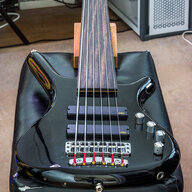
 
I've never played a violin-family instrument but I recall somebody here saying that a major difference between bass guitar and upright bass is there are more tactile cues on upright to tell you where your hand is -- a bass guitar neck is just a long, very gradually tapering piece of wood from the nut to the 18th stop or so. So if finding your position is harder, it's a problem that's kind of built into the instrument.

What I found helped me improve was to practice in a dark room. If you're reading sheet music, make sure the only light is on the music stand. If you're using a tablet or computer screen, leave it at that. You'll still have the temptation to look at your hand but you'll get less out of trying. And ideally you'll learn to depend on your ears more than your eyes, and properly listen to yourself and adjust as you play.

Your playing will get worse for a spell and that can be discouraging, but you should improve quickly.
 
It's good to practise without looking. But in reality there is no pro (fretless) player who never looks at his/her bass. Just watch the famous fretless players, they all look. If you play really simple lines it's easy not to look. But if you play more complex music with big jumps and fast passages it's ok to look. Better look than not look and play out of tune.
 
What is the next step in my progression with fretless so I can play like a double-bass player, looking at music, not having to look at the left hand?
One possibility is to make your side markers either proud of shy of the fingerboard so you can feel them. That really helped with my EUB, FWIW. But I've been playing primarily fretless BGs for upwards of 50 years and still look plenty. Reconciling that with using sheet music has always brought some challenge, and finding breathing room for position changes strategically is something that has come with time for me. Big band multipage charts were especially challenging, and just memorizing section transitions often worked best for me.
 
Everybody has that issue to some extent. I found the key is to get your key positions into muscle memory. I use the 12th and 7th frets that I have put into my warmup routine. I mean really to look down on the 12th, note its position relative to your belly or whatever. And I'll start running my hand up and down the fretboard. At first stoping on the 12th and 7th fret with my middle finger. Bouncing back and forth. Then add the 3rd fret and bouncing between all 3 positions. Sure, look down and watch a few times. I feel this calibrates my mind / muscle memory and gets me ready for playing. After that I won't look down much any more.
 
  • Like
Reactions: vindibona1
Try to position your music stand and bass so that you can see the side of your fingerboard in your peripheral vision while playing.
I cAnT rEad music well at all, let alone sight reading, but when I have to sing and play fretless I put the neck where I can see it in my peripheral vision so I can keep my mouth on the mic and eyes relatively forward. I aLsO CaNt SiNg. Lol.
 
Don't let DB players be your standard for looking/not looking, cause the instruments are different.
Like, is your face close to the fingerboard?
Like at all?
Screenshot_20250919_173737_Chrome.jpg
 
It is important to have goals, that keeps us improving, don't give up it will come. I practice, practice and practiced more to get my fretless chops up to standard and still regularly work out on fretless, weekly devoting my Friday's practice time for Fretless bass. exclusively. I play some scales and arpeggios to warm up then all the tunes in my working pile on of fretless and pay particular attention to intonation, articulation and tone.

FWIW playing fretless has improved my playing in many ways on fretted bass so it is a valiant and worthwhile investment IMHO.
 
When playing live, I look. Live there can be some really weird sonic anomalies that can make it sound like a note is in/out of tune when it really isn't/is. So I don't worry about being a purist, I just use my eyes in those situations. To help with chart reading, I shift my position so my bass points out more forward, so it's easier for me to glance between reading the chart and watching my hand.
 
Having played DB ad EB for quite a while, here's my take. The fingerboards on a fretless electric bass are essentially "flat" with a horizontal plane.
While I can play really well in tune on a Double Bass ( years of practice, gigging, and lessons in high school and college) that doesn't necessarily transfer over to a unlined fretless electric bass. So, having a reference marker on the side of the neck makes sense to me. Personally, my Lakland 55-94 is a lined fretless and it really helps me on reading gigs. I rarely look at the fingerboard when I'm improvising of playing non-reading gigs. Intonation is slightly different on a instrument tuned in 4ths vs one tuned in 5ths. Try playing along with something in a completely dark room for a while. I know it sounds weird but it really hyper focuses your intonation. Just my take of course.
 
I don't think it's realistic to never look, unless you are either extraordinarily talented or you are a bit above average and practice a wide variety of technical music in all keys several hours daily. As long as you are playing within a box pattern plus are minus one or two half steps, ideally you should be able to learn the fingerboard and intervals well enough to play without looking. However, achieving this level of proficiency is a pretty high bar for an amateur. The accuracy of jumps tends to decrease quickly as shifts get larger.

I am one of the people who has mentioned that fretless BG does not have as many physical references as upright. On upright, as long as I know the music and have it played in fairly well I can play without looking. However, sight reading is another matter, especially if I am playing high on the neck in a key that I am not super fluent in.

Looking at the neck doesn't necessarily help with upright since it does not have fret markers. To find a note I use interval recognition. Open strings, fifths, and octave are the strongest references. My process is to find one of the strong references and then find the note I actually need by relating it to the reference. I don't claim to be super proficient at this across the board.
 
This question is often asked. Rich Brown on the Brown'sTone channel on YouTube relayed a tip a fretless guitar player gave him. Orient the neck perpendicular to the sheet music. Now you can look down the neck with peripheral vision without taking your main vision away from the music.

Pretty soon, you are not going to need more than occasional glances to reorient yourself. There are areas of the fingerboard that I can play without looking at all, usually below the 9th position. If I make a major shift I just need to glance to reorient, unless it is above the 15th position. Up above that, I need to look at the board. Above the 17th, even looking may not be enough. Above the 19th, Hail Mary.