• TalkBass has been independent since 1998. Add your voice.
    Create a free account to reply to discussions, view embedded media, and browse with fewer display ads.
    Join freeLog in
    Want zero display ads or expanded classifieds tools? Compare plans.

Adapting to fretless- WITH NO LOOKING! Tips and tricks?

A while ago someone posted a link to a youtube video by an instructor who was making the point about how important "muscle memory" is for playing fretless - while watching his left hand!

Listening intently is important. I've been caught in more than one picture playing my fretless with my eyes closed, just staying in one position and listening for my intonation. I know, hard to do that when trying to read....
 
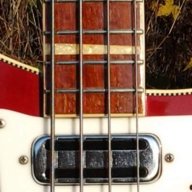
One possibility is to make your side markers either proud of shy of the fingerboard so you can feel them. That really helped with my EUB, FWIW. But I've been playing primarily fretless BGs for upwards of 50 years and still look plenty. Reconciling that with using sheet music has always brought some challenge, and finding breathing room for position changes strategically is something that has come with time for me. Big band multipage charts were especially challenging, and just memorizing section transitions often worked best for me.
When I bought my first unlined fretless, I taped a piece of dental floss to the back of the neck in a few positions so I could feel the floss with my left thumb. Helped until I no longer needed it.

I still glance at my fingerboard occasionally, but the purpose is usually to assure middle finger is in the right position; Side position markers are usually sufficient.
 
  • Like
Reactions: iqi616
My two favorite ways to practice to break myself looking at my left hand/fingerboard:

1) Practice in front of a big, wide mirror where you can see the entire bass. This tells you where you are, you can see any hand techniques you may want to clean up. Do this long enough and your left hand will just know my muscle memory where you are. You can also practice your game face, your rack star moves . . . .

2) Practice in a completely dark room. Right before you go to play a scale or exercise or play along with a recording, flip the lights off and go for it. This way, only your left hand will know where it is, and where it needs to go next.

The whole point is to be able to get from Point A to Point B on the fingerboard without ever looking. Once your left hand is used to knowing where it is, you're good.
 
  • Like
Reactions: TomB and rickdog
Practice is the easiest answer....practice looking at your music, then glancing at your hand position to gain reference, then back to the music...may have to be slow, and only a few notes at a time at first, but you'll get it.
Another thing I've seen people do is use a mirror on the music stand....although I would think this would take some getting used to, as the image is reversed. It can still serve as a quick reference for hand position.
 
  • Like
Reactions: iqi616
I've had my fretless for a few months now and love it (Ibanez SR375F). I was never afraid of fretless as I played cello in college strings class for 1 or 2 semesters. And I do pretty well with it WHEN I CAN LOOK AT MY LEFT HAND.

The problem is that I am regularly in front of printed music which may or may not have my left hand moving like we do on bass. I have a visual coordination condition, so often when I look away from the music, and turn my attention back to it, I'm lost. I try to color code critical points in the music as "mile posts" so when I get lost I can find my place. But I hate getting lost and want to do much better in performance with fretless.

What is the next step in my progression with fretless so I can play like a double-bass player, looking at music, not having to look at the left hand?
A big part of this is hand-shape or posture, which in your context doesn't mean standing with a straight back and shoulders back! Assuming you had a good cello teacher and reached a reasonable standard, this should already be ingrained knowledge.
 
I've never played a violin-family instrument but I recall somebody here saying that a major difference between bass guitar and upright bass is there are more tactile cues on upright to tell you where your hand is -- a bass guitar neck is just a long, very gradually tapering piece of wood from the nut to the 18th stop or so. So if finding your position is harder, it's a problem that's kind of built into the instrument.

What I found helped me improve was to practice in a dark room. If you're reading sheet music, make sure the only light is on the music stand. If you're using a tablet or computer screen, leave it at that. You'll still have the temptation to look at your hand but you'll get less out of trying. And ideally you'll learn to depend on your ears more than your eyes, and properly listen to yourself and adjust as you play.

Your playing will get worse for a spell and that can be discouraging, but you should improve quickly.
Perhaps "installing" thumbtacks or tiny brads at critical spots along the otherwise smooth backside of the neck might help, like braille? I'm surpised nobody does this :p

Seriously, I'm trying to learn the fingerboard without looking. I think the key is NOT LOOKING. If I make a mistake, I try to correct it using my ears and fingers and not my eyes. But sometimes I get totally lost and have to peek. Really diggin' that braille idea ...
 
Perhaps "installing" thumbtacks or tiny brads at critical spots along the otherwise smooth backside of the neck might help, like braille? I'm surpised nobody does this :p

Seriously, I'm trying to learn the fingerboard without looking. I think the key is NOT LOOKING. If I make a mistake, I try to correct it using my ears and fingers and not my eyes. But sometimes I get totally lost and have to peek. Really diggin' that braille idea ...
Yeah, I think you have the idea. It's all of the things above, but really just a matter of building muscle memory and maintaining good posture. I found working my way from the nut up was the best approach. Get comfortable playing the first five without looking, then go up, try first 7. One of the things that got me locked in down low was doing stand-up instructor lessons about playing various walking patterns in the "1/2 position" on the upright, i.e., first 3 frets. That's just a great way to learn anyway, forces you to find what's available in the 16 notes of that small box. Then you just branch out of the box up to the five, and so on.
 
I got caught in a long-booked gig the other night without remembering how early the sun goes down relative to mid-summer. No one brought lighting and while the venue seating was dimly lit, we were in the dark like a couple of dummies. I had to play the whole last set without a clear view of my fret board. So yeah, practice in the dark!
 
Just one more suggestion to elaborate on above point. Really a good idea to develop muscle memory of where the critical anchor points are on the neck. 5th, 7th, and 12th fret lines. If you arm knows when it is in those positions on the neck you are halfway there on playing with your eyes closed. Personally, I sometimes have an issue with the 7th, end up on the 9th instead. Of course, your ears will hear it, but you've already blown a clam.
 
UPDATE:
I had to play out Friday night and was very apprehensive about using my fretless. But I'm really glad that I did. I've been practicing with it at home, mostly basics, scales intervals; Root/3rds/5th's/7th, some Jaco stuff, just trying to get more acclimated to it. I almost chickened out at the last minute, but then thought that nobody has good enough ears to pick up on my screw ups.

I actually was very comfortable with it and it seemed much more natural. I think I only got lost for a few seconds one time and cheated until I could get back in. I thought my intonation was as good as I was going to get it. I ran it through my Boss OC-5 +MXR chorus and found a very natural/organic sound. People were complimenting me on the sound. The other thing that I really liked was the timbre, volume and my ability to use the low B was really a bonus.
The Fishman EQ/DI box is a great help. XLR goes to the house, amp out goes to the amp, so I can keep the volume low, minimizing "stage wash", then a pedal loop and the actual effects pedals with the settings I used. I wondered if it was too much compression, but everything was balanced well. BTW, on the far right, out of the picture is a KORG CA-50 which is more responsive and accurate than the Fishman's built in tuner (or my Korg Pitch Black pedal).

BTW... I have the cheapest, lightest pedal board in the world :). A strip of wood, almost balsa with two strips of velcro. I think I paid $2 for two longish boards of the wood. Super convenient. Goes right into my computer case along with one wireless system, setup tools, pens and markers. Hardly "professional"... but effective and convenient.

1758472838703.png
 
UPDATE:
I had to play out Friday night and was very apprehensive about using my fretless. But I'm really glad that I did. I've been practicing with it at home, mostly basics, scales intervals; Root/3rds/5th's/7th, some Jaco stuff, just trying to get more acclimated to it. I almost chickened out at the last minute, but then thought that nobody has good enough ears to pick up on my screw ups.

I actually was very comfortable with it and it seemed much more natural. I think I only got lost for a few seconds one time and cheated until I could get back in. I thought my intonation was as good as I was going to get it. I ran it through my Boss OC-5 +MXR chorus and found a very natural/organic sound. People were complimenting me on the sound. The other thing that I really liked was the timbre, volume and my ability to use the low B was really a bonus.
The Fishman EQ/DI box is a great help. XLR goes to the house, amp out goes to the amp, so I can keep the volume low, minimizing "stage wash", then a pedal loop and the actual effects pedals with the settings I used. I wondered if it was too much compression, but everything was balanced well. BTW, on the far right, out of the picture is a KORG CA-50 which is more responsive and accurate than the Fishman's built in tuner (or my Korg Pitch Black pedal).

BTW... I have the cheapest, lightest pedal board in the world :). A strip of wood, almost balsa with two strips of velcro. I think I paid $2 for two longish boards of the wood. Super convenient. Goes right into my computer case along with one wireless system, setup tools, pens and markers. Hardly "professional"... but effective and convenient.

View attachment 7326663
That's a nice set-up for the fretless. I haven't put my SR370EF through my board yet, been waiting for that, until I have intonation as good as I think I can get it. I think the chorus will be a very natural sounding enhancement to the fretless tone.
 
That's a nice set-up for the fretless. I haven't put my SR370EF through my board yet, been waiting for that, until I have intonation as good as I think I can get it. I think the chorus will be a very natural sounding enhancement to the fretless tone.
Yes, Chorus helps a bit as the pitch "warbles" a little which can help a bit with intonation, as if you're doing vibrato. I use only a modest amount of chorus. As you can see from my setting, I only have a drop of low octave and SLIGHTLY more plus one octave which gives the sound some girth.

Best thing I ever bought at the time was the Fishman Platinum Pro EQ/DI. I had "auditioned" several of them. I tried the cheaper Fishman, and the LR Baggs Para DI and one or two others. The Fishman PP was by far the best. At the time it was selling for about $200, which I thought was expensive back then. [I have a lot of pedals now that I wouldn't buy because of the price]. I settled for the MXR analog chorus as it was on sale ($69?) which replaced another that was kind of wonky. Occasionally I will add a delay because it has a shimmer feature, but haven't since we got a new MD.
 
  • Like
Reactions: BassicJazzy
I've had my fretless for a few months now and love it (Ibanez SR375F). I was never afraid of fretless as I played cello in college strings class for 1 or 2 semesters. And I do pretty well with it WHEN I CAN LOOK AT MY LEFT HAND.

The problem is that I am regularly in front of printed music which may or may not have my left hand moving like we do on bass. I have a visual coordination condition, so often when I look away from the music, and turn my attention back to it, I'm lost. I try to color code critical points in the music as "mile posts" so when I get lost I can find my place. But I hate getting lost and want to do much better in performance with fretless.

What is the next step in my progression with fretless so I can play like a double-bass player, looking at music, not having to look at the left hand?
If you were an accomplished cellist, im guessing you are suffering the baggage of a solidbody instrument, that can't give you the same feedback and pitch confirmation as a well made, properly setup acoustic instrument. I might also suggest, not all fretless solidbodies are the same. Some will lock in, and "help" with finger placement and pitch response. You should give it your all, but if you are still frustrated, you might start looking at other solidbodies that play well - just like cellos, uprights, etc.
 
If you were an accomplished cellist, im guessing you are suffering the baggage of a solidbody instrument, that can't give you the same feedback and pitch confirmation as a well made, properly setup acoustic instrument. I might also suggest, not all fretless solidbodies are the same. Some will lock in, and "help" with finger placement and pitch response. You should give it your all, but if you are still frustrated, you might start looking at other solidbodies that play well - just like cellos, uprights, etc.
Accomplished cellist? No. Only one semester with cello in strings class in college a bazillion years ago. It's both similar and different. For some reason I have always tried to maintain a good hand position on all my instruments. On fretted basses I try to land right behind the frets. So, on fretless I'm generally pretty close. Fretless is coming along. Perhaps all I need is a bit more practice along with confidence that I'm doing ok on it. Love the sound.
 
  • Like
Reactions: Bander
Accomplished cellist? No. Only one semester with cello in strings class in college a bazillion years ago. It's both similar and different. For some reason I have always tried to maintain a good hand position on all my instruments. On fretted basses I try to land right behind the frets. So, on fretless I'm generally pretty close. Fretless is coming along. Perhaps all I need is a bit more practice along with confidence that I'm doing ok on it. Love the sound.
Have you ever tried Simandl fingering? It may be a dead end for you but for me it's a huge help when reading.
 
Pay attention to your octaves, 4ths 3rds etc... as you go. Mark Bailey has an instructional that goes over it. Try not to look but listen and be attentive to your values.

Played in the orchaestra bass in public school with take home options in the summer, it gave me an appreciation. Played a electric too and still dabble in the viol famliy. There's a lot more ear involved than fret location with a fretless. It won't take long. Have fun!