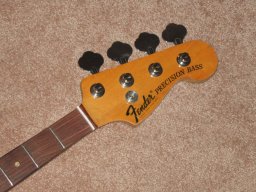
Hi everyone, new member here, and as my name implies, I struggle.
Long story short, I'm trying to get my get my first (and currently only) bass to not feel like a struggle to play.
Currently, after doing many things to it, my lastest problem is that the truss rod doesn't move at all when the nut is turned in either direction, and there is no tension on the nut, yet it doesn't feel loose or rattle when the neck moves.
I always write walls of text, so out of respect for the forumgoers's time, I'll go straight to the point.
After defretting it, I detached the neck and used only the truss rod to force it into a back bow. It had forward bow warp, which made it very had to play unless detuned to C at least.
I left it that way for a few weeks, since I don't currently have a good way to do heat treatment, I figured this would help put the hard maple back in line.
After that, I removed all tension from the neck. This was back in January, I remember actually going further with loosening the truss rod, past the point of no tension. I kept going for a while before turning it back to where I thought was where the start of activating the truss rod started. I wanted to see if I could get the nut out but it didn't, I assumed the nut was non removable.
That's where I think things went wrong since the only logical conclusion I can gather is somehow:
All the tension I put on the neck with the truss rod for the back bow has pressed a gaping hole in the end pocket; now the rod has nothing to press on after the pressure was released, so with nothing to push it at the end it can't go anywhere, it's possible the rod and nut are turning as one, turning uselessly forever.
I put the neck in a simple jig ( plank + wood pieces + clamp) which I learned to do in this forum. I forced the neck into a back bow, then a forward bow with the current tension and see if it could catch and do something, but to no avail.
I went ahead and with some backbow on the jig, installed the styrene fret liners (with a layer of painters tape for some extra thickness), to do a sort of compression fretting with them. The slots weren't too wide, and with the super glue and the back bow they went in tight.
The neck is now much less forward bowed than before (still more than ideal), but when I assemble it in the body, without any truss rod tension most likely it will go banana up when I string it.
So what do you think went wrong? Do you think my theory of the truss rod end pocket getting destroyed has any merit? What else could I do other than removing the fretboard (which the point of this post, what can I do before it gets to that) to look at the inside?
For anyone interested, the bass is a "Racer" storebrand bass. None of you have probably heard of it due to where I live, so there is not much reason to give it as reference. I could provide a few pictures but I modded the headstock in such a way it went from unknown to unrecognizable. It's a PJ type clone.
BTW, it's still a wall, but this is the shortest text I wrote down after 3 re writes. Life with ADD is a struggle. If you reached this further down, thank you for your patience.
Long story short, I'm trying to get my get my first (and currently only) bass to not feel like a struggle to play.
Currently, after doing many things to it, my lastest problem is that the truss rod doesn't move at all when the nut is turned in either direction, and there is no tension on the nut, yet it doesn't feel loose or rattle when the neck moves.
I always write walls of text, so out of respect for the forumgoers's time, I'll go straight to the point.
After defretting it, I detached the neck and used only the truss rod to force it into a back bow. It had forward bow warp, which made it very had to play unless detuned to C at least.
I left it that way for a few weeks, since I don't currently have a good way to do heat treatment, I figured this would help put the hard maple back in line.
After that, I removed all tension from the neck. This was back in January, I remember actually going further with loosening the truss rod, past the point of no tension. I kept going for a while before turning it back to where I thought was where the start of activating the truss rod started. I wanted to see if I could get the nut out but it didn't, I assumed the nut was non removable.
That's where I think things went wrong since the only logical conclusion I can gather is somehow:
All the tension I put on the neck with the truss rod for the back bow has pressed a gaping hole in the end pocket; now the rod has nothing to press on after the pressure was released, so with nothing to push it at the end it can't go anywhere, it's possible the rod and nut are turning as one, turning uselessly forever.
I put the neck in a simple jig ( plank + wood pieces + clamp) which I learned to do in this forum. I forced the neck into a back bow, then a forward bow with the current tension and see if it could catch and do something, but to no avail.
I went ahead and with some backbow on the jig, installed the styrene fret liners (with a layer of painters tape for some extra thickness), to do a sort of compression fretting with them. The slots weren't too wide, and with the super glue and the back bow they went in tight.
The neck is now much less forward bowed than before (still more than ideal), but when I assemble it in the body, without any truss rod tension most likely it will go banana up when I string it.
So what do you think went wrong? Do you think my theory of the truss rod end pocket getting destroyed has any merit? What else could I do other than removing the fretboard (which the point of this post, what can I do before it gets to that) to look at the inside?
For anyone interested, the bass is a "Racer" storebrand bass. None of you have probably heard of it due to where I live, so there is not much reason to give it as reference. I could provide a few pictures but I modded the headstock in such a way it went from unknown to unrecognizable. It's a PJ type clone.
BTW, it's still a wall, but this is the shortest text I wrote down after 3 re writes. Life with ADD is a struggle. If you reached this further down, thank you for your patience.