• TalkBass has been independent since 1998. Add your voice.
    Create a free account to reply to discussions, view embedded media, and browse with fewer display ads.
    Join freeLog in
    Want zero display ads or expanded classifieds tools? Compare plans.

Adler Sub Contra Bass

Ninestring said:
I sat down with several Bosendorfers and you know , it took a second or so for the low F# (27Hz) to "unfold" into a recognizable tone.
I don't doubt that that may be true - I haven't had the pleasure of trying out a Bosendorfer.

By comparison though, perhaps due to its intrinsic quality or perhaps due only to the limitations of my sound gear (ears and brain included), the Adler never unfolds into a recognizable tone at that pitch. Maybe a longer sample would help?
Voicing a pipe by adjusting the " frane" ( spelling not correct") so the pipe speaks correctly is what I mean by voicing.
Sorry, I couldn't find anything on a "frane," just the upper lip, lower lip, and mouth of a flue-type pipe, and other parts on a reed-type pipe (which AFAIK would not go down to 32').

Did you work voicing pipes on a manufacturing basis, or were you an on-site final tuner?

I would love to do that, but unfortunately when my church had our organ overhauled, my real work didn't allow for time off to poke my nose in and try get involved with the organ service company.
The Bosendorfer F# seemed to be , for 99% of musical applications ,useless because of the delay due to size. The low C your mention must really get ignored by most pianist.
Apparently, according to Bosendorfer, there are at least a half dozen or so composers who have taken advantage of it. But it is a rarity.
The use of a C# string on a bass guitar is not just for the low C#, D, Eb E and F. The notes you can access on the higher frets are what make having that string a plus. The piano low C or F# only sounds that note. If I posted audio with me playing right hand touch bass while playing chords with my left hand in the guitar register , one might never realize my bass has a low C# string. I think this thread had to start with the question " can I distinguish that lowest note as part of the overall bass guitar sound ? "

As a bass guitarist , having that extra string to hit the low G , an octave below the 4 string's lowest G up at the 6th fret , C# string is what the string is all about., Those higher notes are clear as a bell. Yes , the lower 5 notes adding another low string gives you is great , but the flexability of having access to notes that previously could only be played on the first 5 frets of the low F# and B string is the point of this string .
Absolutely in agreement here. One of the advantages of a 35" scale 5-string low B bass is the fact that it acts as a 26.2" scale low E bass, just by moving up to the fifth fret.
As with any string ,it is only as effective as what a player does with it. Give it a chance . I have heard this string support a 7 piece band ,and the effect is very cool.
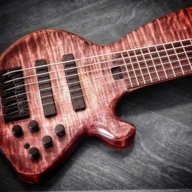
Despite my tendency to challenge ideas, I am even more excited by new ideas and invention. Long live experimentation!
 
We designed our Whappo Grande cabinet to address the needs of those wanting to nail an F# without the cost of extra electronics. It should do an admirable job on a C# as well.

Mark
AccuGroove.com

Here are the specs:

• 1 - 21” Sub Woofer with die-cast aluminum frame and 4.5” voice coils
• 2 Speakon jacks & recessed castor sockets with 2.5" pop-in castors.
• Professional grade 14-gage, oxygen-free, copper wire.
• High Grade ¾” Void Free Birch Plywood, with Rabbet and Dado Construction
• Power Rating: 800 watts RMS @ 8 Ohms RMS at 8 Ohms
• Frequency Response & SPL: 22 Hz - 400 Hz @ 98 dB SPL (19 Hz @-6)
• Dimensions: 32 ¼”H x 24 ¾”W x 18 ¼”D
• Weight: 87 lbs.

150_WGrande.jpg
 
justplayinmybas said:
Is the SPL a servo driven sub? I've heard of those getting down around 15hz. Never actually encountered one though. Not even sure they still make them. B Easy

Myron Bennell Carroll

Yes, it is servo-driven (which I think is an SPL patent) and yes, they make two models using that technology: the above-mentioned Contrabass and the BassTech 7. See them here:

Invalid Link Removed

Always wanted to incorporate one of those into a dream bass rig . . . maybe tombowlus will be lured into trying that if he reads this thread and I can read how it works out . . :D
 
kmacleish said:
Bag End claims reponse down to 8 Hz (not a typo, that's EIGHT Hz) for some of their models when used with the matching integrator. I've always been fascinated by that rating because I wonder how they measure it, and what it would feel like to have it reproduce something in that range (Earthquakes? Thunder?).

A bit off topic but: Bag End could have picked 4Hz, or 2Hz, or whatever, for that number. It is simply an explicitly picked system-cutoff that they built into the device. The ELF (or whatever they call it now) Integrator is a sort of EQ, that takes the natural low-end roll off of the speaker in a sealed box and flattens it out. Operative word here being "flat" -- extend it down as far as you like.

This EQ goes before the amp though, so it takes more power to get those low frequencies than the high ones. They don't make this information easy to find -- eg, how much power does it take to get 18Hz out at 90dB? With their sensitivity charts you can figure this out. Then the question is, what is the maximum volume at that frequency?

The drivers they use are not that special. They have the same excursion limits as most you will find. They also have the same inherent harmonic distortion at very low frequencies as most. The Bag End design does nothing to counter this (no porting, no push-pull, no accelerometer feedback).

So, what do you get? A subwoofer that puts out about as much low-end as any other sealed subwoofer that size, plus an optimal EQ system for squeezing that low end out of it.
 
Let's be reasonable. I learned that an 18 " speaker or larger is not a recipe for success. If you have a four string sub contra-C# -e , then a whappo grande may be the answer.

Having 4 ten inch speakers gives the Adler 11 string a punchy sound , and you can hear the overtones that define the C# string. Larger speakers sound muddy. You have to have an active driver to get the detailing that is needed to make a low E00 sound like an E. I spent hours at the Basson factory today taking the 4X10 with the compression driver I played at NAMM , and working out the cross over frequencies. . Specs don't mean much ,i.e. 8 Hz because it's the entire speaker cab set up that makes the C# funtional. Every body makes claims , but Basson let me try unlimited combinations. Between Victor Basson and Nick , we tried many different combinations using the GK 1001 RB head.

Unfortunately a big speaker isn't the answer. The four ten and horn configuration is "tighter" than a larger speaker with no midrange and horn. You can't "hear" the pitch on a large speaker . Ship out a cab to me that will do the job , and I'll sell it to the world. The Adler 11 string is the ultimate test for a bass guitar. The clarity and detail of the entire range of the new Basson cab is breathtaking. It is truly excellent. It will be ready in about 3 weeks.

I have only been playing electric bass for 40 years , but I think that today ,I actually heard the notes on the C# string. Now ,how do I record that sound ?
 
Ninestring said:
,I actually heard the notes on the C# string. Now ,how do I record that sound ?

haha This is the big question. And if you do record it, what kind of stereo system would it take to do it justice? Perhaps it will just be a matter of time. I recall someone telling me that it took quite awhile for the average home stereo system to be able to accurately reproduce the low E.
 
Let's be reasonable. I learned that an 18 " speaker or larger is not a recipe for success. If you have a four string sub contra-C# -e, then a Whappo Grande may be the answer.
The Whappo Grande was never intended nor do we recommend it as a stand alone speaker cabinet. It is a sub to compliment a full range cabinet.
Having 4 ten inch speakers gives the Adler 11 string a punchy sound, and you can hear the overtones that define the C# string.
Overtones yes & that’s why a full range cab is needed to run if one chooses to use a sub.
Larger speakers sound muddy. You have to have an active driver to get the detailing that is needed to make a low E00 sound like an E.
You comment is in response to the large muddy speakers you have heard over your 40 years of playing & I have to agree. Most large speakers available on the market sound mediocre at best & horrible at worst. That’s why it took us 3 years to design a cabinet that was useable, but again this is a sub. If I took 1 cabinet only, I would rather take our El Whappo, which is a full range box.
Ship out a cab to me that will do the job, and I'll sell it to the world. The Adler 11 string is the ultimate test for a bass guitar.
Are you ever in Northern CA my friend? It would be an eye & ear opening experience to be sure.

Mark
AccuGroove.com
 
Whappo Grande said:
The Whappo Grande was never intended nor do we recommend it as a stand alone speaker cabinet. It is a sub to compliment a full range cabinet. Overtones yes & that’s why a full range cab is needed to run if one chooses to use a sub. You comment is in response to the large muddy speakers you have heard over your 40 years of playing & I have to agree. Most large speakers available on the market sound mediocre at best & horrible at worst. That’s why it took us 3 years to design a cabinet that was useable, but again this is a sub. If I took 1 cabinet only, I would rather take our El Whappo, which is a full range box. Are you ever in Northern CA my friend? It would be an eye & ear opening experience to be sure.

Mark
AccuGroove.com


I'm am an open minded guy in North San Siego.
 
ole Jason said:
haha This is the big question. And if you do record it, what kind of stereo system would it take to do it justice? Perhaps it will just be a matter of time. I recall someone telling me that it took quite awhile for the average home stereo system to be able to accurately reproduce the low E.

You are experiencing a new string and new way of playing and we'll all have to sort this bit out and see what works. I have only had a month's experience with a 17 Hz string so i am doing my best to share my experience with you guys . As Jauqo says -"we are all in this together " .
 
Yeah , the Basson cab will take 3 weeks because they are moving ,which is a 6 figure ordeal for them. Until the cab is done , I am usining the Basson B15H cabs. I'll be playing in Rainbow , Temecula and Palm Springs and in Hong Kong. Send me a private message. it would be good to meet you and show you the Adler 11 string.
 
Ninestring said:
Here is a decending C# major scale ending up on the low C# . It's not my best take , but see if you can make out the last three notes played on the C# string. I'll put up some different mp3 files if this works ok.I ran out of time today ,so this recording is "on the fly ".


When I played this on Real Player, it rattles,which it doesn't do when played back from Peak on my computer. Ig nore the buzz ,it's not the bass or strings.
I listened to this, and curiously, my crappy computer system can accurately reproduce the notes on the low E and B strings, but as soon as you hit the F# and C# strings, all I hear is total mud, like the sound you would produce by waving a metal sheet in the air... :(
 
the ombudsman said:
I listened to this, and curiously, my crappy computer system can accurately reproduce the notes on the low E and B strings, but as sound as you hit the F# and C# strings, all I hear is total mud, like the sound you would produce by waving a metal sheet in the air... :(

It may have something to do with the MP3 format. I can hear the file just fine on the computer ,but when I download the file and play it back on Real Audio Player , well a metal sheet would be a kind description.
 
A comment on the Low C#...

I am fortunate enough to have an early (but rough) recording of Garry playing the 11 string direct to CD- that C# is brutal! My studio monitors had quit a workout!

I put the CD in my truck to see how that system would handle the string. It seemed to do reproduce it faithfully (a pair of Rockford/Fosgate 10's at 4 ohms each in their own sealed 1cf cabinet, run on a 400w Jensen car amp, crossover set at 125hz).

The string added a lot of presence to the track (as it was played 2 hand touch style). I think Jauqo really did his homework on that string!

Mike
 
We should remeber that MP3 format files are small because they selectively remove certain frequencies that our brains are supposed to reproduce.

If our ears natrually do this and so does the MP3 file compression then we are ending up with a terrible representation of what is actually comming form the instrument.

If someone could host a .WAV file Im sure we would hear something much better.

Peace
Nick