
Oh yeah, if you take your bow and bow an regular TP, you'll hear a deep rumbly note and that interferes with what is going on north of the bridge.

TalkBass has been independent since 1998. Add your voice.
Create a free account to reply to discussions, view embedded media, and browse with fewer display ads.
Join free Log in
Want zero display ads or expanded classifieds tools? Compare plans.
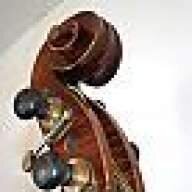
I originally had a standard ebony TP on my bass. The bottom end of my instrument is rather large so when it was installed the afterlength was too long. This caused all kinds of weird phasing in the strings and other wolf notes (ex. Bb on the G-string would go WWwwaawwWWwwaawwWWwwaawwWW; I'd need to close the A on the G-string while playing an open A or it would sound dead)
I did some reading and tried a Wittner TP (hard plastic, about 6 oz) with the correct afterlength. The sound was significantly better, but there was still a few odd notes and there was about 3.5" of wire between the bottom of the TP and the saddle so the TP looked odd floating in the middle of the lower bout.
I thought if reducing the TP weight by 7 oz made a difference then reducing it to about 2 would be even better.
I still have the questions about tuning those wires, and what about the vibrations the wires themselves produce?
If one of the after-lengths is a specific interval to the open string(i.e. 5th), doesn't that become a different interval relationship as you finger notes higher and higher? It seems to me that only on open strings would the interval be constant. I believe that the tailpiece material and wire material have a bigger influence on tone than the after-lengths.


You can close your eyes to shut out a particulaly garish colour combination but its still out there!
amplified is a different story. i think what jake (and others) are trying to say is that if the afterlengths are not in the realm of western pitch, they are always fighting the frequencies you are playing. since they have to be tuned to something, it may as well be something beneficial. if they are not helping your acoustic sound they are hurting it. that's the gist of it as i understand.
amplified is a different story. i think what jake (and others) are trying to say is that if the afterlengths are not in the realm of western pitch, they are always fighting the frequencies you are playing. since they have to be tuned to something, it may as well be something beneficial. if they are not helping your acoustic sound they are hurting it. that's the gist of it as i understand.
Sorry, I can't quite buy this. Sounds plausible on the surface, but a sympathetic frequency that is a half-tone from what I am playing will have significantly more amplitude than one that is a quarter-tone away. Thus the impact of the non-western pitch will not be particularly significant. It's far more likely that the quartertone afterlengh will be induced to vibrate at a multiple of the fundamental note played anyway.
It's akin to sounding an octave harmonic on a string. If your finger position is not dead on the octave, the octave harmonic will still sound. You may be "off" by a quarter-tone in position, but the string is induced to the correct harmonic. So can sub-semitone (or larger) conflicts with respect to afterlengths really contribute to a difference in sound? I wonder....?? And if they do, and do so negatively, why not just damp them and be done?
After all this, can the audience hear the difference?
 ). I think the point about the "quarter tone off" actually resounds sympathetically )) with the point others are making here. Your observation actually supports harmonizing the afterlengths, at least harmonizing them "more or less" (e.g., within a quarter tone), with the open string. Because if the afterlength tones can't contribute beneficially, then they must be subtracting from what your bass could be sounding like or, in the worst case, they will actually create dissonance.


