Shoot, I'm just happy if I can not suck north of the bridge.
What, Michigan Ave?

Sorry, man... the imagery of that has been buggin' me since you posted it....


TalkBass has been independent since 1998. Add your voice.
Create a free account to reply to discussions, view embedded media, and browse with fewer display ads.
Join free Log in
Want zero display ads or expanded classifieds tools? Compare plans.
Shoot, I'm just happy if I can not suck north of the bridge.


Nice MarcusWhat, Michigan Ave?
Sorry, man... the imagery of that has been buggin' me since you posted it....
.... Even though I am from Podunk-Ville originally and now I'm back where I belong  .... I lived in Greater Chi-Town for about 1.5 years. I know what you mean .... DAMN ..... I saw some great blues/jazz shows with double-bass pro-players back then in about 1974-75 .
...Is this just bull, or does it actually make a difference?
I'm not a luthier and don't fool around with the setup of my bass personally at all, but Jake tuned my afterlengths and mode matched my tailpiece to my fingerboard last year and all I can comment on is the before and after. Amazing. We had a little TBDB convention in my living room last weekend and everyone who had played my bass before and after is a convert.
We also did things like changing end pins and I was amazed at how much difference swapping endpins could make to the tone and volume, as well as playability, indirectly.
I'm not advocating that it must be done or your bass doesn't work right, but it's not bunk. To Paul's point, I think a lot of basses are a soundpost adjustment away from sounding much better and a lot of people don't bother, which is a shame. I also see a lot of bridges either tilting or out of place which is a much simpler and more impactful setup necessisity.
But, if you're uphappy with something about how your bass is sounding and you've got someone who can do that work for you at a reasonable price, it's not fruitless.
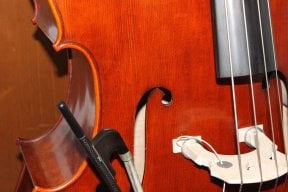
i didn't used to think so. even though it does make sense that the afterlengths contribute to the sound, i didn't think it would be that dramatic. so 2 years ago when i put on a new tailpiece, i picked the lengths of the TP cord and string afterlengths randomly. the holes in the TP were a randomly chosen 2.5 inches from the saddle and the afterlengths below the bridge were a randomly chosen 5.5 inches long. (in the picture, the length between the red Spiro stockings and the bridge tip was about half of what you can see, which may seem odd, but i didn't think it mattered much. so i didn't care.)
well, i just today changed the afterlengths below the bridge and shortened the tailpiece cord. i changed the afterlengths to exactly one 6th of the string length above the bridge. having a string length of 41.7 inches (106 cm), i set the TP so the afterlength is now 6.9 inches (17.6 cm).
my reason for trying this: it was the only thing i had not tried to get rid of some irritating sound. after the new set of Spiro Mittels /Stark E settled in this Fall:
(1) i was still hearing a high-mid metallic sound on the A string,
(2) i was still hearing a big difference in volume between the D and A strings,
(3) i could see how the A string while vibrating was wavering inconsistently during decay, kind of wobbly looking.
finally, (4) there was a persistent but faint buzz on the A string that i just couldn't locate and had done everything i could think of to get rid of -- except change the afterlengths below the bridge.
nota bene: the afterlength shortening is the ONLY change i made today; everything else is EXACTLY the same as before.
well, with the afterlengths now at a 5th (or maybe it is 2 octaves and a 5th) above the open strings, all of those problems seem to have been solved.
there is more volume and improved tone and sustain. the irritating metallic mids are gone, and the A and D are better balanced in terms of volume. the A string actually has noticeably better sustain and does not "wobble" during decay. and the buzz, yes, the buzz: i can't believe it's gone, cuzz the buzz maybe it will come back, but right now it is gone. can an increase in afterlength cure a buzz? why not? if it was emanating from a bridge groove, maybe.
PLUS i can also play "louey louey" by plucking two open strings and one afterlength, how cool is that?
so i have to join those here who say the string afterlengths can make a big difference. cheers, bill
PS it was Jake's good advice that got me thinking about this. (Jake is making me a new tailpiece for my gut bass, and in that connection we got to talking at length about afterlength length, not to make a lengthier story out of it... so, i'll shut up now)
i didn't used to think so. even though it does make sense that the afterlengths contribute to the sound, i didn't think it would be that dramatic. so 2 years ago when i put on a new tailpiece, i picked the lengths of the TP cord and string afterlengths randomly. the holes in the TP were a randomly chosen 2.5 inches from the saddle and the afterlengths below the bridge were a randomly chosen 5.5 inches long. (in the picture, the length between the red Spiro stockings and the bridge tip was about half of what you can see, which may seem odd, but i didn't think it mattered much. so i didn't care.)
well, i just today changed the afterlengths below the bridge and shortened the tailpiece cord. i changed the afterlengths to exactly one 6th of the string length above the bridge. having a string length of 41.7 inches (106 cm), i set the TP so the afterlength is now 6.9 inches (17.6 cm).
my reason for trying this: it was the only thing i had not tried to get rid of some irritating sound. after the new set of Spiro Mittels /Stark E settled in this Fall:
(1) i was still hearing a high-mid metallic sound on the A string,
(2) i was still hearing a big difference in volume between the D and A strings,
(3) i could see how the A string while vibrating was wavering inconsistently during decay, kind of wobbly looking.
finally, (4) there was a persistent but faint buzz on the A string that i just couldn't locate and had done everything i could think of to get rid of -- except change the afterlengths below the bridge.
nota bene: the afterlength shortening is the ONLY change i made today; everything else is EXACTLY the same as before.
well, with the afterlengths now at a 5th (or maybe it is 2 octaves and a 5th) above the open strings, all of those problems seem to have been solved.
there is more volume and improved tone and sustain. the irritating metallic mids are gone, and the A and D are better balanced in terms of volume. the A string actually has noticeably better sustain and does not "wobble" during decay. and the buzz, yes, the buzz: i can't believe it's gone, cuzz the buzz maybe it will come back, but right now it is gone. can an increase in afterlength cure a buzz? why not? if it was emanating from a bridge groove, maybe.
PLUS i can also play "louey louey" by plucking two open strings and one afterlength, how cool is that?
so i have to join those here who say the string afterlengths can make a big difference. cheers, bill
PS it was Jake's good advice that got me thinking about this. (Jake is making me a new tailpiece for my gut bass, and in that connection we got to talking at length about afterlength length, not to make a lengthier story out of it... so, i'll shut up now)
nice.
I take it you tuned the after lengths with that little bridge added on top of the tailpiece? I have an older tailpiece like yours, the kind that's not easily adjustable with the cord.
Two things I'm curious about..
-) when amplifying, I've read here that it's desirable to mute the after lengths, does that leave all these adjustments to be useless?...
Hey Bill, I'm glad you tried that with your afterlengths! The hollowness and the 'wobble' are classic signs of the phase cancellations caused by non-scale notes being present in the afterlengths. The buzz might have been caused by standing waves set up through the out of tune afterlengths.


Of course, if you replace that 14oz chunk of sound deadening and endangered wood with a [Invalid or Expired Link Removed] all those problems disappear and your bass will sound $10 000 better!



What, Michigan Ave?
Yeah, I've been thinking about that Bryan but the tailpieces I carve are usually around 150 grams, with a low of 111 grams!
I'll probably try one eventually but...
111 grams! Wow, you must carve them out of balsa!
Of course, if you replace that 14oz chunk of sound deadening and endangered wood with a [Invalid or Expired Link Removed] all those problems disappear and your bass will sound $10 000 better!


