

Enjoy the benefits of a premium membership!
Upgrade Account
-
TalkBass has been independent since 1998. Add your voice.
Create a free account to reply to discussions, view embedded media, and browse with fewer display ads.
Join free Log in
Want zero display ads or expanded classifieds tools? Compare plans.
You are using an out of date browser. It may not display this or other websites correctly.
You should upgrade or use an alternative browser.
You should upgrade or use an alternative browser.
Alembic price list: HOLY $#%*!!!!!
- Thread starter Chatdawg
- Start date
More options
Who Replied?Yeah they're expensive, but are they worth it? You can pay to have a rich man in Geneva hand build your car for an obscene amount of money, but will that produce an objectively better car than one made in a factory for far less?
Obviously not so don't worry about not being able to afford these vanity instruments.
Obviously not so don't worry about not being able to afford these vanity instruments.

I don't really understand how they can be that expensive. I'm sure they make good instruments and everything, but I find it hard to believe that they're actually better than my dual humbucker Stingray. That one is perfect on every level IMO, yet it costs nearly nothing in comparison.

Haha, you can buy a new car or a bass.
Sounds like upright...
I don't really understand how they can be that expensive. I'm sure they make good instruments and everything, but I find it hard to believe that they're actually better than my dual humbucker Stingray. That one is perfect on every level IMO, yet it costs nearly nothing in comparison.
They're not. You can spend a fortune on a bathtub made of solid gold, hand carved by the finest artisans, and it won't get you any cleaner than a cheap Home Depot tub.
Obviously musical instruments are a bit more sophisticated but the argument stands, past a certain price point you're paying for personalization, not performance.


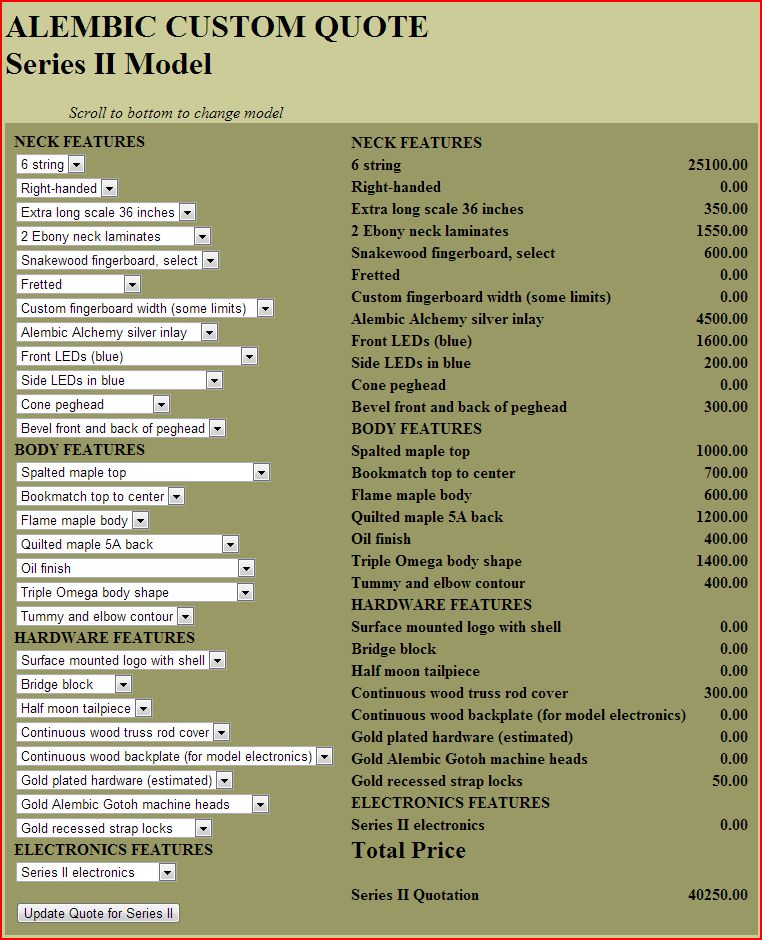
I got it to $43,525 almost a friggin' new Corvette C6
[Invalid or Expired Link Removed]

The burst finish cost almost as much as my USA Jazz bass


I don't really understand how they can be that expensive. I'm sure they make good instruments and everything, but I find it hard to believe that they're actually better than my dual humbucker Stingray. That one is perfect on every level IMO, yet it costs nearly nothing in comparison.
Everybody's preferences are different. Among my 6 basses I have 2 double buck Sabres and 2 Alembics. My Sabres are a friggin' blast to play and hardly a month goes by where somebody doesn't offer cash or trade for one. I do not intend to make that mistake again, but they still don't reach up to the class and capability of my Alembics
They're not. You can spend a fortune on a bathtub made of solid gold, hand carved by the finest artisans, and it won't get you any cleaner than a cheap Home Depot tub.
Obviously musical instruments are a bit more sophisticated but the argument stands, past a certain price point you're paying for personalization, not performance.
Actually, you're paying for personalization AND performance. Is the increment in performance worth the INCREMENT in price? For some yes, for most no. But as long as the yes vote is sufficient, Alembic (the company) will do just fine. They have longer wait times now than when I ordered my custom in 1999. And prices are more than double for spec ing out my bass today. Apparently worth it to somebody.

Alembic are totally excellent people; Ron W's Series onboard pre is the sine qua non of pre's; and they craft beautiful and functional one at a time instruments. They have always been expensive. That is what that kind of operation requires.
When they were introduced there weren't a lot of alternatives to the Fender passive tones. Now more options are available. If Alembics don't fit your budget or needs that is totally cool. If you can locate a Series at a good price give it a shot. If you have an unlimited budget they are a great choice.
IMO
When they were introduced there weren't a lot of alternatives to the Fender passive tones. Now more options are available. If Alembics don't fit your budget or needs that is totally cool. If you can locate a Series at a good price give it a shot. If you have an unlimited budget they are a great choice.
IMO

I've been an Alembic player since 2003. My first was an '83 Spoiler Exploiter, followed by a limited edition John Entwistle Tribute Spyder, an '03 Europa, an '04 Dragon's Wing, a '91 Essence, an '06 Stanley Clarke Signature Standard, a '92 Essence, and a Custom Series II Entwistle Exploiter Replica. I've used, as a result, their basses with Essence (filter, pan, volume), Europa (filter, pan, volume, treble/bass boost/cut switches), Anniversary (2XQ, 2 X filter, pickup selector switch, 2 X volume), Signature (2XQ, 2 X filter, pan, volume), and Series II (on my custom, 2 X continuously variable Q, 2 X filter, 2 X volume, 2 X master volume (with switch to choose between them), pan) electronics. I've used short scale (SC), medium scale (Spoiler), and long scale (all the others). Some have had LEDs (Europa, Dragon's Wing, Series II, Spyder Tribute) and others not. Some have been very heavy (Dragon's Wing, to me) and others relatively light (Series II - wood backplates help A LOT). A few thoughts on some of the main points in this thread based on my experiences as an Alembic player.
Expense - they are expensive. Stipulated.
Weight - they can be heavy. However, if you order a custom, they'll chamber the body if you wish, or used lighter hardware, wood backplates (which cost more money), etc. to make it lighter
Ergonomics - not for everyone. The Dragon's Wing, for example was great to sit down with, but in my experience not so much standing up. It sounded amazing to my ears, though. Same goes for the JE tribute Spyder. Long, long, long neck. The Essence and Europa were/are great ergonomically, as is my Series II.
Hippie Sandwich and Affect on Tone - a matter of taste and opinion.
I've visited the Alembic factory in Santa Rosa, and have spoken to Ron, Mica and Susan in person. Folks have to remember that this is a family owned business, not a mega producer like Fender, Gibson, etc. Things cost more money for them as a result as they cannot buy in bulk like the larger companies can.
Then, there is the fact that the cost of goods and services have been rising over the years. Think Fender doesn't pass that on to you, the consumer? Think again. For Alembic to remain viable in a global market, as a small, family owned business their prices have to reflect the cost. If they didn't, they'd find themselves out of business very quickly.
Quality and Craftsmanship - Second to none. For example, Ron Wickersham built the pickup winding machine that winds their pickups. Sanding blocks are hand made to fit the person using a particular block. They make all their own bridge hardware and bridge blocks. Nuts are hand cut, as are bridge saddles. Inlays are hand cut, and up until recently Alembic made their own circuit boards. Tony Stoufer hand wires their preamps and SF-2s (I saw him doing this when I visited). Their pots are sealed, meaning no dust every gets in them. Their jacks are the same as those that used to be used in telephone switchboards - in other words made for years of continuous use. Knobs use collets, not screws to attach them to pot posts. All screws used to attach backplates are threaded into metal screw inserts glued into the body. Body cavities are shielded using a special silver impregnated paint, meaning absolutely no noise whatsoever. In short, what separates Alembic (and other boutique makers) from your average mass produced instrument is the dedication to, pursuit and achievement of gnat's ass detail. Every new Alembic I've purchased was perfect, and I mean perfect. I could not find one flaw in fit, finish, playabilty (for me) or performance. These folks are obsessed with quality and it shows.
Employees - some of them have been there for years. Outside of Susan, Ron, Mica, etc., James and Tony have been there for years, plying their craft as they always have. I can't speak for the mass produced companies, but I find it comforting to know that the same folks who put together John Entwistle's Alembics put together mine.
Customer service - flawless. Every time I've needed help with something (which has been rare) I've received it. It is sometimes better to call them rather than email (Mica is the main POC for a lot of these kinds of things, and she has other duties), but their response, in my experience has always been prompt and on point.
Customs: It took four years to make my custom. Some of that wait was due to getting some details correct. Some of it wasn't. To say that I was frustrated at times is an understatement, but in the end it was worth the wait. It is an amazing instrument, and nothing else I've ever owned sounds like it (I currently own 28 instruments, to include Gibson, Fender, Rickenbacker, Sadowsky, Pedulla, Parker, Lakland, etc.).
I agree that if you want to try an Alembic, buy one used. Most Alembic users take good care of their instruments, so you'll be getting a nice bass at a much lower price. If you don't like it, you can flip it for what you paid or close to it. As others have noted, they're not for everyone.
Electronics - the filters can be a challenge to those used to "conventional" electronics. Basically, the filters act like a strainer - you keep what you want in your tone at a certain frequency (the stuff that flows out of the strainer) and get rid of the stuff you don't want at a certain frequency (the stuff that remains behind in the strainer). The Q acts as a boost - you set the frequency with the filter, and the boost gives you a dB "oomph" at that frequency, particularly on the initial attack. Can everyone hear this? Maybe not. But having used them for ten years, I can. Again, not for everyone.
Wow Factor - like any low volume boutique, particularly those not shaped like traditional instruments (e.g., Fender, Gibson, Rickenbacker, etc.), there is an associated "wow" factor involved. I often get asked what kind of instrument it is, I tell them, and usually the words that follow are "awesome," "it sounds amazing," "beautiful," etc. If this kind of thing is important to you, an Alembic (or other boutiques) can deliver in spades if my experience is any example.
Bottom Line - Are They Worth The Expense? - like any bass, an Alembic is only worth it to those who play them and like them based on the music being played, tones required, etc. What works for one individual may not work for another based on these and other factors. It all boils down to personal preference. Yes, a cliche, but when you're looking at a very expensive instrument vs. an inexpensive one, that cliche goes a long way.
My advice, as a long time Alembic owner to those who want to try one is to try to find someone who owns one and will allow you to try it. Failing that, buy a lower level (Epic, Essence, Excel, etc.) model and try them (keep in mind the Epic and Excel are set neck, whereas the Essence is neck through; also the Essence has a filter, while the Epic/Excel have traditional treble/bass controls). You won't be out much cash if you decide it's not for you as noted above.
For me they work. I still have my Series II, my '91 Essence (which I used in Iraq) and my Stanley Clarke. I have no plans on selling them any time soon, either.
Alan
Expense - they are expensive. Stipulated.
Weight - they can be heavy. However, if you order a custom, they'll chamber the body if you wish, or used lighter hardware, wood backplates (which cost more money), etc. to make it lighter
Ergonomics - not for everyone. The Dragon's Wing, for example was great to sit down with, but in my experience not so much standing up. It sounded amazing to my ears, though. Same goes for the JE tribute Spyder. Long, long, long neck. The Essence and Europa were/are great ergonomically, as is my Series II.
Hippie Sandwich and Affect on Tone - a matter of taste and opinion.
I've visited the Alembic factory in Santa Rosa, and have spoken to Ron, Mica and Susan in person. Folks have to remember that this is a family owned business, not a mega producer like Fender, Gibson, etc. Things cost more money for them as a result as they cannot buy in bulk like the larger companies can.
Then, there is the fact that the cost of goods and services have been rising over the years. Think Fender doesn't pass that on to you, the consumer? Think again. For Alembic to remain viable in a global market, as a small, family owned business their prices have to reflect the cost. If they didn't, they'd find themselves out of business very quickly.
Quality and Craftsmanship - Second to none. For example, Ron Wickersham built the pickup winding machine that winds their pickups. Sanding blocks are hand made to fit the person using a particular block. They make all their own bridge hardware and bridge blocks. Nuts are hand cut, as are bridge saddles. Inlays are hand cut, and up until recently Alembic made their own circuit boards. Tony Stoufer hand wires their preamps and SF-2s (I saw him doing this when I visited). Their pots are sealed, meaning no dust every gets in them. Their jacks are the same as those that used to be used in telephone switchboards - in other words made for years of continuous use. Knobs use collets, not screws to attach them to pot posts. All screws used to attach backplates are threaded into metal screw inserts glued into the body. Body cavities are shielded using a special silver impregnated paint, meaning absolutely no noise whatsoever. In short, what separates Alembic (and other boutique makers) from your average mass produced instrument is the dedication to, pursuit and achievement of gnat's ass detail. Every new Alembic I've purchased was perfect, and I mean perfect. I could not find one flaw in fit, finish, playabilty (for me) or performance. These folks are obsessed with quality and it shows.
Employees - some of them have been there for years. Outside of Susan, Ron, Mica, etc., James and Tony have been there for years, plying their craft as they always have. I can't speak for the mass produced companies, but I find it comforting to know that the same folks who put together John Entwistle's Alembics put together mine.
Customer service - flawless. Every time I've needed help with something (which has been rare) I've received it. It is sometimes better to call them rather than email (Mica is the main POC for a lot of these kinds of things, and she has other duties), but their response, in my experience has always been prompt and on point.
Customs: It took four years to make my custom. Some of that wait was due to getting some details correct. Some of it wasn't. To say that I was frustrated at times is an understatement, but in the end it was worth the wait. It is an amazing instrument, and nothing else I've ever owned sounds like it (I currently own 28 instruments, to include Gibson, Fender, Rickenbacker, Sadowsky, Pedulla, Parker, Lakland, etc.).
I agree that if you want to try an Alembic, buy one used. Most Alembic users take good care of their instruments, so you'll be getting a nice bass at a much lower price. If you don't like it, you can flip it for what you paid or close to it. As others have noted, they're not for everyone.
Electronics - the filters can be a challenge to those used to "conventional" electronics. Basically, the filters act like a strainer - you keep what you want in your tone at a certain frequency (the stuff that flows out of the strainer) and get rid of the stuff you don't want at a certain frequency (the stuff that remains behind in the strainer). The Q acts as a boost - you set the frequency with the filter, and the boost gives you a dB "oomph" at that frequency, particularly on the initial attack. Can everyone hear this? Maybe not. But having used them for ten years, I can. Again, not for everyone.
Wow Factor - like any low volume boutique, particularly those not shaped like traditional instruments (e.g., Fender, Gibson, Rickenbacker, etc.), there is an associated "wow" factor involved. I often get asked what kind of instrument it is, I tell them, and usually the words that follow are "awesome," "it sounds amazing," "beautiful," etc. If this kind of thing is important to you, an Alembic (or other boutiques) can deliver in spades if my experience is any example.
Bottom Line - Are They Worth The Expense? - like any bass, an Alembic is only worth it to those who play them and like them based on the music being played, tones required, etc. What works for one individual may not work for another based on these and other factors. It all boils down to personal preference. Yes, a cliche, but when you're looking at a very expensive instrument vs. an inexpensive one, that cliche goes a long way.
My advice, as a long time Alembic owner to those who want to try one is to try to find someone who owns one and will allow you to try it. Failing that, buy a lower level (Epic, Essence, Excel, etc.) model and try them (keep in mind the Epic and Excel are set neck, whereas the Essence is neck through; also the Essence has a filter, while the Epic/Excel have traditional treble/bass controls). You won't be out much cash if you decide it's not for you as noted above.
For me they work. I still have my Series II, my '91 Essence (which I used in Iraq) and my Stanley Clarke. I have no plans on selling them any time soon, either.
Alan


My favorite Alembic player was Peter Steele of Type O Negative. In the early days, he played an Alembic Spoiler. But before playing it live - he fixed it up. Remove any uneccesary hardware (like the bridge pickup), spray paint the entire thing black, flat black, then install industrial strength chain as a strap.
Attachments



Isn't the most common working bass Pros use Fender Jazz, then maybe Precision? If the Alembics were do much better, wouldn't they be more popular with the Pros? Craftsmen tend to buy the best tools they can afford. So maybe they, generally, can't afford them either?

This is my dream bass. If I sold a bunch of basses, or ate into our savings, I could afford it.
It was good enough for John Entwistle. as PRO as you get.
Are Alembics over-priced? No. You're paying someone highly skilled to build you exactly what you want and that never comes cheap.
They aren't for everyone simply because not everyone wants to lay out that kind of money.
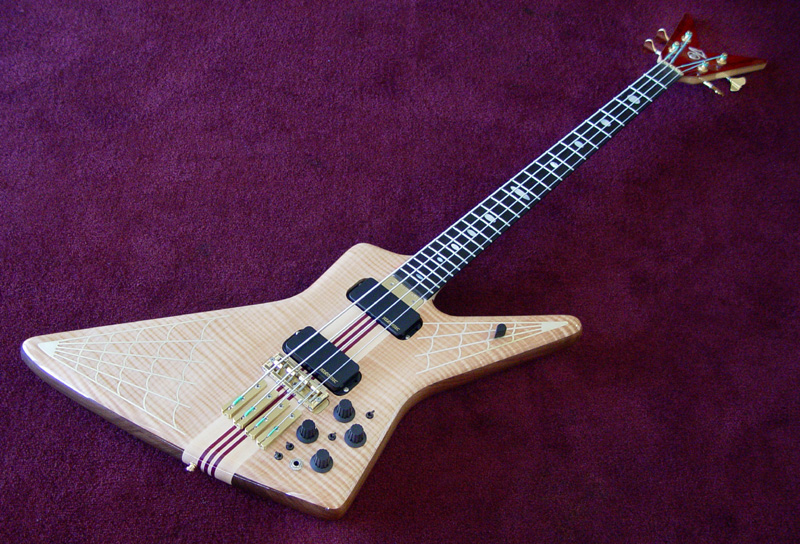
It was good enough for John Entwistle. as PRO as you get.
Are Alembics over-priced? No. You're paying someone highly skilled to build you exactly what you want and that never comes cheap.
They aren't for everyone simply because not everyone wants to lay out that kind of money.
Actually, you're paying for personalization AND performance.
"Performance" is pretty subjective when it comes to musical instruments, unlike say F1 racing where lap time is an objective measure of a car's performance. Players like Jaco and Miller made names for themselves using extremely "low performance" instruments by your metric, but that didn't stop them from becoming legends; meanwhile even a great race driver with a slow car will toil in obscurity.

If it's coming out of CA or NY, you can bet a big chunk of that cost goes into neither the materials or labor unfortunately.

songwriter21
I have an obsession for wood. The musical kind.
I'm guessing that someone has already posted this, but what the hell, it's supposedly THE most expensive bass ever made:
[Invalid or Expired Link Removed]
[Invalid or Expired Link Removed]
Here is my custom alembic +40K ! lol
Paying that much for a bass is just plain stupid!


