• TalkBass has been independent since 1998. Add your voice.
    Create a free account to reply to discussions, view embedded media, and browse with fewer display ads.
    Join freeLog in
    Want zero display ads or expanded classifieds tools? Compare plans.

Alembic Series II

At one time, Yamaha was a distributor for Alembic. You can find some advertisements from back in the day where they would show a Small Body Series guitar with a whole stereo rig of Yamaha stuff. I think they started selling their own active basses only later. There were some Aria Pro II (basses only, I think) that came with Alembic pickups and electronics. And Rokkoman built a number of violin-cornered headless bolt-on instruments with authorized use of Alembic electronics and logos, when the exchange rates were particularly bad for the yen against the dollar.
Ah Yes, the “Alembic Japan” or AJ-I-HB.
I totally want one.
 
I'll let you get on with your life provided you put me out of my misery on this nagging question: did you at any time actually put TI Jazz Flats on your Series bass?

We now return to the dramatic conclusion of Green Eggs and Ham (TalkBass Edition) :roflmao:. Man, you're like a dog with a bone. If I say that I will try a set of TI Jazz Flats in a 5-string set in the next 3 months, can we move on, Flats-I-Am? I promise to report back, FFS. You should be providing the hundred dollars this'll cost!
 
Last edited:
  • Like
Reactions: adje
I'll let you get on with your life provided you put me out of my misery on this nagging question: did you at any time actually put TI Jazz Flats on your Series bass?
I ran TI Jazz Flats on my (non Series) 5 string Essence bass for quite a while. Loved them. So easy on the fretting hand, very fast strings but IIRC a somewhat lower tension than you'd expect with Flats. I'm using TI Power Bass rounds now (TI Magnecore Round Wound Hex Core .047-.119) and really like them as well. I don't see any reason why a flat on a Series bass wouldn't sound good, but some folks just don't like the sound or feel of Flats on any bass, and that's cool, to each their own.

String changes can be one of the most cost effective ways of changing the sound and feel of your bass. Unfortunately, I find very little accurate predictability on how much or what changes will occur. The down side is it's very much a trial and error process.
 
  • Like
Reactions: adje
We now return to the dramatic conclusion of Green Eggs and Ham (TalkBass Edition) :roflmao:. Man, you're like a dog with a bone. If I say that I will try a set of TI Jazz Flats in a 5-string set in the next 3 months, can we move on, Flats-I-Am? I promise to report back, FFS. You should be providing the hundred dollars this'll cost!
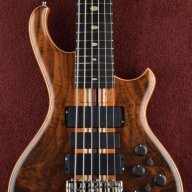
You're excused!:D
 
The Series II also has the LEDs in the neck.
True. And more body and neck laminates and recessed logo. But that’s if the question was about differences between a SeriesI and a Series II bass. The question was about the electronics. That’s part of the reason this all gets so confusing. There are Series I and Series II basses and Series I and II electronics that can go in other basses. There are Signature basses and Signature electronics that can go in other basses. I could go on. But since the question was about the difference between the two electronics packages, that’s all I answered.
 
  • Like
Reactions: kesslari
I have never tried flats on any of my alembics but am planning to try some Labella deep talking black nylons on one of mine. I have an all maple europa 5 bass with signature electronics that i use predominantly for reggae gigs and want to find out how those strings fit for that genre. Any experience of them you can share would be welcome.
 
Well Jazzy, I put Chromes on my Sig. Deluxe 5-er a few years ago, (I do change strings every year or so...) and I've never looked back. They're bright at the outset, but mellow very nicely soon there after. I don't think you'll be sorry one bit. Absolutely zero string noise!!
 
True. And more body and neck laminates and recessed logo. But that’s if the question was about differences between a SeriesI and a Series II bass. The question was about the electronics. That’s part of the reason this all gets so confusing. There are Series I and Series II basses and Series I and II electronics that can go in other basses. There are Signature basses and Signature electronics that can go in other basses. I could go on. But since the question was about the difference between the two electronics packages, that’s all I answered.
Well, one might actually consider LEDs to be electronic, that's why I mentioned them. But yes, realistically, I imagine when someone requests Series II Electronics in their build, it probably doesn't include the LEDs (which presumably come at their own expense).
 
They used to sell the Superfilter, which does this in a rack-mounted unit, I think.

Looks like they still do: [Invalid or Expired Link Removed]


The Superfilter has way more functions than what you get in a Series instrument. A common misconception is that Series II has a built-in Superfilter - it really doesn't. (On occasion, they have built a single channel of the Superfilter into an instrument, but I doubt that they will do it again.)

Right: While you can draw parallels between most of the controls on the SF-2 and Series II electronics (e.g., "Reciprocal Damping Ratio" is really just the same thing as "CVQ") the most overt differences are
- The SF-2 offers Lowpass, Highpass, and Bandpass modes for the filters, whereas Series II filters are Lowpass only; and
- The SF-2 allows you to mix the unfiltered output of the instrument with the filtered signal.

Yeah, a complete Superfilter built into a bass would be off the hook! I do recall reading an old post by Rick Turner (either here on TB or perhaps in the Alembic Club forum) where he described the ridiculous complexity involved in the one time he managed to do that.
 
Will Gunn prefers to use the SF-2 Superfilter for tone shaping of his Series basses. His Series basses have no onboard low-pass filters, Q-switches, or CVQ just a master volume, volume for each pickup and a pickup selector. Link below to the Featured Custom page on the Alembic site that describes his basses.

[Invalid or Expired Link Removed]
 
I had a good on line conversation with Will when I was considering using my SF-2 as a stand alone pre-amp instead of in the send and return loop of my F1-x.
I've done a few gigs with it now (reggae only) though not with a series bass and the bottom end clarity is incredible. I use one channel on low pass and the other on band pass so I can ad heft then pick a punch frequency. The sound guys DI the bass and mic up the cab and so far the feedback has been great.
 
  • Like
Reactions: s_wood and kesslari
Will Gunn prefers to use the SF-2 Superfilter for tone shaping of his Series basses. His Series basses have no onboard low-pass filters, Q-switches, or CVQ just a master volume, volume for each pickup and a pickup selector. Link below to the Featured Custom page on the Alembic site that describes his basses.

[Invalid or Expired Link Removed]

I had a good on line conversation with Will when I was considering using my SF-2 as a stand alone pre-amp instead of in the send and return loop of my F1-x.
I've done a few gigs with it now (reggae only) though not with a series bass and the bottom end clarity is incredible. I use one channel on low pass and the other on band pass so I can ad heft then pick a punch frequency. The sound guys DI the bass and mic up the cab and so far the feedback has been great.

Funny. A while back I had made an open offer over at Alembic Club to trade my Series II 5-string for a 5-string Balance K style Series I or Signature, with some cash involved, depending on the bass on the other end. If I had gotten a taker with a Signature bass, my plan was to get a Superfilter and achieve the Series II flexibility that way. Not a full-on Will Gunn approach, but similar.
 
Funny. A while back I had made an open offer over at Alembic Club to trade my Series II 5-string for a 5-string Balance K style Series I or Signature, with some cash involved, depending on the bass on the other end. If I had gotten a taker with a Signature bass, my plan was to get a Superfilter and achieve the Series II flexibility that way. Not a full-on Will Gunn approach, but similar.
Interesting thought. Looks like my Dragon Wing with Signature electronics would be a very costly conversion to a Series bass (if it's even possible). But if I picked up a Superfilter I could get close?

Not sure how that would work considering the Signature layout is mono output vs Series basses being stereo output. Am I missing something?
 
if you put the SF-2 in stereo mode, then you can patch the series bass outputs into each channel of the SF2 and process each one separately.
[Invalid or Expired Link Removed]
However if you switch to mono mode and using it as a pre-amp you can put a mono bass signal into the front jack on the SF-2 and send the output from channel B to your power amp. Both channels on the SF-2 operate independently and gets summed to the output jack marked Out. That is how I currently use mine with my signature bass.
If you were using it in a send/recv loop then you would use the jacks marked In and Out when in mono mode.
 
Interesting thought. Looks like my Dragon Wing with Signature electronics would be a very costly conversion to a Series bass (if it's even possible). But if I picked up a Superfilter I could get close?

Not sure how that would work considering the Signature layout is mono output vs Series basses being stereo output. Am I missing something?
You could do what im currently in the process of doing which is to get the wiring loom to get my signature electronics converted to anniversary which will give me the same kind of layout as a series bass, with a mono/stereo switch which will enable the use the two sf-2 channels independently.
 
  • Like
Reactions: GBassNorth
You could do what im currently in the process of doing which is to get the wiring loom to get my signature electronics converted to anniversary which will give me the same kind of layout as a series bass, with a mono/stereo switch which will enable the use the two sf-2 channels independently.
That actually sounds like a very good plan. Keep us posted on how it works out, I might want to follow your lead.
 
With him, it's ALL the player. I've been in the studio with him a few times, and seen him live dozens of times, and I'm intimately familiar with his tone. I can deal with the deficiencies of my playing in various ways, but the thought of a 5-string with flats kinda grosses me out; just not my thing. I hear you, 100%, though. Yours is an "oblique strategy," which I have a lot of respect for.

Just sayin': you'll never get that sound on the solo for "Panic Stations" with flatwound strings. Nor the tone of "Grasshopper".


On the subject of Jimmy Johnson's incredible tone, I think my favourite tone of his was from the 1984 RIT special with Lee Ritenour playing 'Mr Briefcase'. He absolutely lights it up without slapping. He was playing IIRC, a graphite-necked Alembic 5 string. I also love his tone on 'Metal Fatigue'. The power and projection of notes on his low B string are phenomenal.
 
On the subject of Jimmy Johnson's incredible tone, I think my favourite tone of his was from the 1984 RIT special with Lee Ritenour playing 'Mr Briefcase'. He absolutely lights it up without slapping. He was playing IIRC, a graphite-necked Alembic 5 string. I also love his tone on 'Metal Fatigue'. The power and projection of notes on his low B string are phenomenal.
Metal Fatigue, especially. It's pretty magical.
 
  • Like
Reactions: India_Sierra