• TalkBass has been independent since 1998. Add your voice.
    Create a free account to reply to discussions, view embedded media, and browse with fewer display ads.
    Join freeLog in
    Want zero display ads or expanded classifieds tools? Compare plans.

All my pedals now have "switch pop"...any suggestions?

Kevan Campbell

Bergantino Artist
Supporting Member
Jun 15, 2008
2,161
3,285
Nashville, TN
Hey y'all! A couple weeks ago I had a short run of two shows in very different locations in Texas (an hour west of Fort Worth and an hour south of Houston the next night), and now unfortunately all of my pedals seem to have the dreaded "switch pop" through my amp (heard both using headphones as well as speaker cabs). Never heard any sort of pops beforehand at all. Does anyone have advice for getting rid of "switch pop" in a pedal?

The Backstory and Details (for any interested):

Venue 1: Outdoor stage, looked like a good setup as far as lights and FOH. Weirdly when I plugged in my cab sounded like a speaker was blown, so I had to go DI only. At the end of the last song off the night it sounded like someone was slowly turning down the volume of my bass until it was absolutely silent (no other issues like this before)...BUT when I was letting another bassist check out my gear less than five minutes later all of my pedals, amp and cab worked perfectly fine.

Venue 2: Inside stage, pretty decent setup but a very lively room so volume is pretty constrained. When driving here I had my gear in road cases in the back of a pickup truck and a huge rainstorm hit us, but when I got to the venue I couldn't find any evidence of water getting inside other than in a separate compartment from my pedalboard where my cables live (and there not more than a few drops). All of my gear powered up and worked great that night, no issues whatsoever.

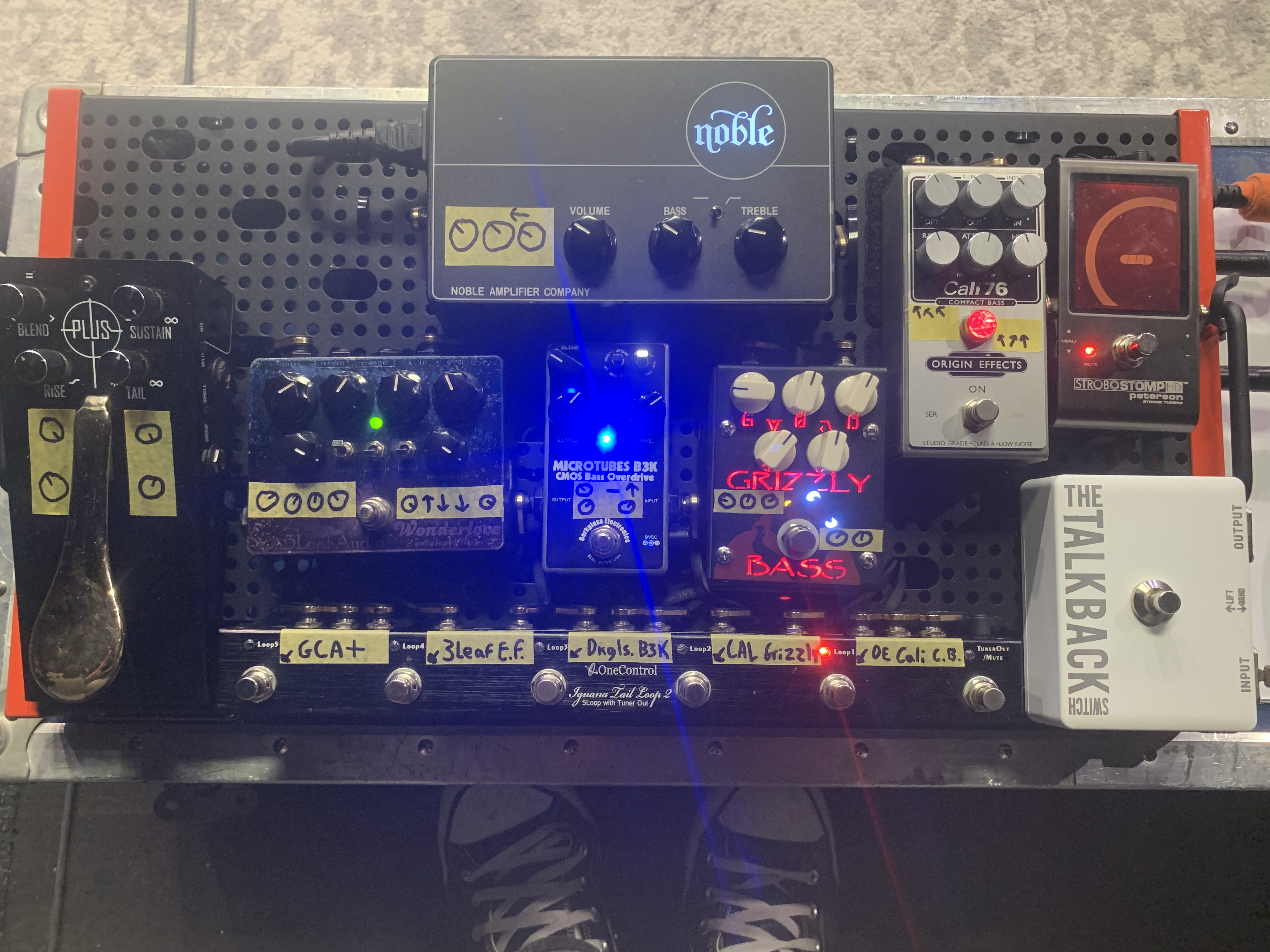
After both shows I was home last week woodshedding when I discovered the "switch pop" had struck my pedals. Interestingly the Origin Cali CB, Peterson Tuner, 3Leaf Wonderlove and Gamechanger Plus have the least amount of pop and the little bit there is seems to be disappearing. Unfortunately the Darkglass B3K, Creation Audio Labs Grizzly and OneControl Iguana Loop still have it badly. Not the end of the world as I have overdrive and dirt on my B Amp, but I like the flexibility of using these too as they're a bit more "nuanced" and have more range.

What do y'all think? Anything that I could do at home to fix the "switch pop" or should I send them back to their respective manufacturers for repair?

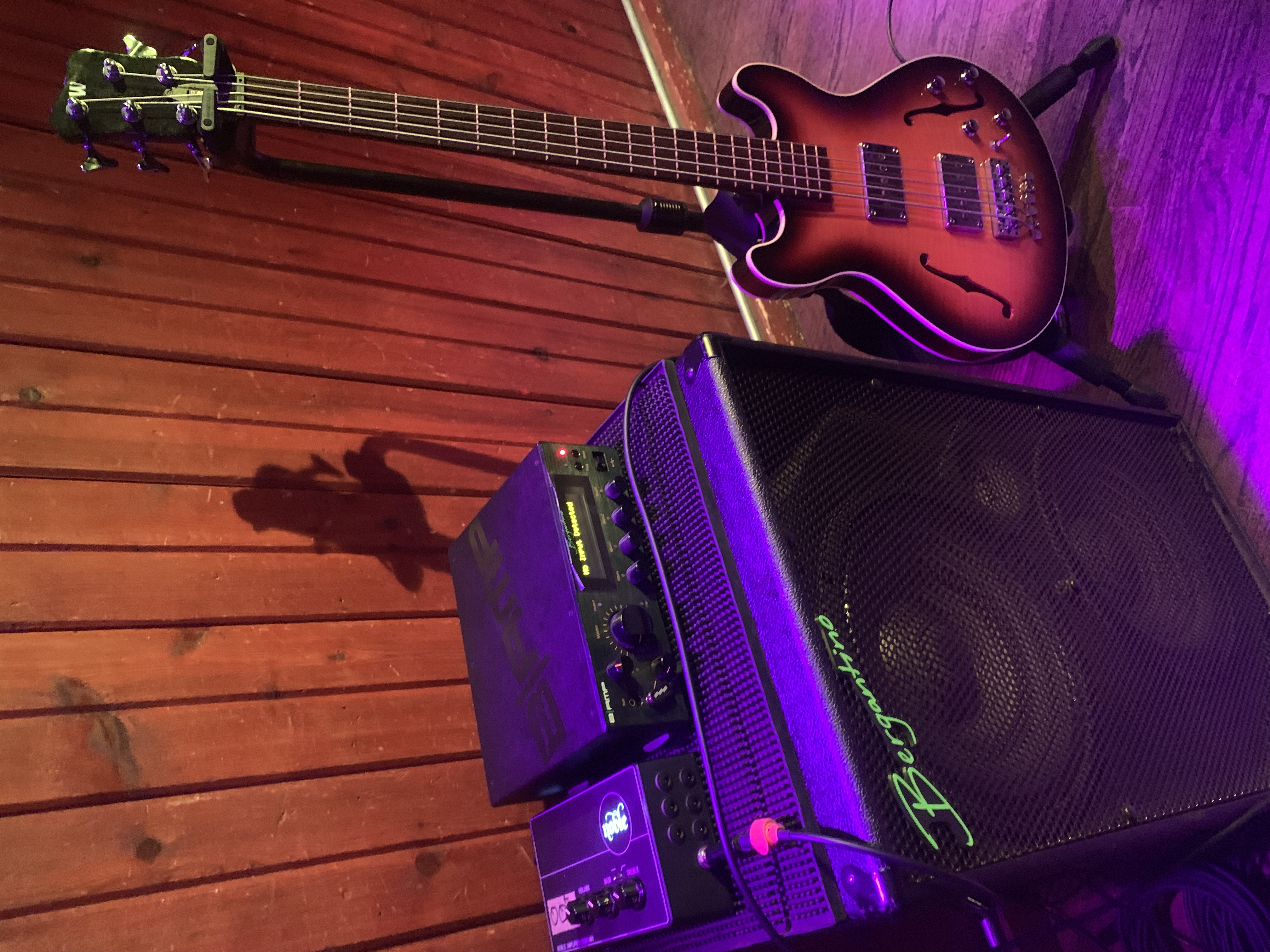
Photos below for reference (Eventide Cioks Powermax PSU not picured but underneath board, the Warwick Star Bass II isn't my normal #1 for shows):
tempImageeXuxjQ.png
tempImagepb9Wnc.png
 
True bypass pedals are usually not dead silent when switching. If the pop has gotten way worse, perhaps something is putting a bit of DC offset on your signal path.

Have you changed anything with your pedal power supply or the way the pedals are patched (both signal path and power feeds)?

Could possibly be a bad cable.

Have you changed anything in the way you balance your tone. Running higher treble on the amp or turning up a tweeter for example.

Sending off all your pedals for repair may only cost money and not fix the problem.
 
True bypass pedals are usually not dead silent when switching. If the pop has gotten way worse, perhaps something is putting a bit of DC offset on your signal path.

Have you changed anything with your pedal power supply or the way the pedals are patched (both signal path and power feeds)?

Could possibly be a bad cable.

Have you changed anything in the way you balance your tone. Running higher treble on the amp or turning up a tweeter for example.

Sending off all your pedals for repair may only cost money and not fix the problem.

No changes in tone or settings. It could be a bad cable but so far the issue has been replicated at home with an instrument cable that never comes out to shows.

I have another Eventide Cioks PowerMax PSU that I could also try as well. The issue is still there when pulling the lead and using it with only a separate cable and a OneSpot power supply though.

Did you already test your pedals seperately, with a different PSU than the Cioks?

Yeah, I’m having the same issues when using a OneSpot power supply and a new-ish instrument cable that never leaves my home. I do have another Eventide Cioks PowerMax PSU just like the one I normally use (it’s on my fly board).
 
I’ve heard from a couple builders that static charge build up can make this worse at times. This can happen during shipping or if getting moved around a bunch under the right conditions.

Cycling the foot switch on and off a bunch can often help discharge the static charge and get things back to normal, and has worked on several pedals for me.

It’s free a worth a shot!
 
I’ve heard from a couple builders that static charge build up can make this worse at times. This can happen during shipping or if getting moved around a bunch under the right conditions.

Cycling the foot switch on and off a bunch can often help discharge the static charge and get things back to normal, and has worked on several pedals for me.

It’s free a worth a shot!
I second this. I got a pedal through EWS and they say the same thing in the manual, that if pop is heard just press the footswitch a few times to discharge the pedal. It does work.
 
Yeah, I’m having the same issues when using a OneSpot power supply and a new-ish instrument cable that never leaves my home.
What happens when you use each pedal 1 at a time? It is very unlikely all the pedals failed at once. If it really has gotten worse it is most likely a single thing causing the problem for all of them.
 
Based on your post and the 2 gigs described I could imagine a scenario where static buildup was the culprit. I'd try the "multiple presses and see if that fixes it" thing. The fact that you say that some of the pedals are already getting better also supports this.
 
No changes in tone or settings. It could be a bad cable but so far the issue has been replicated at home with an instrument cable that never comes out to shows.

I have another Eventide Cioks PowerMax PSU that I could also try as well. The issue is still there when pulling the lead and using it with only a separate cable and a OneSpot power supply though.


Yeah, I’m having the same issues when using a OneSpot power supply and a new-ish instrument cable that never leaves my home. I do have another Eventide Cioks PowerMax PSU just like the one I normally use (it’s on my fly board).
I had a similar issue last year; bad power cable from TrueTone power supply to tuner pedal. The worst part was the random nature of the glitch. Hope you find the culprit!
 
  • Like
Reactions: Kevan Campbell
Static seems unlikely, you'd need some very high resistance to accumulate any of that. I bet it will dissipate faster than you could collect it under any conditions short of shuffling plastic shoe soles on dry carpet.

Can you measure the audio lines with a cheap DC voltmeter? Use a digital one, they all have extremely high input resistances these days..

You may need to look for some DC offset, because a lot of modern stuff is designed with DC coupling in the audio lines, partly because it's said (not very wisely) to be better for sound, and partly because doing that might save the cost of at least one electrolytic capacitor. If you have more than one pedal in series designed this way, some DC offset might get propagated all the way down the chain, affecting multiple devices.

If that test checks out, then a 10 microfarad electrolytic capacitor inserted in series after the source might keep the output clean for whatever follows. Wire it so the plus terminal goes on the most positive side of any DC voltage found, but if the offset has very little current it might not matter which way round it goes.

Also, dodgy connections can cause a rectifying effect, like a diode, so any strong RF sources might generate a DC offset even if there is no obnoxious noise caused. Removing strong RF from uncontrolled locations is a bitch, so the only thing you can easily do is make sure your audio lines are clean and shielded and terminated correctly so they can stand the conditions. There's a standard text with pictures by the firm Rane (they make speakers). It details connections between balanced and unbalanced gear, amongst others. Look for a document with nice pics of red and black wires in its cabling diagrams, you'll not regret having a copy of that, not ever. If noise or DC offsets are trouble, that thing is often the cure.
 
Last edited:
I don't know, but if I ever use an unbuffered pedal (which is rare.... buffered pedals are vastly superior unless you specifically want the weird artifacts of an unbuffered one going directly before a tube amp, or whatever all of the classic 60s guitar tricks used to be), then I always start and end my pedal chain with buffered pedals. When doing so, I've never had issues with switches popping on unbuffered pedals (like my previous wah, or my home made fuzz box, or so on).

I'm not currently running similar stuff to you, but as a guy who's designed and built plenty of pedals and preamps, I personally am thinking that the dc voltage leaking somewhere does sound likely. There should be zero dc voltage on your signal anywhere, and if there is then one of your pedals, and/or the power supply, could be at fault.

You do need to take each of your pedals one at a time and try them out. In the end, if only one pedal is the cause, you'll know soon enough. If no pedals do it alone, then go back to your regular setup and start testing groups of pedal - plug your bass in part way through your chain. still an issue, narrow it down further. No issue? plug into normal first pedal and plug the output of pedal half way through your chain into your amp. Still no issue? plug in the whole chain again and make sure it still is popping. If it is, then try combinations of only the middle 3 or 4 pedals... cuz it must be an interaction there.

not all pedals are wired to ground the same way, and therefore sometimes they interact badly in certain orders. It could be that a dc current has been going through the system from the start, and it slow ate away at a capacitor in one or more of your pedals or the psu until it is not worse than it used to be and causing pops when switching.

I completely sympathize with your issue.... good luck, you WILL be able to track it down, eventually, but it might not be an obvious problem at all until you at least work out how you can replicate it with only one or two pedals. There must be a way to do that. Once you are there, electronics testing routines with volt/ohm meters can help you figure out what the issue is and, worst case, which pedal to unload, if not repair.
 
My mxr bass octave deluxe has pedal loading problems...hitting the switch a few times will generally cure it. The weird thing is, I notice it much more frequently when....either....I have a higher voltage pedal in front of it, (like a 12v comp or 18v wah...etc). Or two...I don't have the mid boost engaged. I have an ehx knockout, that just pops no matter what.
Some pedals are just finicky, I guess. But yeah....it doesn't hurt to check cables, clean the pedals, and discharge them every once in awhile. In fact, this reminds me that I should probably do that soon myself.
 
  • Like
Reactions: Kevan Campbell
I don't know, but if I ever use an unbuffered pedal (which is rare.... buffered pedals are vastly superior unless you specifically want the weird artifacts of an unbuffered one going directly before a tube amp, or whatever all of the classic 60s guitar tricks used to be), then I always start and end my pedal chain with buffered pedals. When doing so, I've never had issues with switches popping on unbuffered pedals (like my previous wah, or my home made fuzz box, or so on).

Seconded. That detail is very important.. Buffered outputs mean an op-amp is likely doing the buffering, and it can both source and sink current with low resistance. This reduces microphony in cables, and can cure nasty electromagnetically induced feedback problems too.

Guitars with no active electronics had fairly high output resistances so the preamp inputs had to have very high input resistances. That means noise is always a big risk, so the buffering of outputs is critical because then it doesn't matter how high the input resistance is if the electrical shielding and grounding is good.
 
That's a hell of a nice rig you got there.
I'd add only a little. In time, I came to believe that when weird problems occur - something pops but only in some rooms, something buzzes with a bass and does not with other bass, etc. - the obvious culprit is a contact that is going bad. Either a bad cable, or a wiring going bad inside a stomp box, or in the amp, or in the cab, or in the bass. If the amp+cab and the bass work with no issues, it's likely that the problem is in the pedalboard. But to be sure, if the bass is active, change the battery.

The test method is: disconnect everything, try it one by one, with cables you are sure are working perfectly. It might well be that a switch slowly goes bad in your true bypass pedal, for example.

The popping sounds, I believe unknowingly, sometimes occur when electricity is bad in the network. At home this wouldn't be your case, but I can imagine there might be something wrong with your pedalboard power supply. Try another supply, or try the stomp boxes with batteries, to find the source of trouble.

sounded like someone was slowly turning down the volume of my bass until it was absolutely silent

If you can't find anything testing the stomp boxes, have your amp tested and cleaned by experienced technician.
 
  • Like
Reactions: Kevan Campbell
ooh ooh ooh, LoL, sorry I just also suddenly remembered that in the days when I played through more traditional bass amps with pedals (I'm all modelling these days), the AMP itself sometimes could be generating dc on the input if there is something wrong with the amp. It should be nearly impossible, BUT it did happen to me on one of my amps.

I'm pretty sure the op had tried different amps (or going ampless)? but just in case you didn't, this is worth a shot as well.

It's even possible that something such as an amp or a pedal or a power supply that has had issues for a while DID gradually start to damage one or more or your pedals, so that whatever was causing it before no longer needs to be in the signal chain now for the popping to continue. But that would be very sad so we won't go there unless absolutely proven that each pedal now, on it's own, is doing these popping things, even in a buffered loop of some kind (such as with a buffered tuner as your first pedal at the very least, and ideally a buffered pedal at the end of the signal chain just to remove the amp from the equation).
 
Last edited:
  • Like
Reactions: Kevan Campbell