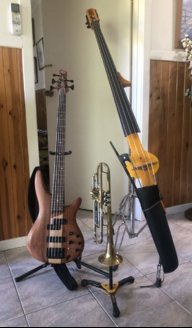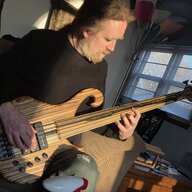
I love my SRF705. It's a fantastic bass.@Real Soon The Ibanez Portamento fretless board goes all the way to the neck pickup. Sweet bass!

TalkBass has been independent since 1998. Add your voice.
Create a free account to reply to discussions, view embedded media, and browse with fewer display ads.
Join free Log in
Want zero display ads or expanded classifieds tools? Compare plans.
I love my SRF705. It's a fantastic bass.@Real Soon The Ibanez Portamento fretless board goes all the way to the neck pickup. Sweet bass!
You shouldn't be disappointed. Neck is like silk, well balanced, and the tones are great. IA whole lot more affordable, too heh... I kinda just discovered them, and yeah-- interest piqued. Unless I find some one-off awesome oddity somewhere, that might be what I bring home
I agree! I love mine!I love my SRF705. It's a fantastic bass.
Same, that would be one of the changes I'd make. Frets, Drop some Nostrand Big Splits in it, Bass Xtender and a new nut.You shouldn't be disappointed. Neck is like silk, well balanced, and the tones are great. I
'm not a huge Bartollini fan, but they sound great in this bass. The piezo's sound very good also.
Lack of need? I couldn't care less. I barely go above the 15th fret for anything other than a slide anyway.Although I almost never go past the twelfth fret except when goofing around, I don't understand why every bass doesn't have 24 frets. It just makes so much sense from the standpoint of orientation to have two full octaves on each string. The cost would be negligible. Is there any reason other than tradition?
I think it's only tradition, there is a market for that configuration so companies continue to manufacture instruments to fulfill customer needs.Although I almost never go past the twelfth fret except when goofing around, I don't understand why every bass doesn't have 24 frets. It just makes so much sense from the standpoint of orientation to have two full octaves on each string. The cost would be negligible. Is there any reason other than tradition?


So, to preface this, I currently have seven basses, which, yes, is excessive. My horde includes a fretless six string custom Thor Bass, a fretless five string Ibanez, a fretted five string ESP, a fretted six string Ibanez, a fanned fret five string Ibanez, a four string Ibanez, and a four string ESP. The one thing all my basses have in common is that they all have at least 24 frets (one of my fretless basses has 30, technically). I cannot deal with playing on 20 fret necks. It screws with my entire usual play style. Yes, this means that I can't do Fender basses. At all. I know, that's an unpopular opinion, but I cannot be alone in the "I need 24 frets to do my job properly" camp. Or am I? You tell me! Constructive comments welcome.

I question why they don’t all have 25. The zero fret pretty much eliminates the open string tone problem. (Long rant removed)I don't understand why every bass doesn't have 24 frets.
I did this to my bass in 1988. Right after I saw Michael Manring. I defretted after seeing Jaco in 1987. The original bass, a Kramer Pioneer model had a bare maple fretboard to begin with So the luthier added a thin piece of ebony and let it overhang up to the pickup. I still have it and it is a great recording bass. I use to only prefer 24 fret basses but today I can deal with the 19 or 20 even if I am soloing. You can always use fingered harmonics for the higher notes. I changed from virtoustic to lyrical in my soloing. I also play sax and when I was young I would do all these altissimo p[6 letters] contests - basically adding an octave plus over the 3rd F on the tenor sax.
However be you @Tedthulhu . Make music - who cares if you are an outlier. Do not be a sheep.


Agreed. I prefer 24 frets from an aesthetic POV, though I've had 22- and 20-fret basses. FWIW, I do use that range from time to time.So, to preface this, I currently have seven basses, which, yes, is excessive. My horde includes a fretless six string custom Thor Bass, a fretless five string Ibanez, a fretted five string ESP, a fretted six string Ibanez, a fanned fret five string Ibanez, a four string Ibanez, and a four string ESP. The one thing all my basses have in common is that they all have at least 24 frets (one of my fretless basses has 30, technically). I cannot deal with playing on 20 fret necks. It screws with my entire usual play style. Yes, this means that I can't do Fender basses. At all. I know, that's an unpopular opinion, but I cannot be alone in the "I need 24 frets to do my job properly" camp. Or am I? You tell me! Constructive comments welcome.