• TalkBass has been independent since 1998. Add your voice.
    Create a free account to reply to discussions, view embedded media, and browse with fewer display ads.
    Join freeLog in
    Want zero display ads or expanded classifieds tools? Compare plans.

Am I missing something

I started on a jazz, played it exclusively for decades before getting anything else. Maybe that's why I use plucking pressure to control my volume 99% of the time. The blend sounds terrible on a passive bass in my opinion. On an active bass it works ok, but even on my Streamer Stage I (V/B w/ 3-band EQ) I rarely use the volume knob. I usually use pedals to get louder, and less plucking pressure to get quieter.

V/V is much more about finding tonal sweet spots than actually controlling the volume.
 
VVT on my sg bass was inconvenient for me too! Put in a 3 way switcher and it fixed for me.
Love me jaguar bass, but the switches with just on off limit me and I actually want vvt in addition to on off for each pup, series parallel, and active passive switching
 
Is that right about adding 250k or 500k ohms to the signal path? I assumed that a blend pot would be configured such that in the center position both pots would be on 0 ohms and as you moved in away from center one pot would remain 0 and the other would gain resistance.
The way a vol pot is wired is with one outside lug to ground and the other to signal. The pickup goes to the wiper where it is swept from signal at one end to fully grounded at the other. No matter where the pot is set it gives a const 250K ohm path from signal to ground (btwn the outside lugs). Add a second vol and they are in parallel for 125K.

I believe a Vol/blend setup puts 3 pots in parallel further increasing the load for the pickups.
 
  • Like
Reactions: HolmeBass
It may depend on what you think those controls are for. I pretty much never use the volume controls on a bass to control loudness. For me, volume is set at the amp, with single-pickup basses usually set to max volume and two-pickup basses' volume controls only being used to set the mix between pickup levels, which is done for tone, not loudness. If I need to fade a note, I use a gradual hand mute; if I need to fluctuate volume repeatedly, I use a volume pedal.
 
  • Like
Reactions: n1as
For the first 25 years I played a P bass. I then got a J and while VVT is good for playing at home and recording I just cannot get on with it at a gig, I need a master volume.

I'm sure if I had started out on a J then I would be fine with VVT.
 
Most basses with more than one pickup either have a pickup pan/blend control, or a toggle switch to move between pickups/coils.

Blend controls are actually pretty rare. One of the first basses I can recall that came stock with a blend pot was the Peavey Palaedium in the late 1980s. One reason may be that a proper blend pot is more expensive than a volume pot.

Toggle switches are common but do not help with blending volumes of the two pickups. Toggles with a single volume allow only 50/50 which is even more limited than a toggle and two volumes.

Lots of players (not me) believe in running volume wide open for the brightest tone, so on a Jazz you are only adjusting one of the knobs, not both.
 
  • Like
Reactions: HolmeBass
Blend controls are actually pretty rare. One of the first basses I can recall that came stock with a blend pot was the Peavey Palaedium in the late 1980s. One reason may be that a proper blend pot is more expensive than a volume pot.

Toggle switches are common but do not help with blending volumes of the two pickups. Toggles with a single volume allow only 50/50 which is even more limited than a toggle and two volumes.

Lots of players (not me) believe in running volume wide open for the brightest tone, so on a Jazz you are only adjusting one of the knobs, not both.

Quite true, but most of my basses do have blend pots, bar the Sabre and the Rascal (five way selector switches instead). It's only really the traditional instruments like Jazzes and Precisions that have V/V/T.

The five way selector on my Sabre gives me 1. Full 8 poles rear humbucker, 2. Full rear humbucker + single coil of front humbucker (another 8 poles, as the front has 16 in total), 3. All coils, both pickups, 4. Single coil only (again, rear half of 16 pole front humbucker), 5. The whole 16 pole front humbucker, so there's no shortage of tonal variation and no real need to blend. Adding the bridge mutes also gives another dimension to the sound, should I want a double bass sort of attack with less sustain, or a traditional Motown sort of feel. At any rate, there's plenty there and that's just one bass. It also makes changing sounds for different songs on the fly easier - just the flick of a switch to a different position and no fannying around with blending, either. :)
 
Last edited:
I TOTALLY agree. Gotta have a master volume, or a single volume. I really want VTVT masterVol.
+1
Some of my gigs require quick shut offs or backing of volumes for certain situations.
I have to have a master volume.
 
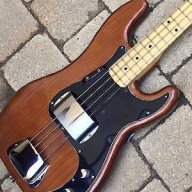
Had this bass for a while and never cared for the VVT set up. It was great in the studio and sounded good just wasn't a fan of the layout. Good bass though.
image.jpg
 
I prefer the original Fender Jazz set up. You get more tonal variety with 2 volumes than with one pan. With a pan you are turning one up and one down so the balance between the two is always the same. With a volume for each pickup you can blend the two at the balance you want. Sometime, I use only the neck pickup and role back the tone pot to get close to a P sound when I don't have time for an instrument change. (Notice I said close. You can't really get there)
Yes, it does take a second or so more to make a change, but I have never found it to be too much a problem.
 
I prefer the original Fender Jazz set up. You get more tonal variety with 2 volumes than with one pan. With a pan you are turning one up and one down so the balance between the two is always the same. With a volume for each pickup you can blend the two at the balance you want. Sometime, I use only the neck pickup and role back the tone pot to get close to a P sound when I don't have time for an instrument change. (Notice I said close. You can't really get there)
Yes, it does take a second or so more to make a change, but I have never found it to be too much a problem.
Looks like if you had one pan you would make skull eggs and bacon
 
I thought I was the only one who found the VVT somewhat inconvenient. Nice to know I'm not crazy by myself. I think the VVT is nice to have in studio when you are working on one song and trying to get the tone just right but prefer the VBT live when adjusting on the fly. I play two Reverend Rumblefishes and must say there is a big difference in tone with the VVT versus the VTS. Even though I prefer the convenience of the VTS but I usually end up playing the VVT because I just like the tone.