
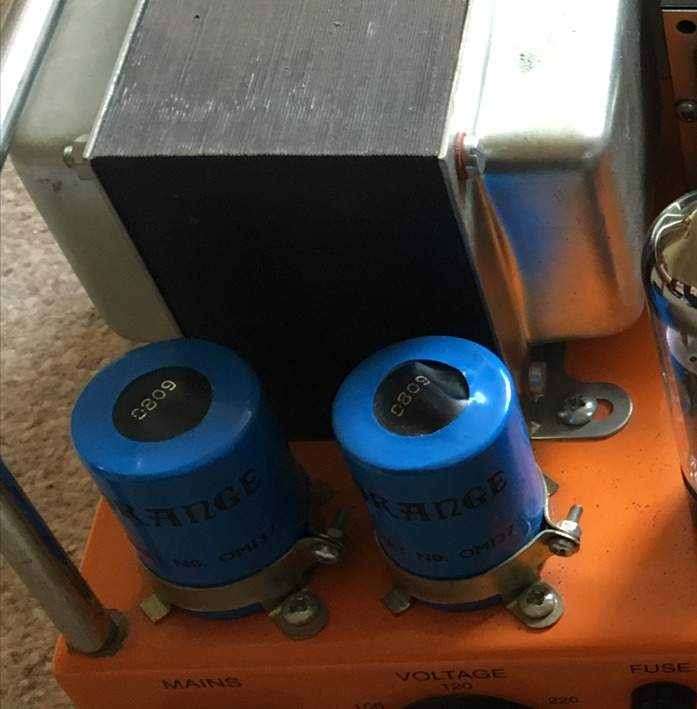
Any ideas what could've caused the bulging on the top of this capacitor? Apparently the amp has been recently serviced and given clean bill of health.

TalkBass has been independent since 1998. Add your voice.
Create a free account to reply to discussions, view embedded media, and browse with fewer display ads.
Join free Log in
Want zero display ads or expanded classifieds tools? Compare plans.





Thank you for the responses. It's not my amp but it's currently for sale elsewhere. I'm not convinced it's impact damage, it looks more like something to do with heat. I doubt the adjacent tube could generate enough radiated heat to do this so internal failure (perhaps partial?) of this capacitor seems favourite to me.
I, for one, would like to know who 'serviced' it, so I could thank them for missing something so obvious...
... I've seen and repaired computer motherboards (caps near the voltage regulator/power section), my A/C unit (starter cap), filter caps for load centers...
... all with same problem... intermittent, or not functioning as intended, with bulging caps as their visual clue...
... the humanity...
A marginal cap near a hot transformer can have a shorter life.

Lacking the knowledge and test equipment to do this, do you think if a person were to have the cap replaced, that would be be a good plan B?If I saw this, I would test for capacitance, ESR and leakage current at rated voltage. If it passes all these tests, I would leave it alone.
Lacking the knowledge and test equipment to do this, do you think if a person were to have the cap replaced, that would be be a good plan B?
Nope. The capacitor might have failed on its own but in the process caused latent damage elsewhere. It might also have failed because something else went wrong first.
*Replacing a damaged part in isolation may not fix the cause or effect of its failure.*
NO, because there is always risk of damage to PCBs and terminals when replacing a part.Lacking the knowledge and test equipment to do this, do you think if a person were to have the cap replaced, that would be be a good plan B?

Carefully cut the plastic wrapper enough to remove the black disk on top. Don't cut into the aluminum can. If the can isn't bulging underneath, it's just deformed plastic.Lacking the knowledge and test equipment to do this, do you think if a person were to have the cap replaced, that would be be a good plan B?
I see this kind of thing regularly, 9 times out of 10, there's nothing at all wrong with the cap. If there is, it's generally more obvious with performance issues. When the Lexan disc is held at the edges and there is expansion of the material, it has to go somewhere, and the only place is up.The top of this type of capacitor is designed to show any swelling due to internal pressure. Pressing on the top will tell you if the top black cover is simply misseated on the cap. If it presses down flat, without the indication of any bulging underneath, the cap could be fine.
OK. I understand that.NO, because there is always risk of damage to PCBs and terminals when replacing a part.
It's no different than the guy who changes spark plugs every 3000 miles rather than when really needed (say every 50,000 miles) , and then at 50,000 miles ends up with a stripped thread in the head... now a very costly issue that otherwise wouldn't exist.

This is true, however I would expect in this instance any doubler capacitors to be better isolated from the chassis and have more substantial insulation on the clamp strap than just a shrink wrapped wrapper. In the old days the cans were completely exposed without any kind of wrapper at all.The Lexan disc is required on certain accessible caps where the case may be at a high enough voltage to cause a shock, and is required for some applications, especially where failure cold cause it to become energized. Some caps (depending on where they are used in a circuit), when shorted, can place lethal voltages on the case. Certain voltage doubler or voltage multiplier circuits fall into this category.


