
Fender Rumble 40 or Rumble 100. You've got a tone you're happy with (I'm jealous) so stick with what you know and just boost the power a bit.

TalkBass has been independent since 1998. Add your voice.
Create a free account to reply to discussions, view embedded media, and browse with fewer display ads.
Join free Log in
Want zero display ads or expanded classifieds tools? Compare plans.
Something to keep in mind is that all wattage numbers are not reported equal between manufactures. GK and Mesa are much more accurate in real world numbers vs many other brands. Therefore, they tend to be "louder" than others. For example; I had an Ampeg 350w that struggled to keep up with a 4 piece band. Once I switched to a GK 200w (same 2x10 speaker cabinet) I could bury them all...Much appreciated! The MB-112 is out of my price range by around 100 gbp, but it's good to know that a 200w 1x12 can be suitable, gives me much more faith in similar powered/sized models
If you're approaching "Bury them all" level in a conventional big band setting, I imagine you'll have some pissed off musicians and a furious band leader. You might even be told to pack up your gear and get off the stage.Something to keep in mind is that all wattage numbers are not reported equal between manufactures. GK and Mesa are much more accurate in real world numbers vs many other brands. Therefore, they tend to be "louder" than others. For example; I had an Ampeg 350w that struggled to keep up with a 4 piece band. Once I switched to a GK 200w (same 2x10 speaker cabinet) I could bury them all...
The perceived "loudness" also is a function of the driver efficiency and cabinet design, which means more in a smaller combo amp.Something to keep in mind is that all wattage numbers are not reported equal between manufactures. GK and Mesa are much more accurate in real world numbers vs many other brands. Therefore, they tend to be "louder" than others. For example; I had an Ampeg 350w that struggled to keep up with a 4 piece band. Once I switched to a GK 200w (same 2x10 speaker cabinet) I could bury them all...
Won't tell you to get the amps and cabs I use because they are way out of your price range. But I would suggest you peruse the used market for a 500-watt into 4 ohms amp and a GOOD, 8 ohm, 210 cab that will handle 300-watts rms. That will give you about 250 to 300-watts into your 210 and when (not if) you buy a second 8 ohm 210 cab, there will be enough watts to drive both of them at large venues.Hi all - I recently secured a new gig with a 20-piece big band (14 horns), and I need to upgrade my amp for this.
At the moment, I have a 10-year old Fender Rumble 30 which has been fine for 4-piece rehearsals and home use, and thankfully most of my work has been studio-based.
What I need now is something that can compete with the big band setup in a rehearsal context (basically something that can be heard in a small rehearsal space), to be DI'd to the front of house in gig scenarios and used as a monitor.
What power/size/model recommendations do you have? I'm really on quite a budget (350gbp), so used is definitely fine, and portability is a big plus. I'm just not sure whether offerings like the Peavey Max 208 are worth it.

I personally would NOT call a 200-watt 112 cab reasonable for what you are planning. I have a 225-watt 112 cab set up that I use for small venues with a 5-pc. group (bass, two guitars, drums, and keyboards) It is NOT enough for a medium sized venue. My small venue rig is an Eden TN226 (225-wattts into 4 ohms) and an Eden EX-112 cab (300-watts rms power handling). Liked the sound so much I bought a second EX-112 cab to use for medium sized venues. Since both are 4 ohm cabs I have to use my dual power-block Eden WT500/800 amp and plug one into each power section (delivers up to 400-watts rms per channel). That worked fine for Medium-sized venues as long as they were not long (deep) rooms.Much appreciated! The MB-112 is out of my price range by around 100 gbp, but it's good to know that a 200w 1x12 can be suitable, gives me much more faith in similar powered/sized models
Hi all - I recently secured a new gig with a 20-piece big band (14 horns), and I need to upgrade my amp for this.
At the moment, I have a 10-year old Fender Rumble 30 which has been fine for 4-piece rehearsals and home use, and thankfully most of my work has been studio-based.
What I need now is something that can compete with the big band setup in a rehearsal context (basically something that can be heard in a small rehearsal space), to be DI'd to the front of house in gig scenarios and used as a monitor.
What power/size/model recommendations do you have? I'm really on quite a budget (350gbp), so used is definitely fine, and portability is a big plus. I'm just not sure whether offerings like the Peavey Max 208 are worth it.
im with burgerdj...if you like and understand the Rumble...just go bigger.
Hi all - I recently secured a new gig with a 20-piece big band (14 horns), and I need to upgrade my amp for this.
At the moment, I have a 10-year old Fender Rumble 30 which has been fine for 4-piece rehearsals and home use, and thankfully most of my work has been studio-based.
What I need now is something that can compete with the big band setup in a rehearsal context (basically something that can be heard in a small rehearsal space), to be DI'd to the front of house in gig scenarios and used as a monitor.
What power/size/model recommendations do you have? I'm really on quite a budget (350gbp), so used is definitely fine, and portability is a big plus. I'm just not sure whether offerings like the Peavey Max 208 are worth it.
With a big band, you really don't need much power. The situation where you would need the most is an outdoor gig with no PA. Suggestions would be difficult since you're looking at the used market and I'm not sure what's available. Personally I'd look for a 12" combo with about 200W realizing that I'd never use the 200W, but you can always turn down.
Do you really mean an amp to "compete" with, or do you mean an amp to "properly support" the band?
My mind went there immediately as well, seeing the title. Music is a team sport - you're there to do your part in a cooperative artistic venture, not compete with anyone or for anything. In my case, I do the majority of my gigs without an amp - how loud I am is determined completely by someone running FOH. The only real clue I ever have as to how loud I am in the house is how much my feet are shaking, and when I'm on a concrete stage, even that is pretty much cut off - concrete just doesn't move that much.
Anyway, if you do have to have an amp, the point is it has to be big enough so it doesn't sound like uncontrolled farting when it shouldn't. But for Pete's sake, it's NOT a competition. Sorry, rant off.
Stan Kenton also comes to mind. Fortunately, I played over the decades with more subdued drummers for finesse rather than power. For example, they knew the trick to keep repeating the last chorus of "In the Mood" until they started seeing dancers leave the floor, then start hitting bell strokes on the crowns of the cymbals to signal the band for the last repeat, shout section, and out.I switched between cover bands, concert bands, and big bands throughout my career. The big bands often required more volume out of my rig than the cover bands. Many of the big band drummer had the idea that they had to really kick the band Buddy Rich style--meaning they played loud and aggressively. These drummers were often selected specifically for this ability.
My GK 700RB/112 comb made 225W. It got the job done, but I would have liked a bit more headroom on some stages. I usually used the GK for my rehearsal rig and toured with an Eden D210XLT which was a bit louder. Never ran out of headroom with the Eden.
Indeed! It was just for some humor and relative comparison. In the volume wars, no one winsIf you're approaching "Bury them all" level in a conventional big band setting, I imagine you'll have some pissed off musicians and a furious band leader. You might even be told to pack up your gear and get off the stage.

+1 ^The perceived "loudness" also is a function of the driver efficiency and cabinet design, which means more in a smaller combo amp.
One of the band leaders I played for was a Kenton band fanatic. He would always have the drummer feather the bass drum on every quarter note. If the drummer’s doing it right and you’re locked in, it adds hellacious attack to your notes. Makes every quarter note you play like the Kool-Aid man, the attack of the bass drum knocks down the wall, and through the hole comes your pitch, like the Kool-Aid man. Toughest band leader I ever played for, but also the best.Stan Kenton also comes to mind. Fortunately, I played over the decades with more subdued drummers for finesse rather than power. For example, they knew the trick to keep repeating the last chorus of "In the Mood" until they started seeing dancers leave the floor, then start hitting bell strokes on the crowns of the cymbals to signal the band for the last repeat, shout section, and out.
Do you really mean an amp to "compete" with, or do you mean an amp to "properly support" the band?
I have played in all manner of horn bands, from combos to Motown to full swing bands: 5 sax, 5 bone, 5 trumpet, rhythm. I have accompanied them on everything from unamplified double bass to electric bass with a tall stack. Rarely did I ever need anything more, whatever the size of the band, than a good, clean @200 watt combo amp angled where the rest of the band could hear it. I usually set it up on an amp stand so it is off the ground and slightly angled to avoid rumbling or standing waves.
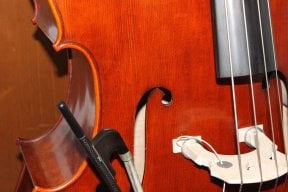
Also, if you are going to be playing swing big band repertoire on a regular basis, seriously consider learning and purchasing an upright double bass, or even an EUB, because the inherent tone quality of the bloom lends itself to supporting the style better than electric bass, even with a foam mute at the bridge.
One band I used to play for was driving the repertoire too hard. I finally realized it was me: my electric bass had too much sustain. So I bought a double bass. At the next rehearsal, the bloom of the double bass helped everyone relax back into the swing style, and we had a lot more gigs after that.
My mind went there immediately as well, seeing the title. Music is a team sport - you're there to do your part in a cooperative artistic venture, not compete with anyone or for anything. In my case, I do the majority of my gigs without an amp - how loud I am is determined completely by someone running FOH. The only real clue I ever have as to how loud I am in the house is how much my feet are shaking, and when I'm on a concrete stage, even that is pretty much cut off - concrete just doesn't move that much.
Anyway, if you do have to have an amp, the point is it has to be big enough so it doesn't sound like uncontrolled farting when it shouldn't. But for Pete's sake, it's NOT a competition. Sorry, rant off.