• TalkBass has been independent since 1998. Add your voice.
    Create a free account to reply to discussions, view embedded media, and browse with fewer display ads.
    Join freeLog in
    Want zero display ads or expanded classifieds tools? Compare plans.

Amp tone vs Bass tone

If you have a set up with a bass and an amp, both with quite a lot of controls, do you adjust more the amp or the bass when you want to change your sound? Do you try to get a great tone from the bass, and then just color it a little with the amp, or the other way around?

I understand that at the end it's always a combination of both, but I guess we all have a preference.

 
you forgot pedals.:D

I run my passive bass all out on everything but me amp is still fairly flat. I guess I like the sound without a lot of adjustments. My new bass is active and that takes a little more work. But I try to do most of it on the bass since I switch back and for between the two guitars.
 
Ha.. this could go on a long time. I think it's all subjective, and there's an infinite way of fiddling to get the "perfect" tone. For what it's worth (not much), I try to start off with the bass (active) flat, and tweek the amp to get the tone for the room. From there, as things progress, I play with the preamp a bit. Good question.. I look forward to more input!
 
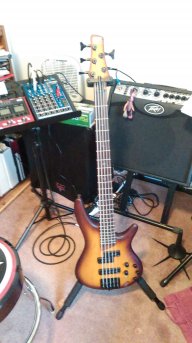
This is my rig:
BassRigatjamspace.jpg


I find that I can shape a nice clean tone with my amp and dial in all of the grit and growl I need with my Spectors preamp, so I'd say it's a good mix of both.
 
I use the controls on my bass to rapidly switch between a couple different tones. Bridge pickup for aggressive, loud parts, and neck pickup for softer parts.

Both go through the same amp settings, but they sound quite different, even so. On the bridge pickup, I get quite a bit of overdrive, whereas on the neck pickup, it's not nearly as apparent.
 
In my case, I've set the best possible EQ on my amp to suit all of my basses (I use 3 or 4 fretted basses and 1 fretless on rotation), and I switch between basses and between pickup settings on my basses. I also use the mid control of one of my active basses when I need a more aggressive tone.
For ambiance and spices, I use effects pedals, when needed.
 
Yeah, pedals, and don't forget playing technique. Lots of "stuff' goes into the final product. I look for a bass that sounds good as-is, and run my amps @ nuetral, then add flavor with pedals and fingers. so many ways to tweak an electric instrument.
 
I start with my "go to" setting(s) on my bass and amp. Will tweak amp to deal with a room/venue issue and tweak bass & right hand playing position to achieve subtle tone changes for a particular tune.
 
In general, I set up the amp for a general sort of sound I'm going to use and adjust for the room. From there the majority of tone changes are in the hands. Maybe crank up the growl knob on my GK for certain heavier songs, or roll down the tone knob on the bass or something but for the most part, the knobs don't move much once they're set.
 
Please forgive me in advance, I must confess I'm addicted to reading the manuals on everything. With that confession behind me I was surprised when I was reading a manual that came with an amp I just bought. It directed me to max out the tone and vol of the bass, turn the amp gain to 0, and then set the amp vol to "3 o'clock" which is about the 75% position. Then it said to bring up the amp gain until I got the vol I wanted.

I was rather dubious about doing that but, what the heck, it's what the manual said to do. I was pleasantly surprised by the sound I got. I usually play in a church and rarely do we have a musician as the sound person. I've never tried adjusting my bass that way there but need to get a partner and give it a try.

Anyone else adjust the amp as this manual directed?
 
Please forgive me in advance, I must confess I'm addicted to reading the manuals on everything. With that confession behind me I was surprised when I was reading a manual that came with an amp I just bought. It directed me to max out the tone and vol of the bass, turn the amp gain to 0, and then set the amp vol to "3 o'clock" which is about the 75% position. Then it said to bring up the amp gain until I got the vol I wanted.

I was rather dubious about doing that but, what the heck, it's what the manual said to do. I was pleasantly surprised by the sound I got. I usually play in a church and rarely do we have a musician as the sound person. I've never tried adjusting my bass that way there but need to get a partner and give it a try.

Anyone else adjust the amp as this manual directed?


2 schools of thought on this....the right one is whichever sounds best.

1. Set the master vol. high or wide open and use input gain as the volume. Maximize clean headroom.

2. Set the input gain high, or just before clipping and use the master as the volume. Maximize signal/noise ratio and get the "flavor" of the pre being pushed.

Some amps just plain sound better with the input turned up. That's how I do it and use the master vol. as the volume. Or sometimes maybe a little inbetween to have some travel in both knobs. In PA, I always dime the poweramps and use gain throughout the chain as volume controls. Again, whichever ways sounds the best, is the best. The power section of an amp doesn't really have a volume that controls it's output. The poweramp is basically doing what it does and the master volume controls the gain level of the signal going into it.
 
More the amp but I'm not above using the bass' tone controls if it's not convenient to get to the amp. After years of never touching my bass' tone controls, I recently started doing it to try and get different sounds out of my basses, and I like it.
 
I'm with Jimmy on this.

I use nothing but a passive four string Shecter and a passive four string Spector (hence my user name). The basses have two different tones and I certainly have to adjust the amp to compensate.

A good rule of thumb is to start with your amp EQ "flat" or with all knobs at noon (on most amps, anyway), plug in the bass and (assuming it's passive) have all the knobs full on. Start adjusting from there, and adjust the amp first.

In my case, the Shecter is by far "ballsier" than the Spector. It has much higher gain and natural depth. I adjust the amp for this bass first. When I then plug in the Spector, I know I can add gain and bass to match a similar level of output.

If your passive bass has two pickups, chances are, it also has two individual volume controls. In my experience, one pickup generally has a more pronounced midrange and the other has more pronounced bass. If it has a tone knob, this usually smooths out the tone and removes treble. In my opinion, rolling back the tone knob is most useful for clean songs without distortion.

Remember that midrange is really the "voice" of your insturment, the "tone", and will allow you to cut through the mix more effectively.
 
You make a good point about strings getting older and the treble becoming stale. The treble is bright and glistening on new strings and has that good metallic crunch. Over time, it turns into a less pleasant "click" at the 3k+ hz range. There is nothing wrong with rolling back some treble and boosting the mids a little more. It does seem counter-intuitive, but you're right - it works!