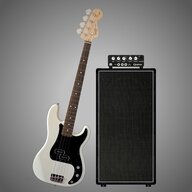
I know I'm speaking to intelligent people here, but all the preceding back-and-forth impedance gab prompts me to remind everyone that nothing other than a minimum 8 ohm load should be connected to the RB115 or RB210 external speaker jack
.
TalkBass has been independent since 1998. Add your voice.
Create a free account to reply to discussions, view embedded media, and browse with fewer display ads.
Join free Log in
Want zero display ads or expanded classifieds tools? Compare plans.
I know I'm speaking to intelligent people here, but all the preceding back-and-forth impedance gab prompts me to remind everyone that nothing other than a minimum 8 ohm load should be connected to the RB115 or RB210 external speaker jack.
It's more sound than running the combo by itself but I would expect the 210 speakers to be louder and punchier while the 410 sounds a little more "round" and distant. If you like it, that's all that matters. I was referring to the person who wants to buy another cab and letting them know about the ohms/speaker thing just so they know.I think everyone knows that. My main concern was an 8 ohm 2x10 vs an 8 ohm 4x10 cab and whether or not it was worth it to run the 4x10 since apparently all 4 speakers don't get their full power.
Speaker impedance is possibly the most discussed and consistently misunderstood subject on Talkbass.I think everyone knows that.
My last bass head had too many ohms.Speaker impedance is possibly the most discussed and consistently misunderstood subject on Talkbass.
I had band practice with the RB-210 today. The guitarist said he could feel it. The drummer said he could hear it clearly and that it cut through. I could hear it fine.
Previously, I was using a Rumble 100. Despite having trouble hearing myself, the guitar player would complain it was too loud.
The RB-210 is miles ahead, though I suppose it's not a fair comparison. I did find that the mids had to be turned up a bit.
What brand bass did you play?
Fender P-bass with the tone control wide open. The practice space is about 10 feet wide by 25 feet long with 9 feet ceilings. We're a 3-piece surf-rock band, drums, bass and guitar. I suppose we play pretty loud.
I think the amp is probably overpowered for a small practice space. Likely the RB-115 would have been fine. But the idea is to have full power available for gigs.
It was finally a pleasure to hear myself properly.
I think most Ampeg's are a bit scooped in the mids straight up but adjusting them is no biggie.I was just curious because you said you needed to crank up the mids a little more. That seems to be the common "complaint" with this RB210 is the lack of mids. I figured a P bass would make up for the inherent lack of mids, but I guess not. I use Fender Ps, also. Hmm.
That doesn't matter. The 410 is louder. Half the power to the 410, half the speakers in the 210, still more volume.Sure it can sound good, but both 8 ohms cabs get half the power. One cab has 4 speakers and the other has 2 speakers. Now if the 410 was 4 ohms and the head was 2 ohms safe, good to go.
You think wrong.I think most Ampeg's are a bit scooped in the mids straight up but adjusting them is no biggie.
Yeah, it's a pretty loud little combo.Received the RB112 yesterday. Order this one to see if it' better then the RB110 Inteied before. First impression is it'a great amp with nicer lows but the RB110 sounds a bit tighter in my opinion. Volume is crazy for home use, but its nice to have the extra options compared to the RB110. Today I will try the signalpath from the DI into my DAW.
I have no experience with any other Ampeg amps, but my RB-110 is a little mid-scooped with all EQ knobs set to zero (straight up, 12:00, noon).You think wrong.
I have no experience with any other Ampeg amps, but my RB-110 is a little mid-scooped with all EQ knobs set to zero (straight up, 12:00, noon).
I was curious, so I measured the frequency response by putting pink noise into the input, then taking the DI out signal into my interface, and using a spectrum analyzer in my DAW. The results show a dip right around 300-400 Hz whether the SGT is on or off. The screen shots with notes about settings are below. I've also shown the frequency response for the pink noise directly into the interface for comparison (it's flat).
View attachment 4410286
View attachment 4410287
View attachment 4410288
I also found that the overall shapes of these response curves remained the same whether the amp volume was turned up or down, and regardless of the "grit" or "level" settings with the SGT on. They moved up or down as these changes were made, but their overall shapes remained the same.
Since I did not mic the speaker, these curves do not necessarily show what the amp "sounds" like in the room. I'm not suggesting that any of this should be interpreted as sounding "good" or "bad", this is just what I measured as I described.
Also, if you inject the pink noise into the aux in, bypassing the EQ circuits, does the power amp have the same 300-400 Hz dip. If no, then the preamp is doing it.
I believe you about these combos 100%. I have the 12 and the 210. They are voiced a little boomy. Bump down the bass a knotch, and bump up the mids a half a notch, and they sound like a portaflex.I have no experience with any other Ampeg amps, but my RB-110 is a little mid-scooped with all EQ knobs set to zero (straight up, 12:00, noon).
I was curious, so I measured the frequency response by putting pink noise into the input, then taking the DI out signal into my interface, and using a spectrum analyzer in my DAW. The results show a dip right around 300-400 Hz whether the SGT is on or off. The screen shots with notes about settings are below. I've also shown the frequency response for the pink noise directly into the interface for comparison (it's flat).
View attachment 4410286
View attachment 4410287
View attachment 4410288
I also found that the overall shapes of these response curves remained the same whether the amp volume was turned up or down, and regardless of the "grit" or "level" settings with the SGT on. They moved up or down as these changes were made, but their overall shapes remained the same.
Since I did not mic the speaker, these curves do not necessarily show what the amp "sounds" like in the room. I'm not suggesting that any of this should be interpreted as sounding "good" or "bad", this is just what I measured as I described.

I believe you about these combos 100%. I have the 12 and the 210. They are voiced a little boomy. Bump down the bass a knotch, and bump up the mids a half a notch, and they sound like a portaflex..