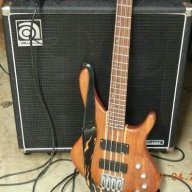
I just bought the SVT-7 Pro head used from Guitar Center (excellent condition) I watched a video talking about how to adjust the gain, by turning everything flat and master down while playing turn gain up until it peaks then back it off. I used the -15Db because both my basses are active. should i use the compressor to help keep it from peaking with the gain up? i have the SVT410HE 8 ohm cab 500/1000. I did notice that here and there even with the -15Db on it would clip with gain down. also the headphone jack seems to not work correctly if i plug all the way into the headphone jack I get no sound, but if I pull out a little bit it works fine. I bought the Pro Coverage Warranty ( 2 years )

Enjoy the benefits of a premium membership!
Upgrade Account
-
TalkBass has been independent since 1998. Add your voice.
Create a free account to reply to discussions, view embedded media, and browse with fewer display ads.
Join free Log in
Want zero display ads or expanded classifieds tools? Compare plans.
You are using an out of date browser. It may not display this or other websites correctly.
You should upgrade or use an alternative browser.
You should upgrade or use an alternative browser.
More options
Who Replied?
I have no experience with active basses on that head, but generally, peaking can be caused by heavier attack as you play, so as long as it's not prolonged, it's acceptable. Using compression to control that is fine. You have to experiment with the settings, as both gain and compression will affect the tone. I would suspect that with active electronics, you wouldn't want much gain, control the volume with the master volume knob, and the frequency boost settings. Play with it! BTW, never used the headphone jack....
So would it would be fine if I went with half gain and half compression? The thresh light made me wonder since I barely turn on compression and it goes from peak light to thresh. I just got the amp so I can take it into GC to have them fix anything that is wrong for free. I'd like to be able to play without the -15Db on. How serious is the thresh light? I've never had a compression knob or the thresh light.

You can turn the gain all the way up without worry. Just keep the master volume to a reasonable level. The clipping indicator tells you when the pre amp is distorting. It will take on a fuzzy characteristic but won't hurt anything. Try playing with both gain and compression to find a sound you like.
Ah ok. Thanks. I had the master all the way down and without the -15Db on the moment I turn the gain up it peaks. I just figured that if I turn gain to about 2/4-3/4 and turn up the compression some it will balance out the gain. My cab is 500 watts so I'm already at 600 with 8 ohms.

Yeah, don't worry about the peak light. If you don't crank the master or the bass knob your cab should be fine. Just use your ears, if the cab sounds off or like it's struggling then back off a bit.
Last edited:
I have this amp and I wouldn't worry about the peak light - a lot of Tb'ers call that the sweet spot with Ampegs - I personally ignore it
I also don't use the -15db with my active basses - takes away too much
I have also found just a little compression works best with this amp
My Gain setting is similar to yours and I have the compression at 9 o'clock - give it a try - and congrats on the new amp!
I also don't use the -15db with my active basses - takes away too much
I have also found just a little compression works best with this amp
My Gain setting is similar to yours and I have the compression at 9 o'clock - give it a try - and congrats on the new amp!

Ya, definitely try it without the -15db switch pushed in. I've got a few actives that are quite hot, but I've never needed it, and to my ears, it makes it sound kind of wimpy.

- Apr 3, 2003
- 35,515
- 19,942
- Disclosures
- Editor-in-Chief, Bass Gear Magazine
I have this amp and I wouldn't worry about the peak light - a lot of Tb'ers call that the sweet spot with Ampegs - I personally ignore it
I also don't use the -15db with my active basses - takes away too much
I have also found just a little compression works best with this amp
My Gain setting is similar to yours and I have the compression at 9 o'clock - give it a try - and congrats on the new amp!
+1 I almost never use a pad or the "active input" with my active basses. There is typically more going on than just gain reduction. Often, the input impedance is different between the active/passive inputs (or running with/without the pad).
If you feel daring, try this: turn everything all the way up except the master volume and compressor. That means all volume and EQ knobs on your bass, the gain, and all EQ knobs on the amp. That will push the maximum signal through the pre-amp section. It should sound very fuzzy and distorted. But that will give you an idea of what the amp sounds like when being fully clipped. It won't damage anything so long as you keep the master volume low. Just experiment. It's fun.
There is only one input on this head, I'm not sure what you mean by never using "active input". I haven't had a passive bass for years now but my BTB is probably twice the volume of my Washburn.+1 I almost never use a pad or the "active input" with my active basses. There is typically more going on than just gain reduction. Often, the input impedance is different between the active/passive inputs (or running with/without the pad).
Thanks a lot. I will try all these things next practice. I have a digitech BP pedal/processor I mainly use for tuning but sometimes I use a couple tones I made on the presets. That would also boost the signal into the head correct? So using thAt I would probably want to dial a couple things back for that.If you feel daring, try this: turn everything all the way up except the master volume and compressor. That means all volume and EQ knobs on your bass, the gain, and all EQ knobs on the amp. That will push the maximum signal through the pre-amp section. It should sound very fuzzy and distorted. But that will give you an idea of what the amp sounds like when being fully clipped. It won't damage anything so long as you keep the master volume low. Just experiment. It's fun.
- Apr 3, 2003
- 35,515
- 19,942
- Disclosures
- Editor-in-Chief, Bass Gear Magazine
There is only one input on this head, I'm not sure what you mean by never using "active input". I haven't had a passive bass for years now but my BTB is probably twice the volume of my Washburn.
I said "pad or the 'active input' with my active basses." I was just trying to make the comment more universally applicable. So, to clarify, for heads which have a passive input and an active input, I typically use the passive input. For heads which have an active/passive switch, I typically leave it set to passive. For heads which have one input with the option to engage a pad, I typically do not engage the pad.
My best results have come from using the passive option (or unpadded option), then setting the initial gain stage (if the head has both a gain and a volume) so that I am getting a strong, but not clipping (and I mean really clipping - use your ears for this; it's typically okay for the red lights to come on every now and then), signal, and then use the master volume to set overall level. Of course, with heads that don't have an initial gain stage control, you might need to take a different approach. And keep in mind that you can often get different results by varying the ratio of input gain to master volume (especially with tube preamps).
That would also boost the signal into the head correct?
Quite possible. It might also have its own level control to adjust this.
I said "pad or the 'active input' with my active basses." I was just trying to make the comment more universally applicable. So, to clarify, for heads which have a passive input and an active input, I typically use the passive input. For heads which have an active/passive switch, I typically leave it set to passive. For heads which have one input with the option to engage a pad, I typically do not engage the pad.
My best results have come from using the passive option (or unpadded option), then setting the initial gain stage (if the head has both a gain and a volume) so that I am getting a strong, but not clipping (and I mean really clipping - use your ears for this; it's typically okay for the red lights to come on every now and then), signal, and then use the master volume to set overall level. Of course, with heads that don't have an initial gain stage control, you might need to take a different approach. And keep in mind that you can often get different results by varying the ratio of input gain to master volume (especially with tube preamps).
I've only used amps with a single input, I'm just not familiar with a lot of amps. I've had the B2RE for almost 10 years, that's really all I've used. I had a fender bassman combo but it was stolen. How do I engage or disengage the Pad on the SVT-7 Pro?


